
System Benchmarks
First, we will start with some system and rendering benchmarks: 3DMark, Cinebench 2026, and Geekbench 7. This will give us an idea of how the CPUs compare outside of gaming.
3DMark
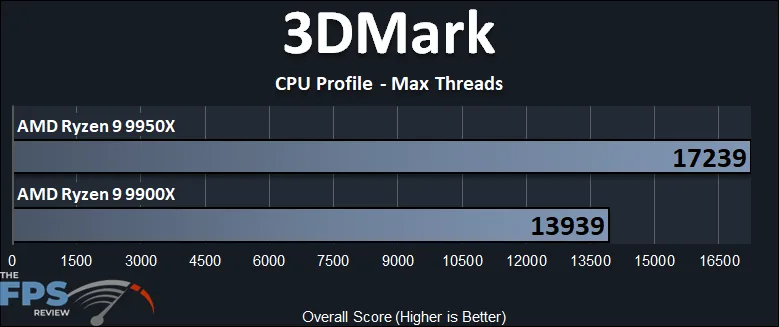
Using 3DMark’s CPU Profile Max Threads test, we can see the advantages of 16-Core/32-Thread for demanding workloads. The AMD Ryzen 9 9950X is 24% faster than the Ryzen 9 9900X. Therefore, if a highly multi-threaded workload is needed, the Ryzen 9 9950X is going to provide a substantially higher amount of performance.
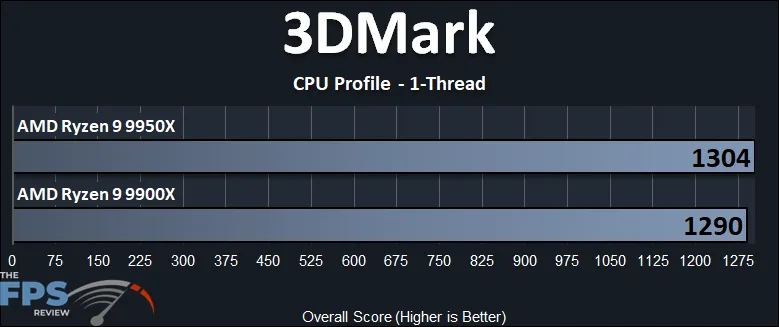
When it comes to single-core performance, there is only a 100MHz difference in the boost clock between both CPUs, and they both have the same IPC for the Zen 5 architecture. Pitting both against each other, the Ryzen 9 9950X is only 1% faster than the Ryzen 9 9900X in single-thread performance, so they are practically the same in this regard.
Cinebench 2026
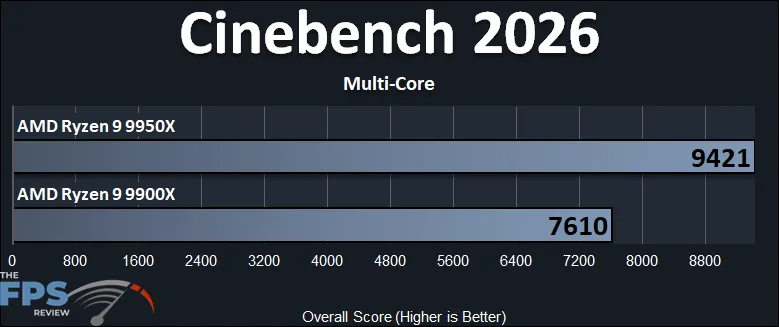
With rendering in Cinebench 2026, the 16-Core/32-Thread CPU dominates here as well. The AMD Ryzen 9 9950X is again 24% faster than the Ryzen 9 9900X. Therefore, in rendering applications, the Ryzen 9 9950X will be noticeably faster.
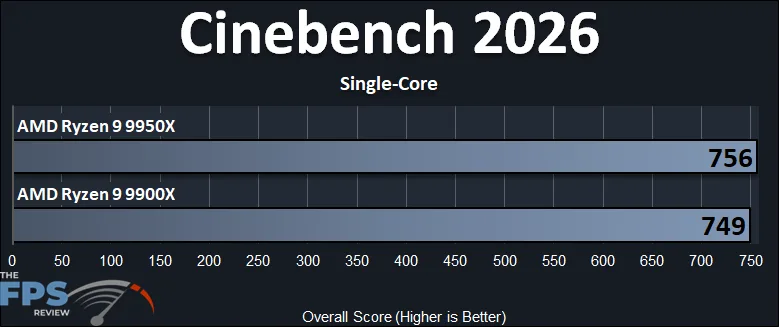
In Single-Core testing, the results are similar to 3DMark, with only a 1% difference between the CPUs.
Geekbench 7
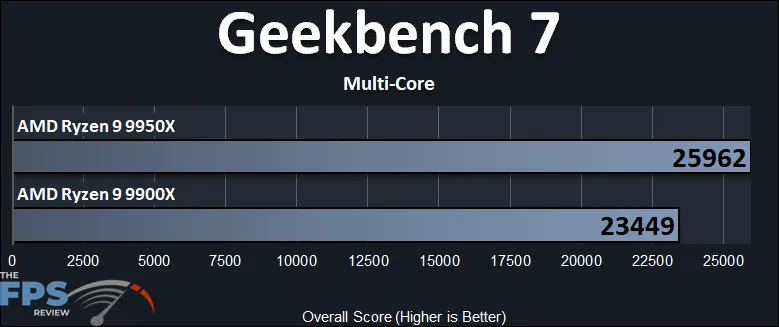
In Geekbench 7, this benchmark tests a more overall system-focused benchmark routine, so it is broader. In this instance, the AMD Ryzen 9 9950X is 11% faster than the Ryzen 9 9900X. This benchmark doesn’t focus as much on the potential of the multi-threading and core difference.
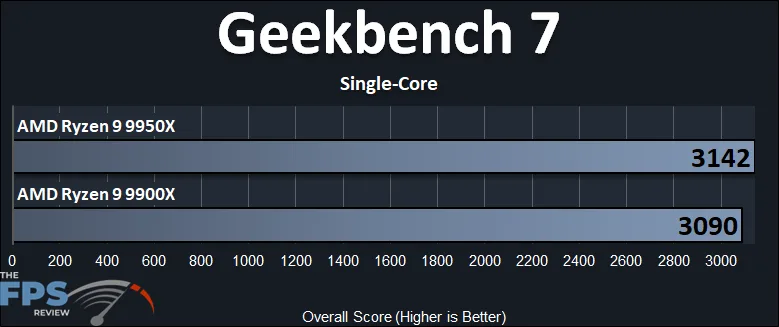
In Single-Core testing, the AMD Ryzen 9 9950X is 2% faster than the Ryzen 9 9900X in this test.
Discussion
Join Discussion →No replies yet. Be the first to reply on the forum.