
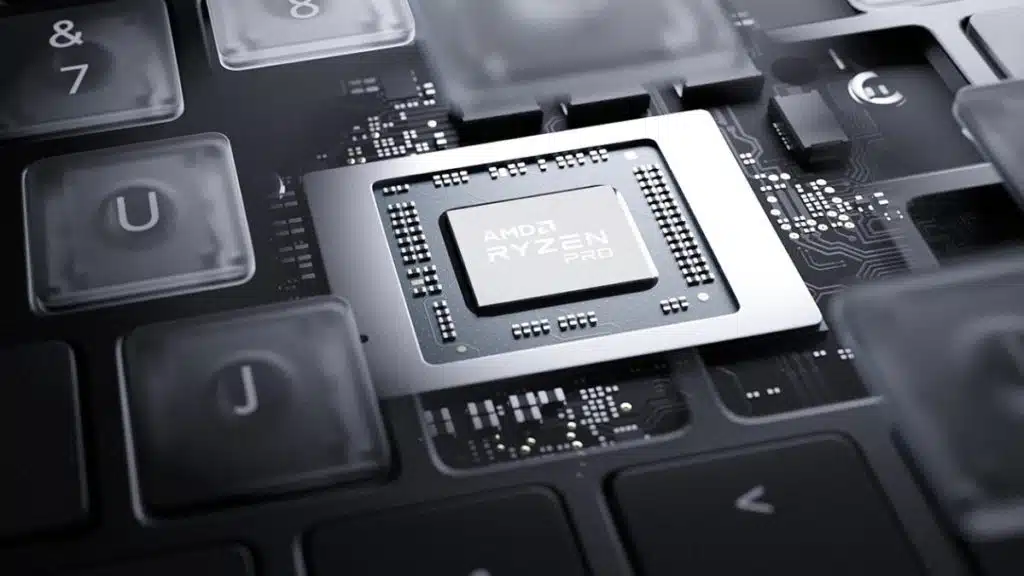
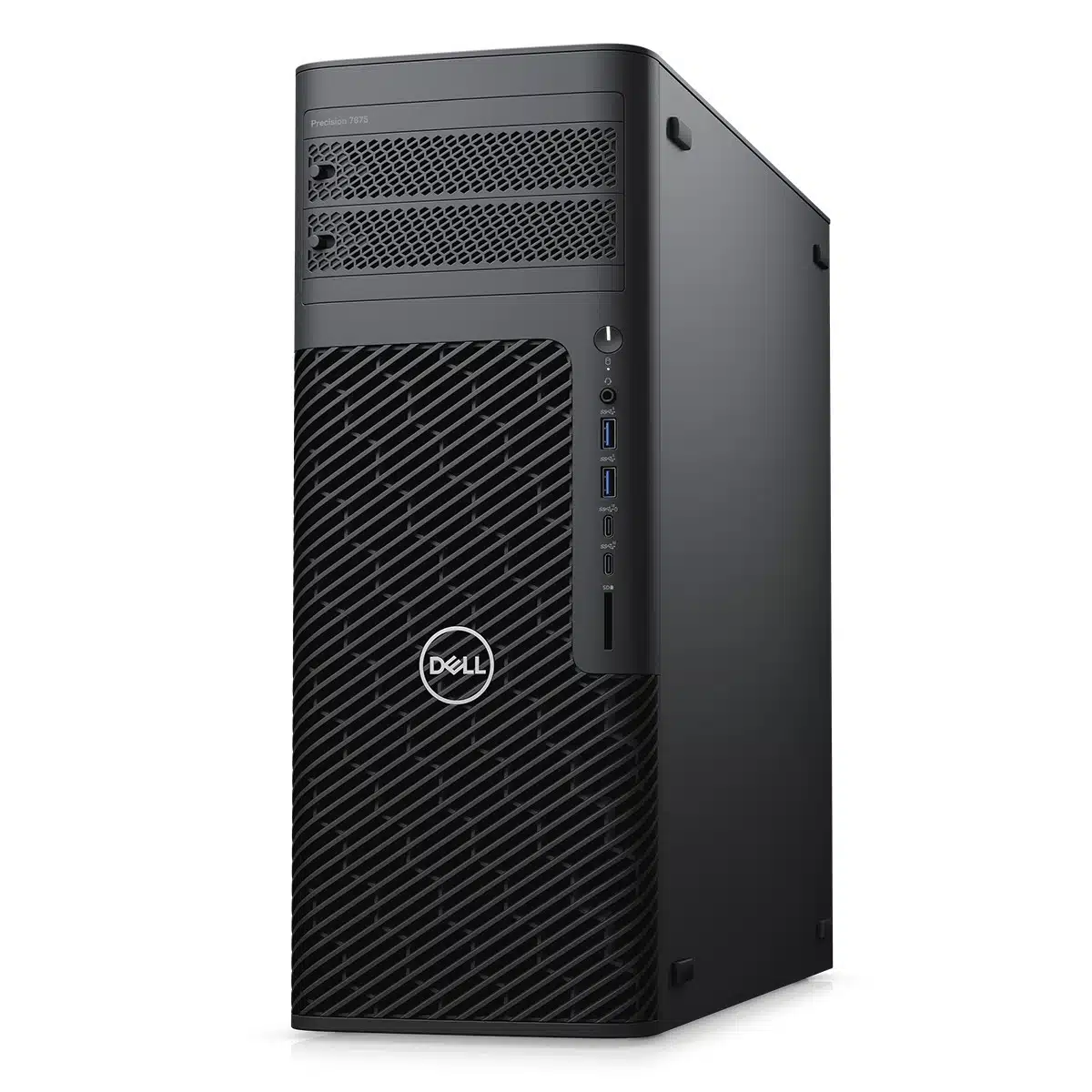
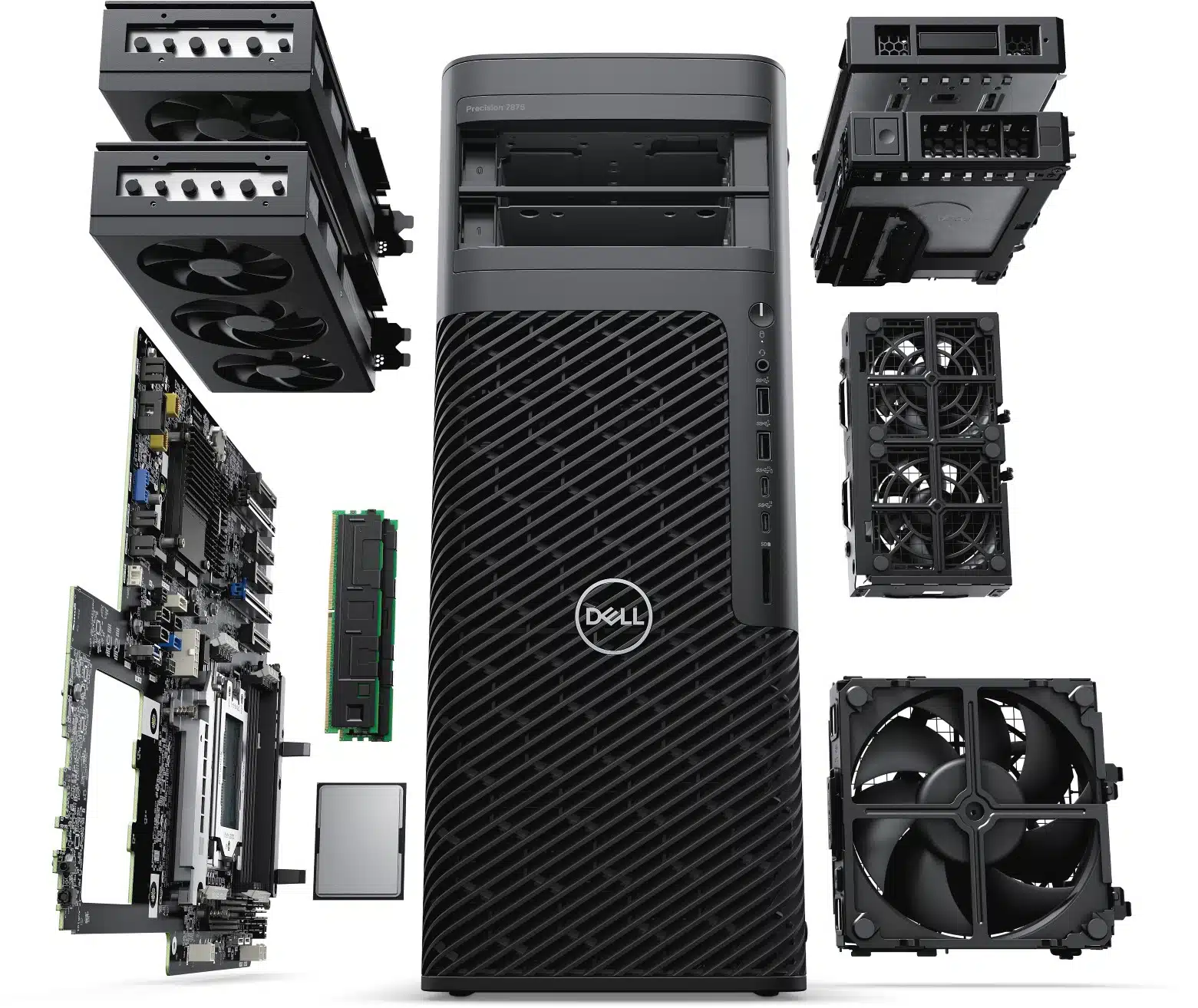
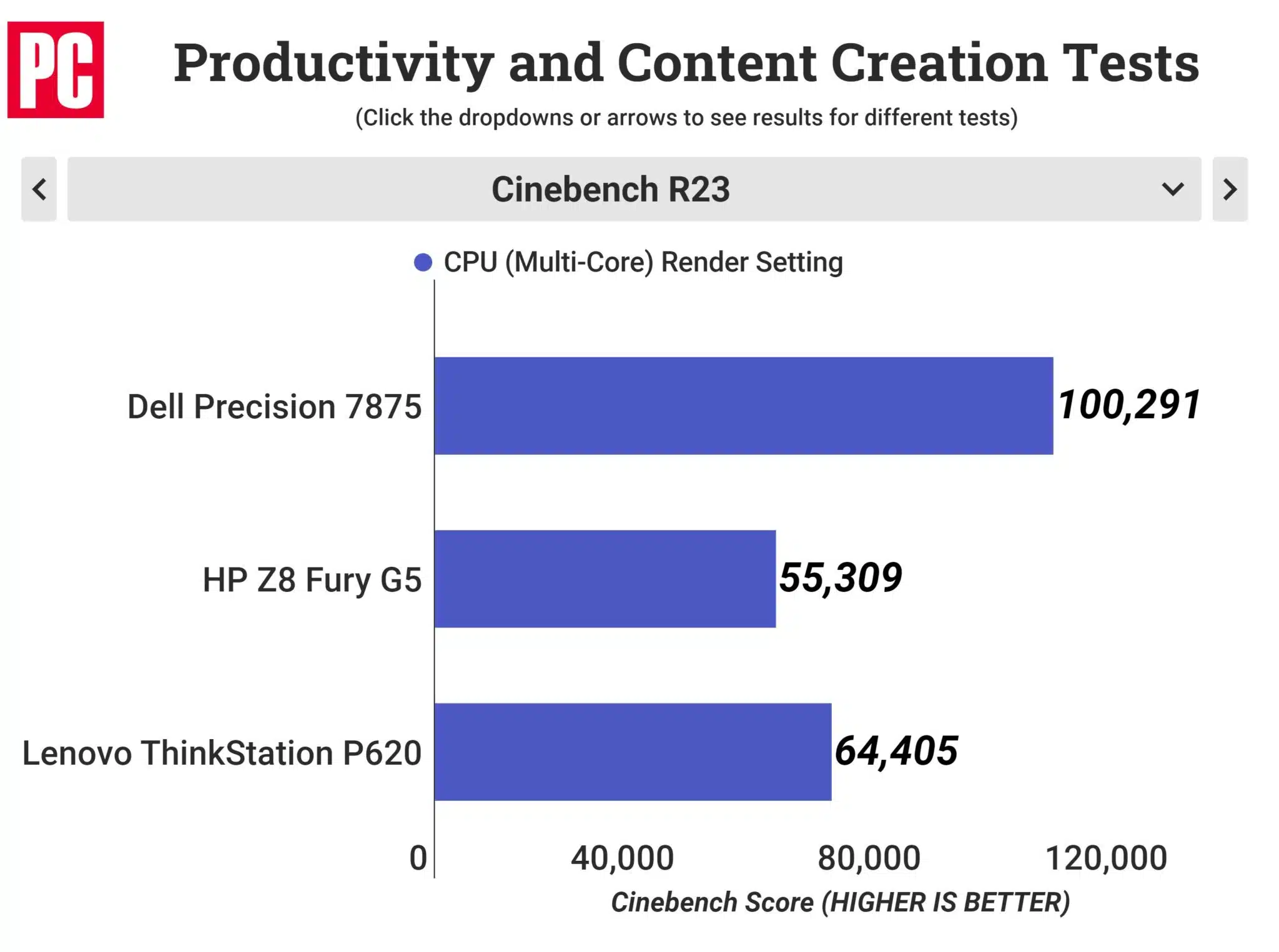
AMD’s new Ryzen Threadripper PRO 7995WX has established itself as the new multi-core king of workstation PCs after scoring over 100,000 in Cinebench R23. PC Magazine was able to test the new HEDT part, which won’t be released until November, via remote access to Dell’s upcoming Precision 7875 workstation. This heavy-duty workstation PC features 512 GB ECC memory with 2x RTX 6000 ADA GPUs. Intel presently does not have anything remotely close to the Ryzen Threadripper PRO 7995WX in the HEDT sector so comparisons were made to an Intel Xeon w9-3495X and AMD Threadripper Pro 5995WX, which barely looked comparable despite their own impressive results. The reviewers did state that the test machines were not like-for-like so, to be fair, these results should not be considered an apples-to-apples comparison but nonetheless, this is the one Threadripper to rule them all, at least for now.
Per PC Magazine:
“We’re comparing the Precision 7875 with the HP Z8 Fury G5, equipped with a 56-core Xeon w9-3495X, and the Lenovo ThinkStation P620 with the 64-core Threadripper Pro 5995WX. Obviously, neither machine is a purely parallel apples-to-apples comparison, but those are hard to come by when you have a fire-breathing 96-core CPU at your disposal.”
Test System Configurations:
- Dell Precision 7875: AMD Threadripper Pro 7995WX, 2x Nvidia RTX 6000 Ada Generation, 512GB
- HP Z8 Fury G5: Intel Xeon w9-3495X, 4x Nvidia RTX A6000, 128GB
- Lenovo ThinkStation P620: AMD Threadripper Pro 5995WX, Nvidia RTX A6000, 128GB
Summary of other test scores
| Test | Scores |
| Blender | 22 sec |
| Geekbench | 52,817 |
| 3DMark (1 Thread) | 1,027 |
| Adobe Photoshop 22 CC | 1,133 |
| Crossmark | 1,452 |
| HandBrake 1.4 | 3 min, 3 sec |
Clearly, both the 96-core/192-thread AMD Threadripper Pro 7995WX and Dell’s Precision 7875 are built for the most demanding case-use scenarios but even then the average PC user can appreciate what this new processor has to offer, and it is the one Threadripper to rule them all. What makes this processor even more impressive is its faster and more power-efficient than its EPYC counterpart.
Per guru3D:
“This top boost clock is a considerable 38% higher than its EPYC counterpart, even though the Ryzen Threadripper Pro 7995WX has a 10W lower TDP at 350W.”
Discussion (19 replies)
Join Discussion →I don't think Intel will have a horse in this race any time soon. They just can't touch that core count without dual socket.
Give it a couple years if AMD proves a hungry market exists and they will chase that rat.
It'll be a real dog and pony show.
Hmmm any more animal allegories?
Moose and squirrel? Nope, not the right one.
They have options, but they certainly are in dire need of a shrink.
They could just put a few hundred E-cores on a Xeon...
and KILL it immediately. (Unless Ecores are just the winners for the processing type that you would even begin to want 96 cores for.)
I mean, once you're over eight or so cores, you're beyond the limitations of single-thread apps, right? That's why E-cores work to begin with.
And if you need triple-digit core counts per socket, I'd bet that they'd do just fine. Note that Intel does make embedded SKUs that are E-core only that run quite well versus the previous Skylake-based ones they were using. ServeTheHome has been reviewing mini-PCs with them for the last year or so.
I just might get one of these. Currently contemplating buying a Genoa EPYC setup here soon though.
You can get an Epyc with all 3D cache dies, if you're still talking about Rust servers?
No, these wont be used for Rust.
I have absolutely no need for one of these and I want one. A man can dream but I've no doubt such a setup would be far beyond what I can afford.
While I enjoy building computers. When it's... get the used Trike I want, OR build a threadripper system... I'm going for the trike. ;)
I'm kind of curious about the single core score. We knew it was going to kill on the multicore score :p
Also, what on earth is an RTX 6000?
Edit:
Google answered that. I missed this workstation launch completely.
This, and versus the Xeons Intel just released.
I think every web and tube pontificar missed the whole enthusiast angle outright - it's not about more cores, it's about:
Single-thread on both these new HEDT platforms should be relatively easy to push. Both platforms are capable of pushing >5.0GHz, and both are stout enough to make things like gaming a non-issue, IMO.
* Basically, you only get one or two NVMe that directly connect to the CPU, and in Intel's case that means cutting the GPU slot in half if you want to use PCIe 5.0.
** More cache is a big one, and really my primary interest, given how well AMDs X3D SKUs are at alleviating 1.0% and 0.1% low FPS issues, resulting in an overall smoother and more consistent gaming experience.
*** I think it was Wendel at L1T that showed something like 500W from a Xeon being cooled by a 92mm Noctua tower that is designed to fit in a 4U chassis. For those accustomed to the traditional 100W / 120mm philosophy when it comes to water cooling, it may come as a surprise that a 360mm AIO could probably handle 600W or 700W from one of these monsters. The biggest bottleneck in CPU cooling is the IHS and smaller dies, relative to say GPUs that'll gladly get by on a 240mm AIO while dumping 450W. The larger overall package sizes on HEDT seem to provide some interesting computing options for enthusiasts.
Yea I'm watching these threadrippers. A good 32 core threadripper... is tempting with 4 channel DDR5 memory... Just depends if it's going to be a 5 grand CPU for the HEDT DIY market. If so I'll probably bow out again.
I miss the days of the prosumer coming out first in a product stack. Basically you can buy this threadripper now, or wait until March (?) and get a 8950 which will be faster per core for dramatically less cost.
In theory, this was possible for Zen 4. The biggest issue seems to the difficulty AMD has in meeting server CPU demand; if they could get out ahead of that, they could easily push the whole 'big socket' stack down to entry-level HEDT before moving on to the small socket SKUs.
As I read the tea leaves while sitting on an iceberg of salt, I'm not expecting significant gains in the IPC realm. Neither Intel nor AMD are making big waves about increased core performance with their next gen releases. But if either did, it's entirely possible that the current motherboards could host them, I think.