
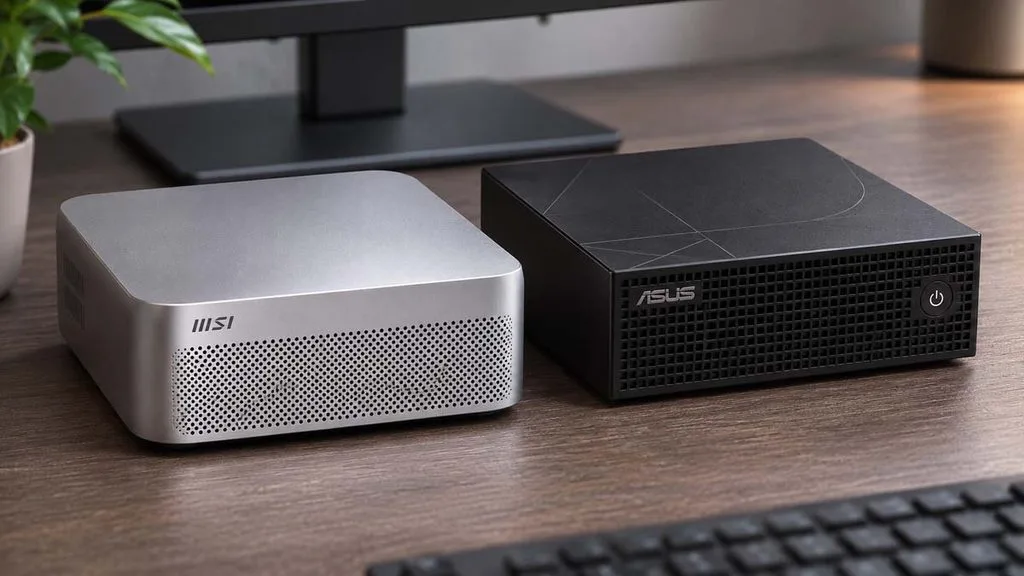
NVIDIA’s RTX Spark platform made the jump from laptops to the desktop this week, and the first small-form-factor reviews landed together. Reviewers found the same story: more cooling headroom buys real gains in sustained AI and render work but surprisingly little everywhere else. Elsewhere, AMD’s new EXPO Ultra Low Latency profile got a byte-level teardown, three high-wattage power supplies went under the load banks, and the AM4 versus AM5 X3D question came up again.
NVIDIA RTX Spark Desktops: MSI EdgeMesa N AI+ / ASUS ProArt GR1X
Written reviews:
- StorageReview: https://www.storagereview.com/review/asus-proart-gr1x-review
- StorageReview: https://www.storagereview.com/review/msi-edgemesa-n-ai-plus-review
- HotHardware: https://hothardware.com/reviews/msi-edgemesa-n-ai-plus-mini-rtx-spark-workstation
- TweakTown: https://www.tweaktown.com/reviews/11680/msi-edgemesa-n-ai-plus-series-the-full-rtx-spark-pc-experience-arrives/index.html
- WCCFTech: https://wccftech.com/review/msi-edgemesa-n-ai-x-mini-pc-review-nvidia-rtx-spark-delivers-superb-gaming-ai-performance-in-a-compact-form-factor-with-uncompromised-140w-tdp/
- Windows Central: https://windowscentral.com/hardware/asus/asus-proart-gr1x-nvidia-rtx-spark-desktop-review
- Tom’s Guide: https://www.tomsguide.com/computing/mini-pcs/nvidia-rtx-spark-mini-pc-review-benchmarks-vs-amd
- Guru3D: https://www.guru3d.com/review/asus-proart-gr1x-review-blackwell-ai-on-your-desk/
- Notebookcheck: https://www.notebookcheck.net/Hands-on-with-the-Asus-ProArt-GR1X-Mini-PC-with-Nvidia-RTX-Spark-N1X-and-128-GB-of-RAM.1453503.0.html
Video reviews:
- Level1Techs: https://www.youtube.com/watch?v=B9f6IjCAtyc
- Micro Center: https://www.youtube.com/watch?v=8Tw2LdgTcY0
Consensus summary: Reviewers agree that moving the N1X into a desktop chassis with a 140W-class power limit mostly pays off in sustained work. Long renders, encodes, and multi-user LLM serving run noticeably faster and far cooler than on the laptops. Everyday CPU performance and gaming barely move, and several testers were surprised by how small the uplift was. The two systems are essentially tied on performance: the GR1X wins on thermals and storage expandability, and MSI’s 128GB configuration wins on model capacity and load times. Price is the common sticking point, with entry configurations starting around $4,400 and a conventional RTX 5070 Ti desktop still far faster for gaming.
FPS Review take: These are local-AI workstations that happen to game, not gaming PCs. Nobody buying for frame rates should be shopping at $4,400. If you followed our coverage of the RTX Spark laptop launch reviews, the desktop versions answer the “what if it had more cooling” question: a little more speed, a lot less heat, and no change to the value equation.
AMD Ryzen 7 5800X3D vs Ryzen 7 9800X3D
Written reviews:
- Club386: https://www.club386.com/amd-ryzen-7-5800x3d-vs-9800x3d/
- TechSpot: https://www.techspot.com/review/3021-ryzen-5800x3d-cpu-gpu-scaling/
Video reviews:
- Hardware Unboxed: https://www.youtube.com/watch?v=PGd7VKud2h0
Consensus summary: Hardware Unboxed’s refreshed 14-game test with an RTX 5090 at 1080p puts the 9800X3D 33 percent ahead on average. The 5800X3D still averages 142 FPS, nearly matching what it managed two years ago. The gap swings widely by game. Space Marine 2 shows a 45 percent lead and 51 percent better 1% lows. Assassin’s Creed Black Flag Resynced shows only single-digit average gains but up to 40 percent better 1% lows. The 5800X3D holds back cards like the RX 9070 XT and RTX 5080 in CPU-heavy titles even at 1440p, yet at native 4K it rarely limits anything, which matches earlier testing showing the two chips converging once the GPU becomes the bottleneck. The overall verdict is that the 5800X3D remains a very capable gaming CPU, and the 9800X3D is a worthwhile upgrade mainly for players chasing triple-digit frame rates in CPU-bound games.
FPS Review take: For AM4 owners, a 5800X3D is still the best reason not to rebuild yet. That changes if you’re chasing high refresh rates with a top-tier GPU. Our Zen 4 vs Zen 5 Ryzen 7 X3D gaming comparison shows what the newer generations add on AM5. And yes, Lisa Su apparently wanted the 5800X3D back as a final gift to AM4 owners.
AOC Agon Pro AGP346UCSD
Written reviews:
Consensus summary: Reviewers rate the image quality from AOC’s fifth-generation QD-OLED ultrawide highly. It handles text work as well as gaming, and the uncompressed UHBR20 bandwidth, built-in KVM, and decent speakers add real value. The consistent complaint is price: rivals using the same panel cost less and offer stronger USB-C charging, and few systems will drive it to 360Hz anyway.
FPS Review take: If you don’t need UHBR20 or the KVM, the cheaper Philips Evnia 34M2C8600P from our November 7 roundup delivers most of the same panel for less. Wait for the inevitable price drop.
Biwin Black Opal NV7400 2TB
Written reviews:
- TechPowerUp: https://www.techpowerup.com/review/biwin-black-opal-nv7400-2-tb/
- TweakTown: https://tweaktown.com/reviews/11199/biwin-black-opal-nv7400-2tb-ssd-mainstream-value-champion/index.html
- The SSD Review: https://www.thessdreview.com/our-reviews/nvme/biwin-black-opal-4tb-nv7400-gen4-ssd-review
Consensus summary: Biwin’s DRAM-less Gen4 drive continues to impress for its class, with standout sustained write performance that beats most competitors. It holds onto its reputation as one of the best values in mainstream NVMe storage. Nobody positions it as a flagship, but at current storage prices it keeps landing at or near the top of value recommendations.
FPS Review take: We came to the same conclusion in our own Biwin Black Opal NV7400 2TB review. With Black Friday a week out, this is the Gen4 drive to watch for a price drop.
Ocypus Omega L36 Ultra Eng Limited Edition
Written reviews:
Video reviews:
- KitGuru: https://www.youtube.com/watch?v=liAUX6YJKyc | YouTube ID: liAUX6YJKyc
Consensus summary: Ocypus’s limited-edition AIO is a genuinely clever and well-built piece of hardware. Its motorized LCD module pops up under load to cool the motherboard VRMs, and it does lower those temperatures. CPU cooling is only average for a 360mm unit and it gets loud at full fan speed, which makes the almost $400 price very hard to justify outside a showpiece build.
FPS Review take: It’s a fun piece of engineering (Ed: a cooler that literally stands up when things get hot), but $400 buys a lot of conventional 360mm performance. For a more grounded LCD AIO, see our Lian Li Hydroshift LCD 360R review.
Corsair Frame 4000X RS
Written reviews:
- TweakTown: https://www.tweaktown.com/reviews/11674/corsair-frame-4000x-rs-mid-tower-chassis/index.html
Consensus summary: Corsair’s $139.99 mid-tower delivers strong out-of-the-box value: four included fans, good thermals, and a highly modular design built around back-connect support and swappable I/O. The trade-offs show up in cable management with the stock tray and the lack of bundled iCUE LINK fans or a controller. Its long list of optional accessories can quickly erase the initial savings.
FPS Review take: The base case is good value. The catch is that the customization ecosystem is the real product, and that’s where the bill quietly grows.
ASUS ROG Cronox GR801
Written reviews:
Consensus summary: ASUS’s new ROG flagship case gets most of the details right and builds easily. It ships with an LCD, a lighting panel, and better fans than past ROG cases, which makes its £499.99 price easier to swallow than its predecessors’. The main gripes are minor: a flimsy vertical GPU mount and the need for three separate ASUS apps to control a full ROG build.
FPS Review take: Half a grand is a lot for a case, but this one at least ships with the parts that usually turn a premium chassis into an even more premium total. ASUS needs to consolidate that software stack.
G.Skill Trident Z5 NeoX RGB DDR5-6000 (EXPO ULL) / Patriot Viper Steel 5 Infinite RGB DDR5-8200 48GB
Written reviews:
- Igor’s Lab: https://www.igorslab.de/en/amd-expo-ultra-low-latency-decoded-byte-gskill-trident-z5-neox-rgb-ddr5-6000-review-teardown-overclocking/
- FunkyKit: https://www.funkykit.com/reviews/memory/patriot-viper-steel-5-infinite-rgb-ddr5-8200-48gb-memory-kit-review/
Consensus summary: AMD’s new EXPO Ultra Low Latency profile delivers measurable latency and bandwidth gains over standard EXPO, enough to beat tighter-timed kits in benchmarks. The modules themselves are unchanged hardware with a new SPD profile, though, and X3D owners gaming at high resolutions will see little benefit. That makes the standard a hard sell at 2026 memory prices. On the high-frequency side, Patriot’s DDR5-8200 kit uses SK Hynix ICs and posted standout bandwidth on Intel with XMP alone.
FPS Review take: One-click EXPO ULL is nice for people who will never touch subtimings, but it’s a firmware feature being sold as a hardware upgrade. For our own look at high-speed kits on Ryzen, see the G.Skill Trident Z5 Neo RGB DDR5-8000 EXPO review.
Cooler Master Elite Platinum 850W / 1000W
Written reviews:
- HWBusters: https://hwbusters.com/psus/cooler-master-elite-platinum-1000w-atx-v3-1-psu-review/
- HWBusters: https://hwbusters.com/psus/cooler-master-elite-platinum-850w-atx-v3-1-psu-review/
Video reviews:
- Hardware Busters: https://www.youtube.com/watch?v=1XIsfd-KQAc
Consensus summary: Both capacities are quiet, with the fan idle across most light loads. Both share protection tuning that doesn’t tighten properly when the unit runs hot. The 1000W model earns a recommendation over Cooler Master’s own Gold sibling for its noise and performance, while the 850W’s weaker transient response and short hold-up time leave cheaper competitors as better buys.
FPS Review take: It’s a decent pick at 1000W and a pass at 850W. The protection tuning is the kind of thing that never matters until the day it does.
ASRock Steel Legend SL-1200P / NCASE SFX850 / Super Flower Leadex Titanium 1700W
Written reviews:
- KitGuru: https://www.kitguru.net/components/power-supplies/zardon/asrock-steel-legend-sl-1200p-psu-review/
- HWBusters: https://hwbusters.com/psus/ncase-sfx850-atx-v3-1-psu-review/
- HWBusters: https://hwbusters.com/psus/super-flower-leadex-titanium-1700w-atx-v3-1-psu-review/
Consensus summary: All three units deliver strong electrical performance for very different builds. ASRock’s 1200W combines excellent regulation, low ripple, and a ten-year warranty but needs to be found near its lower street price. NCASE’s first SFX power supply passed every ATX v3.1 power excursion test, at the cost of a loud fan at full load. Super Flower’s 1700W edged the field on overall performance, but it shares the week’s recurring flaw of hot protection tuning and gets loud near its limits.
FPS Review take: Three very different buyers here: the high-end gamer, the ITX builder, and the dual-GPU workstation. The NCASE is the one to watch if its first effort holds up. For context at the very top end, see our Seasonic PRIME PX-1600 review.
Discussion
Join Discussion →No replies yet. Be the first to reply on the forum.