

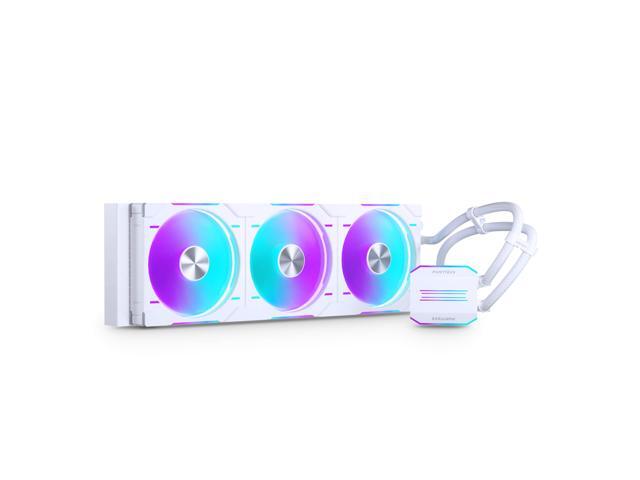
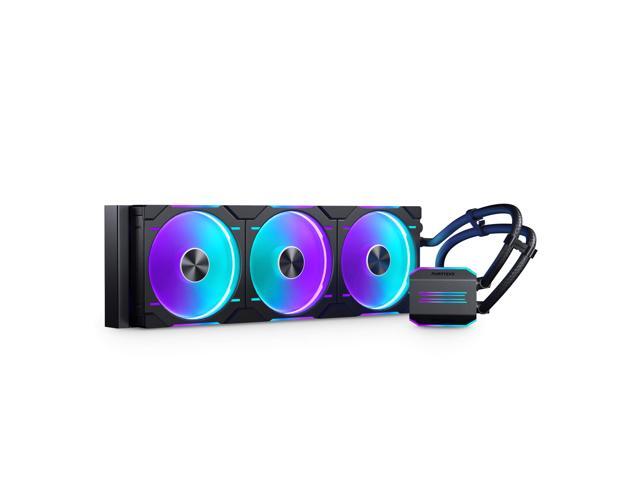
Phanteks has expanded its Glacier One D30 AIO lineup with the launch of the 420D30 in black or white color options for Intel or AMD processors. Phanteks introduced the Glacier One line with 240mm and 360mm models, featuring its low noise D30 fans with DRGB lighting that can be daisy-chained or connected via a single cable. The AIO copper plate comes pre-coated with thermal paste and Phanteks has also included additional compound. The 420D30 is compatible with most AMD and Intel processors including 14th gen CPUs. Three 140mm D30 PWM fans cool the 420mm aluminum radiator that is 27mm thick.

Description
“The Glacier One D30 AIO cooler is a high-performance cooling solution that offers a smooth D-RGB lighting solution thanks to the D30 fans. The Glacier One D30 AIO cooler equipped with D30 fans, can be daisy-chained and controlled through a single cable. Its large copper base and fin array make it suitable for use with high-end CPUs, while its design allows for maximum clearance with motherboard and RAM components.”

Features
- High performance water cooling for Sockets Intel LGA 115x, 1200, 1700(Support Intel Core 14th Gen), 2011, 2011-3, 2066 and AMD AM4, AM5
- Pre-filled for plug-and-play installation reliable operation with reinforced flexible braided tube sleeving, 100% pure copper cold plate and PWM controlled pump and fans.
- Pre-applied thermal compound and extra Phateks thermal compound included
- Toolless intuitive mounting system
- 3x tube clips included to guide the tubing and fan cables
- Flexible tubing with durable braided sleeving
- Low profile pump cap designed with rotary fitting staying close to pump to allow for maximum clearance with motherboard and RAM components.
- Triple 140mm D30 DRGB PWM fans – Smooth D/A-RGB lighting, 30 mm thick and aerodynamic fan blades inspired by the ultimate T30 fan. Easy and clean fan linking system, uses clips to link fans together to reduce cable clutter.
- D/A-RGB lighting can be controlled and synchronized with Phanteks’ D-RGB lighting products and D/A-RGB equipped cases and motherboards.
Specifications

Discussion (19 replies)
Join Discussion →I guess with the new CPU's from Intel and who knows with AMD my old 360 MIGHT not be enough. Next up... double deep 360 coolers. 2x the radiator surface area!
After using an Arctic 420mm I wasn't impressed with it over a 360mm AIO. Was running a 13900K at the time with minimal differences in temps between the two.
Stock, neither will pull >300W needed to saturate one of these. This is more about being able to leverage radiator surface area to keep fan speeds and thus noise down.
The biggest issue is the IHS that Intel and AMD are using. That interface, i.e. CPU die to IHS to cooler, is what really limits cooling effectiveness. See GPU AIOs handling double the heat output per surface area of the CPU AIOs as an accessible example.
For Intel, the bent IHS due to the LGA1700 clamping mechanism hurts a bit, and for AMD it's the extra-thick IHS they used to keep the package height of AM5 the same as AM4, despite using the shorter LGA socket for AM5. But in both cases, running direct die (the way GPUs do) results in massive increases in cooler effectiveness.
Leaving the IHSs in place, we wind up hunting for more cooling performance to make up for the poor thermal transfer of current IHS designs, but gains can only be marginal as you've experienced.
There is a point where adding more radiator surface area won’t do you any good, and your constraint is on the block and it’s contact area and efficiency
For high end CPU's, 360 AIO's have been somewhat borderline at times for awhile now. Anything over an Core i9 11900K and they seem to struggle a bit or at least leave some room for improvement. Granted, that's the Intel side. AMD wise, its a different story.
I have used the Thermalright Bracket with both coolers with same results.
It's really the IHS that's in the way.
As long as you have IHSs you're limited in how much you can cool per die and IHS area. That's why a single 92mm tower can cool a 500W Xeon, but the best Noctua (3x140mm?) HSF will still struggle with 300W on an i9.
This is why you see direct-die kits for both AMD and Intel becoming more prevalent; they're risky, but they can also improve performance while reducing noise (the same way AIOs can do over an air cooler when the CPU is being pushed).
Same, that goes on every LGA1700 setup I have one on.
I'm getting more and more convinced that a 280 AIO with good fans is the sweet spot for AIOs. Even if you go bigger, the pump and block aren't really of enough quality to show any improvements, so if you need more cooling than a 280, you might as well go custom loop.
I would love to see something like the Arctic Liquid Freezer II 280 tested with 2x NF-A14 industrialPPC-3000 PWM fans. Let them power down to basically nothing at idle, and run up to full on screaming 3000 rpm under load (presuming you use noise canceling headphones).
Main reason for the popularity of 360mm AIOs is that many cases allow for the 120mm fans but not the 140mm fans. Further, and this is just from personal research and direct experience, there's a greater variety of fans for 120mm, and the best 120mm fans tend to be better than the best 140mm fans.
So, regardless of surface area differences between 280mm and 360mm AIOs, the 360mm units tend to come out on top overall.
Those fans are exactly what you'd want in an industrial application - and absolutely not what you'd want if you had to be in the same room as them when they're doing their business. Noise per decibel is far higher than needed in order to hit their reliability rating (same for the 120mm versions).
Phanteks' D30-140, 30mm thick 140mm fans as the name implies, just became available and are what I'd probably pick today, since they are thicker, have a pressure-optimized fan blade design, are directly linkable, and are able to be used with standard PWM fan headers and three-pin 5v ARGB headers for lighting.
Wanted to add some numbers here, comparing total fan area in mm squared:
Fan Size (down) # of fans (right)
1
2
3
[/TR]
120mm
35531
71061
106592
[/TR]
140mm
48361
96722
145083
[/TR]
[/TABLE]
Note that the 360mm AIO has nearly 10,000 square mm of additional fan area. A good 280mm should be very good, but it's not quite where a good 360mm can be.
Note: I'm using NF-A14s in my current custom loop. They are fine at 750rpm for running when the system isn't in heavy use. They are also fine at 2000 rpm when running with noise canceling headphones.
The question I have is - can the pump and block integrated into the AIO make much use with the extra area? I'm sure my D5 with an Optimus Foundation Block can see some benefit to the extra space, but I have little faith that a whole AIO that costs less than the foundation block gets anything out of it.
Sure; how much is always relative to the condition and composition of the CPU / GPU being cooled of course.
I'm sure, but not everyone wants to have headphones on all the time? And such a solution restricts microphone choice to headset mics or low-sensitivity dynamics that you have to have 2" (literally) in front of your face?
The below chart from GN is an example of what I mean - the Artic Liquid Freezer II 360 with 10.2% more mm2 is only yielding a 2.6% improvement to cooling performance with fans running 10% faster in RPM when compared to the 280mm version. My guess is if you ran the 140mm fans to get the same RPM / DBA, the performance would be the same between the two AIOs. I'm guessing it's the block and pump that is having the most impact on limiting performance, not the size of the rad
I haven't had any speakers attached to my PCs since my children were born - if I want to hear anything sound wise from the PC, it's headphones for me. And that's not really much of a loss, since I was using headphones 100% of the time prior for the attached mic. I've never had anyone complain about the fan noise while talking, but I generally don't do THAT much talking when playing MW:O or whatever.