

With shipments totaling 68.5 million units in the third quarter of 2023, the global PC market managed to outperform expectations. But that volume was still down 7.2% compared to the same quarter in 2022, according to the International Data Corporation (IDC) Worldwide Quarterly Personal Computing Device Tracker.
Despite the PC market surpassing initial forecasts, both driving and inhibiting factors influenced this performance. First, the increased volume can partly be attributed to inventory restocking, mostly on the consumer side. Second, there was a notable effort to address anticipated cost escalations, such as expected increases in India import duties. Although these duties were later suspended, such concerns nonetheless led to the channel absorbing more units than likely necessary. Finally, further tightened IT budgets led business PC units to underperform against an already conservative commercial forecast.
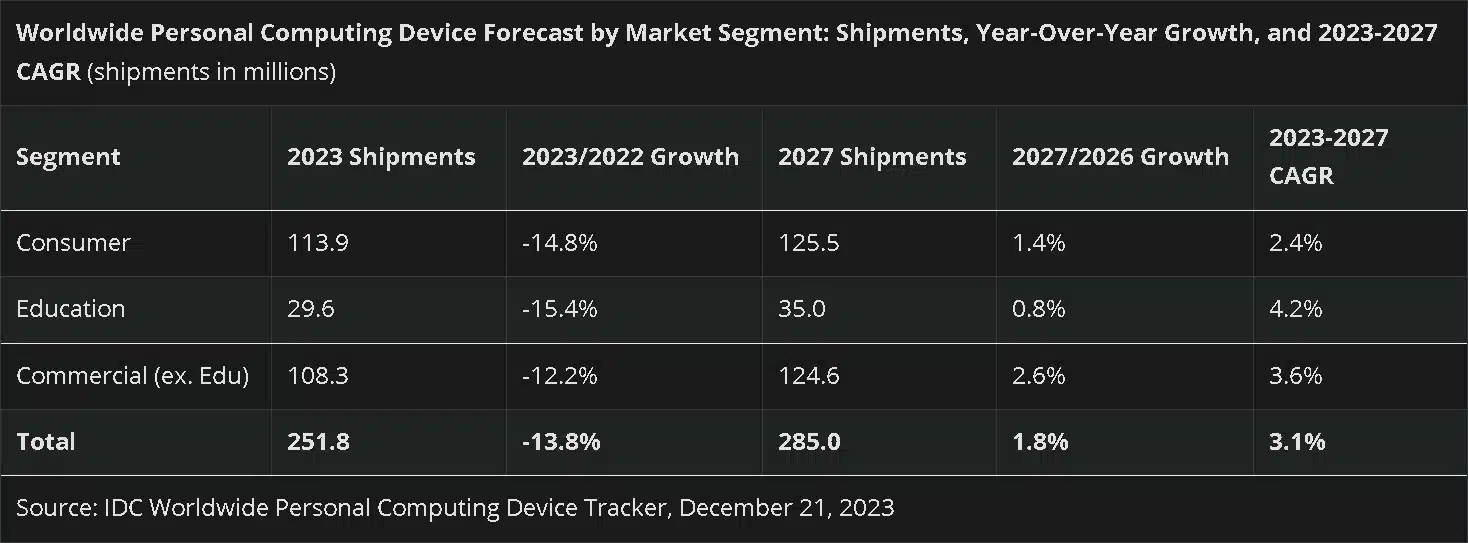
Given current conditions and a tenuous macroeconomic environment, IDC has lowered its forecast for the worldwide PC market. 2023 shipment volume is now expected to decline 13.8% compared to 2022, which itself declined 16.6% over the previous year. Two consecutive years of double-digit year-over-year drops is an unprecedented trend in the PC market but will likely contribute to a recovery thereafter. Despite the short-term challenges, IDC continues to expect a market rebound in 2024 and beyond with many factors converging within the next two years. A few of the main drivers include:
- PC Refresh Cycle: The vast and aging installed base of commercial PCs surpassing the four-year mark by 2024 is expected to necessitate a refresh, coinciding with the pressing demand to migrate toward Windows 11. The total PC market of 2024 should see growth of 3.4% compared to 2023.
- AI Integration: The integration of AI capabilities into PCs is expected to serve as a catalyst for upgrades, hitting shelves in 2024 and at first aimed toward certain segments of the enterprise PC market. Over time, further advancement in use cases and cost reductions could spread to the broader market.
- Continued evolution and recovery of the consumer installed base: The collective influence of these factors positions 2024 as a pivotal year for the PC market, offering a respite from recent challenges. Beyond 2024, growth is expected to surpass pre-pandemic shipment levels and culminate in 285 million units by 2027.
“Perhaps historical context can offer some consolation to the tough slog the PC ecosystem is going through,” said Jay Chou, research manager for IDC Mobility and Consumer Device Trackers. “While we still expect eight consecutive quarters of year-over-year volume declines from Q1 2022 through Q4 2023, it still pales to the 19 consecutive quarters of year-over-year PC declines from Q2 2012 to Q4 2016. Furthermore, notebooks are already at higher levels than 2019, signaling a sizable expansion of the notebook market even after COVID-induced purchases have subsided. We maintain that factors like hybrid work, commercial refresh, and growth in premium PCs can lead to a compound annual growth rate of 3.1% from 2023 through 2027.”
Notes:
Traditional PCs include Desktops, Notebooks, and Workstations and do not include Tablets or x86 Servers. Detachable Tablets and Slate Tablets are part of the Personal Computing Device Tracker but are not addressed in this press release.
Shipments include shipments to distribution channels or end users. OEM sales are counted under the company/brand under which they are sold.

Discussion (17 replies)
Join Discussion →It's because for 90% of users the use case for a PC is to check email and browse the web. Phone's and tablets have supplanted that for that market. The remaining market are decidedly tiny but spend a shit ton of money for their compute. Desktops worth 3k, laptops 2k or more... AND cellphones and in many cases tablets.. SCREENS GALORE!
If you added in consoles... the market would be much bigger. ;)
There was unprecedented demand for PC hardware for gaming during the COVID-19 lockdowns. Naturally, the demand will pick up in 2024 and 2025 as the hardware purchased during that time frame ages out. So this isn't a surprise to me. I don't think the demand will reach what it did during the early days of the lockdowns but its going to be stronger than it has been since 2021 or so.
If you bought, say, a 5900 in late 2020 / early 21, there really isn’t a super big reason to upgrade. A lot of the people I helped upgrade were coming from Sandy Bridge type platforms. They are set till like 2030+
Nonsense. That's really not something you can predict. Not only that but the market isn't what it was during the Sandy Bridge days which in itself is an outlier compared to the 30 year slice of computing history I've been dealing with these things. We've never seen that level of stagnation for such a protracted period of time and with AMD actually competing now, things have been more exciting than they were in the Sandy Bridge era.
Are you expecting a new engine for WoW? Counterstrike? Is zoom going to need more power than a 5900 (DnD Beyond over Zoom is a thing)? Are PS 6 ports going to need more than a 5900? Id be shocked if any of those guys need a performance bump to play the stuff they do.
If you're only playing games from this generation or older sure. But with newer generations of games and hardware and programs in general you are going to need more compute. And that will see more support for what drives that compute demand.
guess what that is going to be? it will be AI. Ai is going to supplant gaming as the driver for high end home compute.
Evidently, you are unaware that other games have been released over the last 20 years and that new games are released throughout any given year. It should then come as a surprise that more demanding games are in development that will require more than the hardware we have available to us today, to be enjoyed at maximum settings.
People play other games besides WoW and Counterstrike.
Some people do, yes. The guys I helped build machines for in late 20 / early 21 don’t usually play anything else. Something like Baulder’s Gate 3 is right up their alley though. And 10 to 1, those old 2700Ks that I replaced would play BG3 just fine. I don’t know what you expect to come out in the next 7 years, but I just don’t see the minimum requirements eclipsing a 5900.
I am skeptical on this.
It's the hot buzzword right now - but how much local AI computing will the typical household do?
AI computing, apart from minor tasks like biometrics and other "fuzzy" algorithms, I think is going to stay in the arena of data centers. The main thing with AI isn't in running the algorithm - that doesn't take too much at all, it's in the training of the models. And there, the bigger the better, and even on huge datacenters today takes weeks/months/years.
The quality of training is what will differentiate products and drive competition. To try to compete with someone with global datacenters on training quality is ... not going to happen with local resources. The only reasons I can think for anyone to even attempt to try local training is if they want to ensure a pure dataset or are experimenting - and then they need to be willing to accept weeks/months/years of time invested at significant expense.
Couldn't you do something akin to folding@home to get big datasets from smaller users?
I'm generally skeptical about the latest buzzword and predictions of unparalleled success in whatever market segment. I toss "AI" in the same metaphorical box as "VR" and "Linux"; sure, some people do it, but despite all the proclamations that they will be the next big thing, they persistently remain edge cases.
Ai integration is growing and offloading a traied aincomputento local resources will be a better experience for end users. The use case is already here it's just not readily visible.
When AI is fully and seamlessly integrated, and not used as a marketing badge, then my skepticism will relax. As long as it continues to be used to sell and ship more units, I will remain skeptical. No amount of fanboy-ism (aka grassroots marketing) will change that.
YMMV
Look at what office 365 does with copilot. Also windows 11 patch 23w2 includes copilot for windows.
So because you built machines to play World of Warcraft and Counterstrike and because you think a 2700K's could technically play BG3, you can't see any reason to upgrade past a Ryzen 9 5900X? Got it. First off, Baulder's Gate 3's minimum requirements specify a Core i5 4690. That's already a couple of generations beyond your Core i7 2700X example.
In any case, you seem to have a myopic viewpoint on this. Speaking of minimum requirements, playing games on systems only meeting minimum requirements is something you can do, but not something most people want to do if they don't have to. It doesn't usually provide a good gaming experience. Though someone who only plays 20 year old games probably isn't going to understand that I guess. Newer games will come out over the next 7 years that may not specify more than a 5900X as a minimum requirement but that doesn't mean that more powerful processors aren't desirable or even necessary.
We already have games out today that run faster on newer CPU's than the 5900X. There are people with wants and needs that are different from your own.