
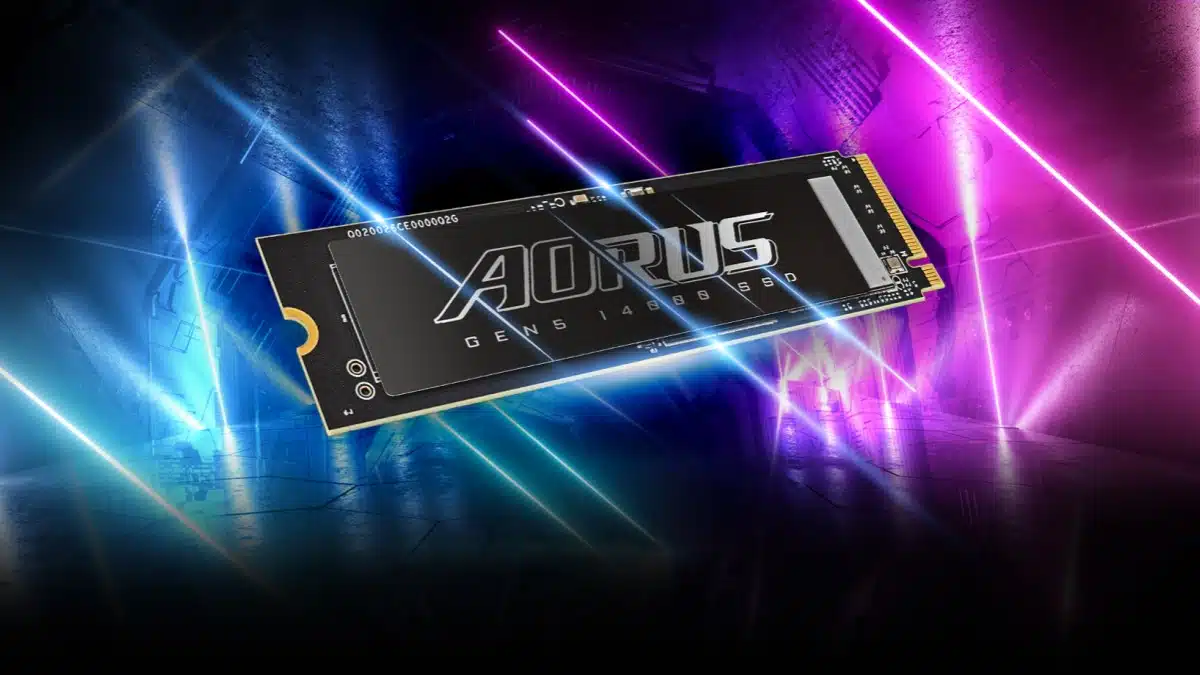
The GIGABYTE AORUS Gen5 14000 SSD 2TB supports PCIe Gen5 x 4, NVMe 2.0, and includes a DDR4 DRAM cache with 3D TLC NAND for fast data transfers. The AORUS Gen5 14000 SSD 2TB is capable of sequential speeds up to 14,500 MB/s (Read)/12,700 MB/s. It uses a Phison PS5026-E26 Controller built on a 12nm process featuring 8 NAND flash channels with 64 CEs and comes with a 5-year limited warranty.
Per GIGABYTE (2 TB model product page):
“Powered by the PCIe Gen5.0 x4 controller Phison PS5026-E26 and boasting brand-new 232-layer 3D TLC NAND Flash, the AORUS Gen5 14000 SSD redefines the pinnacle of speed and efficiency. With blazing sequential read/write speeds of up to 14,500 / 12,700 MB/s, this SSD is engineered to meet the demands of PC enthusiasts, gamers, and rendering professionals. Experience lightning-fast data transfers and enjoy a smoother, lower-latency gaming experience with the AORUS Gen5 14000 SSD. Unlock the true potential of your system and elevate your gaming prowess to unprecedented levels.”
Heatsink not included
GIGABYTE does not include any added heatsink but does say that the motherboard heatsink must be used to achieve optimal data transfer speeds due to the increased need for heat dissipation.
Per GIGABYTE:
“When utilizing AORUS Gen5 14000 SSD, it is crucial to pair it with a motherboard equipped with a built-in heatsink. The high-speed data transfer capabilities of PCIe5.0 x4 SSD demand efficient heat dissipation to maintain optimal performance and prevent thermal throttling.”
Other AORUS Gen5 14000 Models:
Altogether there are presently three different GIGABYTE AORUS Gen5 14000 SSD models ranging in storage capacities from 1 TB to 4 TB. While the 2 TB model offers the fastest transfer speeds the 4 TB is only slightly slower and the 1 TB model is slower than it.
| Capacity* | Model | Sequential Read MB/s** | Sequential Write MB/s** |
|---|---|---|---|
| 1000GB | AORUS Gen5 14000 SSD 1TB(AG514K1TB) | 13,600 MB/s | 10,200 MB/s |
| 2000GB | AORUS Gen5 14000 SSD 2TB(AG514K2TB) | 14,500 MB/s | 12,700 MB/s |
| 4000GB | AORUS Gen5 14000 SSD 4TB(AG514K4TB) | 14,100 MB/s | 12,600 MB/s |
Discussion (6 replies)
Join Discussion →Uhhh... what?
Yowza! Pretty sure I got distracted looking up at the new TV.
Most motherboards come with at least one slot that has an M.2 slot cover that doubles as a heat sink. Even very budget tier motherboards have one of these. (With varying degrees of quality of course.)
Re read what I quoted Dan. ;) It's sinc-ception. Heatsink on heatsink.
Sorry Dan, that was all me. I had a "special" moment and accidentally duplicated a line of thought while being distracted by the new TV that got installed the day before. I actually went all out and had it mounted on the wall along with the cable concealer kit.
[URL unfurl="true"]https://www.bestbuy.com/site/tcl-85-class-qm8-series-4k-uhd-hdr-qd-mini-led-smart-google-tv-85qm851g/6579456.p?skuId=6579456[/URL]
I'm noticing that the 4TB model has lower quoted specs than the 2TB model - not as low as the 1TB model, but still interesting as means that there are configuration quirks between the controller and the NAND flash.
Obviously interested in delivered speeds and endurance both short-term, i.e. significant continuous writes leading to slowdowns and heat generation, and long-term with respect to the flash life itself, i.e. are we going to see a decrease as speeds and capacities are pushed etc.
Also wondering what kind of cooling scheme the industry is going to settle on. We're still in the 'fast and furious' days of innovation and there are several more generations of PCIe already spec'd out. I do expect that the more or less 'end state' of NVMe will involve optical interconnects, and at least Intel has already proven these in mass production as single integrated circuits with controllers for their 400Gbps optical NICs.