

Google debuted Project Genie last week, and not long after, multiple video game publishers saw stock prices drop. Based on Genie 3, the generative AI solution allows users to give text descriptions or upload images to generate photorealistic environments, which can be explored in real-time. Project Genie’s release could very well end up being the snowflake to trigger an avalanche within the gaming industry as the next level of Artificial General Intelligence (AGI).
“World models use their deep understanding of physical environments to simulate them. Genie 3 represents a major leap in capabilities – allowing agents to predict how a world evolves, and how their actions affect it.”
-Google
In a somewhat unexpected twist, videogame publishers CD PROJEKT, NINTENDO, ROBLOX, TAKE-TWO, and Unity all saw their stock prices drop right after the release of Project Genie. As reported by VGC (via Nasdaq), Unity’s shares saw the largest drop of roughly 35%.
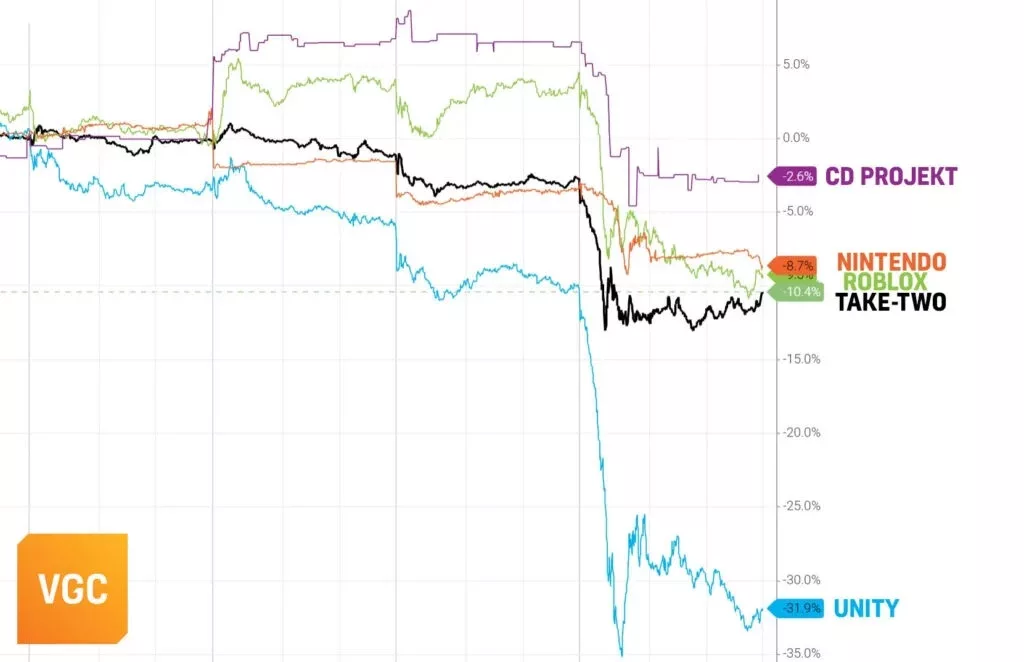
Should video game publishers and their stakeholders be worried, well probably not, but they ought to at least be paying attention. Google Lab’s solution is still in its infancy, but it is among a growing list of online services that offer users the ability to create content using minimal skills. While Project Genie is being noticed for its ability to create explorable world environments and incorporate player avatars/characters, it still has very real limitations. It should also be noted that Disney recently embarked on a slightly similar venture with its billion-dollar investment into OpenAI by allowing Sora to be used for creating short videos with its licensed Marvel, Star Wars, and Pixar IPs.
Meanwhile, Unity’s CEO Matthew Bromberg is taking these turn of events in stride and, rather than shrinking away in fear or lashing out in anger against them, has stated a silver lining exists here while also pointing out the pros and cons of current AGI limitations. The lengthy 300+ word post is a good read and clarifies that the Unity Engine already integrates AI-driven content creation via its human creators for world models.
Folks. Can I explain something about world models? Seems like today might be a good day for that.
— Matthew Bromberg (@MBromberg) January 30, 2026
Advances in large-scale “world models” — whether developed by partners like Google or others — materially expand the frontier of interactive content creation. These models can…
“As a result, world models expand content supply and reduce development friction, while Unity remains the system of record for runtime, distribution, and long-term operations. This dynamic broadens Unity’s addressable market and reinforces its central role in the interactive ecosystem.”
– Matthew Bromberg, Unity CEO
Discussion (12 replies)
Join Discussion →Neat idea. We all know this will be terribly misused right? Like disturbingly so.
Sad but true. Thought the same while doing this post.
Well, i mean its hard for AI not find its place when humans are also producing derivative products routinely.
The derivative market will remain just as big, and " indie" gaming will remain the place of innovation, I guess same as always .
I suppose the drop is due to the fact that in time, even with little money indie innovators will be able to create quality in most aspects that would challenge big boys, idk
The problem nobody is talking about here is the cost of computation. How much hardware is needed? How expensive is the AI time to do this past the venture capitalist free use window?
The arguments against AI costs and power consumption remind me of early computer skepticism. People probably said the same stuff. Too expensive, uses too much electricity, breaks all the time, requires expert knowledge to use. Fast forward a few decades and suddenly everyone's got one in their living room. History might be repeating itself here.
Oh I don't doubt that it is. I'm just saying low funded dev's exulting in the use of AI to create their in game assets at a cost better than hungry artists is interesting. Knowing full well that the real cost hasn't been passed on yet as everyone is proving value with use. Once the bills start rolling that hay day will dry up.
It will come back as compute catches up and exceeds demand again... eventually... hopefully in my life time.
Idk supposedly the bigger energy cost is during AI model training.
Not the same thing. Computers were designed by engineers and were conceptually sound. AI is "designed" by AI bros throwing more computational power at the wall to beat the other AI bros. Well, not even beat as there is no finish line, just to keep ahead of them in a race to nowhere in particular. They are like greyhounds chasing the rabbit, except nobody knows what exactly the rabbit is.
Everyone already has 10 AIs in their living room, we are getting beaten over the head with it. And 99.999% of AI usage amounts to slop, it creates no value. I can count on one hand the times where AI was somewhat useful for me since its inception. Even if we dismiss the environmental concerns and look at it from a pure economics point of view it hardly justifies billions of dollars worth in data center investments and energy usage.
Yep, history repeating itself. 😂
Yep, it repeats alright just not the history of home computers but the far more laughable and recent precedents of crypto, NFTs, and the metaverse.
Meh nothing a couple of thorium reactors cant fix.
Im not much for the energy argument we should become more advanced, and more energy intensive, dyson sphere here we go. How you go about it is crux of the matter i guess. Use fresh sunlight , burn old sunlight, or use old supernovas.
Ongoing critique of many publisher's is not paying attention to what people are wanting to play. Seems to me this is a ripe opportunity to do just that and use their resources to bring a quality game to market.