
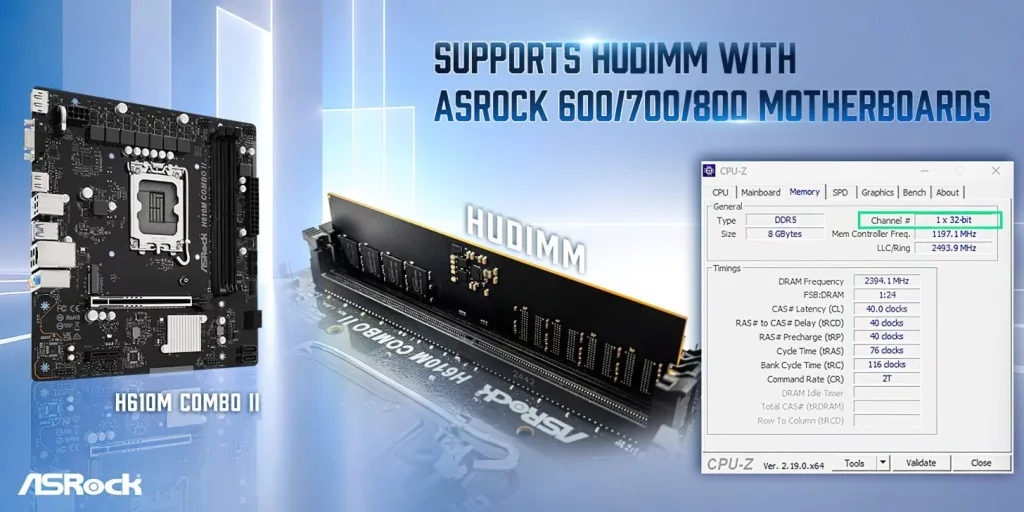
In a market where DDR5 has become something of a luxury item thanks to AI infrastructure gobbling up DRAM supply, ASRock has announced a new memory standard it’s calling HUDIMM (Ed: Who?), short for Half-channel Unified DIMM. Announced April 17, the spec works by operating DDR5 in a single 32-bit sub-channel rather than the standard two-channel (2×32-bit) architecture. Modules can be built with roughly half as many DRAM chips, which should translate directly into lower production costs.
ASRock’s Intel 600/700/800 series motherboard lineup is already receiving BIOS support for HUDIMM modules, and the company says it’s actively working with DRAM manufacturers to bring more compatible modules to market. Intel’s own Robert Hallock, VP and GM of the enthusiast channel segment, offered rare public co-endorsement of a third-party initiative, saying the technology ensures users on Intel 600/700/800 chipsets have greater access to DDR5 benefits in the years ahead.
Standard DDR5 splits each module into two 32-bit sub-channels, a design that made sense for high-capacity single-DIMMs but adds unnecessary complexity and cost for the everyday builder. HUDIMM sidesteps that by going single sub-channel. Bandwidth takes a hit compared to a dual-channel DDR5 configuration, but ASRock’s pitch is explicitly aimed at builders who just need affordable, functional DDR5, not maximum (or even average) throughput.
The HUDIMM is a patent-pending standard, which raises the question of whether it stays an ASRock exclusive or becomes an industry-wide effort. For now, ASRock is collaborating with DRAM makers rather than opening it to a wider consortium, so how broadly this lands will depend on whether any of those partners decide to push it into the mainstream. DDR5 shortages have been grinding the gears of builders all year, and anything that cuts module cost without forcing a platform change is worth watching.
Discussion (18 replies)
Join Discussion →Half-channel DDR5, and it's not April 1st...
Isn't that name from Game of Thrones or something
So its a standard ai farms specifically won't want? But why would ram makers target that? I dont understand the purpose here.
Wow what a solution, before if budget contrained you, you'd would cut the amount, now you get to cut the amount AND have the privilage of cutting the bandwith too.
I truly and specifically expected to read the exact opposite, since theres a need for a dd5 diet, a better and faster way to use scarce resources was developed. But this?
half the performance for half the price?
ASUS just did this too, was going to post about it this morning but ran out of time.
You got me thinking like you have internet that needs coins :D
His AOL free Internet trial ran out.
I remember in 2002 I actually had to use AOL. We were at a training base in BFE central-ish Florida, and that was the only reliable option; even other dial-up services weren't as reliable.
To think we not only gamed on that, but we also downloaded games and patches and short videos and music and everything else...
At least you weren't the person who would pay for broadband when it came out around that time AND paid for AOL to use AOL on said broadband. lol
Those people cracked me up.
Eh, AOL and CompuServe were the first 'internet communities', so I get it.
I don't know about the first. Maybe the first to be mainstream about it, but even then irc was pretty easily accessible by the average internet user as well.
AOL and CompuServe might have been the first paid ecosystem community so to speak.
I downloaded music on dial-up but I never played games on it. I waited until I went to college and had access to their T1 line. First game I ever played online was Unreal Tournament 1. Got my @ss handed to me, and it was those college years that taught me that I'm an offline against-the-bots player. I've rarely played any other games online since. A few matches of some of the Halo games, CoD4 on a PC server called Grumpy Old Men Gaming (miss those guys!), Hawken when I was an alpha and beta tester, and maybe a few scant others. I'm not really an online multiplayer guy.
I had a client like that in the late 2000s! I worked for a private medical/nutritional practice as their IT guy, and they did this sh1t! I kept trying to teach them that they only needed the broadband connection but they would say sh1t like "but then I can't access my email!" and other excuses, even though I showed them countless times how to access everything they needed only with the broadband connection. Hilarious when you're not the one dealing with it, frustrating when you are.
I had an absolute blast playing UT and UT2003 in LAN matches. But discovered a crazy thing. My main PC was a Celeron 700 MHz (Coppermine) and I had a spare Pentium (maybe 133 MHz. It's all hazy at this point). The matches were fun and I was winning often enough to keep me interested in going. Then the other guy bought a P4 Northwood 2.4 GHz and suddenly, I felt like a chicken running for my life. I would frantically do 360 degree turns and would only sometimes catch glimpses of my opponent right before I got slaughtered. And of course he refused to swap PCs. That made me lose interest pretty quickly. Both PCs need to be similar in specs otherwise you won't even see what hit you. And online play is all about lag. The only online game I would play is turn based strategy against another human. Don't trust fast paced multiplayer action games to be fair due to the crazy amount of external factors.
When I first got back into PC gaming I had a prebuilt from BB called VPR Matrix which was all-in-all a pretty solid machine. Over the years it served as my introduction to (then) modern systems and over 5-10 years I upgraded/replaced virtually every part of it. The last processor it got was one of those and yeah, I loved it. I've still got that machine tucked away in the closet with no plans to ever get rid of it.