
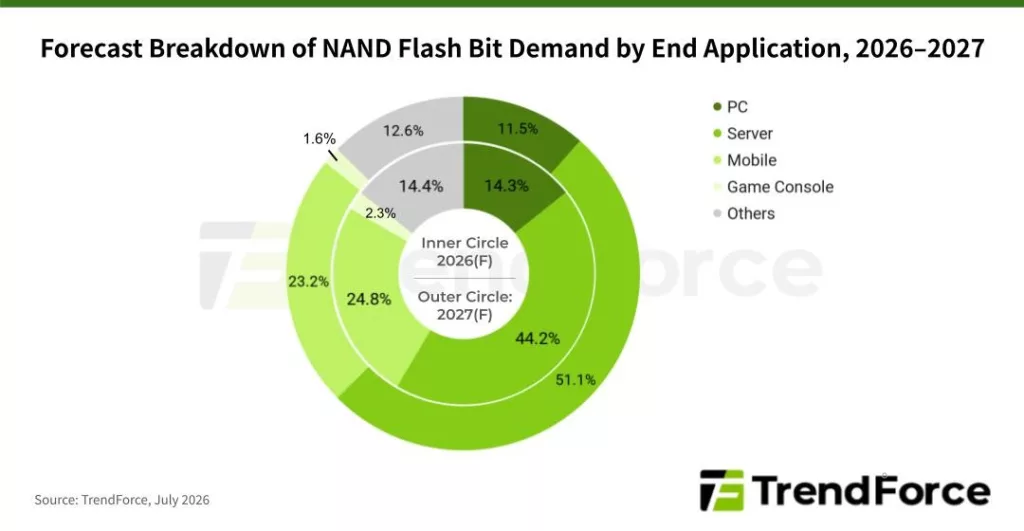
Another week, and another analyst firm giving its two cents on what to expect in the future regarding the ongoing NAND/Memory shortage. This time, in particular, the prediction focuses on NAND technology, which is primarily used in SSD storage. According to a report by TrendForce, we could be nearing the end of the tunnel thanks to the efforts of manufacturers who have been working to bring more fabrication facilities online to produce increased amounts of product. This, combined with a continued decrease in demand for smartphones and notebooks (thanks to higher prices related to current supply shortages), is expected to create an environment where supply once again exceeds demand sometime in the second half of 2027. The report tracks how in 2026 sales for notebooks have already dropped by 10% and are projected to continue a downward trend.
“The notebook market is also expected to remain under pressure. Following an estimated shipment decline of around 10% in 2026, notebook shipments are projected to contract slightly again in 2027 due to persistently high component costs, including memory and CPUs.”
– Trendforce
Shipments of server platforms from all major manufacturers continue on an upward trend in 2026, and demand for them is expected to remain strong in 2027. While components such as memory and storage will continue to be needed for servers, it’s believed that, for NAND, between increased production and decreased consumer demand, supplies will finally end the shortage in the consumer sector in 2027.
Sadly, even if this forecast pans out to be accurate, PC enthusiasts are unlikely to truly enjoy its benefits for at least another twelve months. In addition, there’s no guarantee that once supplies reach acceptable levels, product prices will come down to pre-2026 levels. Not to mention, multiple firms and industry execs have said they do not foresee memory supplies returning until the next decade. Regardless, perhaps it’s best to take what rays of sunshine we can get, and hopefully at least some amount of normalcy may return next year.
Discussion (14 replies)
Join Discussion →it feels like there are two different trends at cross purposes here
at some point in future they both have to intersect
ADATA chairman warns DRAM shortage will last another 10 years
[embedded media]
$1.65 trillion "hidden" future obligations for the tech giants
there is a lack of future income visibility to support this more certain, future liability.
[URL unfurl="true"]https://x.com/i/trending/2079379258410156214?s=20[/URL]
Agreed and honestly this is the first report I've seen stating anything is getting better next year. I'm not really buying it since so many are agreeing that we shouldn't see supplies leveling out until 2028 at the earliest and possibly not until sometime in 2030 or beyond.
They can't really predict it. Just throwing numbers out there like a blind man throwing a dart.
The memory situation wont be solved until HBM memory is improved with something like 3D or vertical-channel-transistor DRAM so they get more capacity per wafer. Which some experts estimate that is still a decade out, hence the "10 years" comment from him.
They could have a break through tomorrow on something that could alleviate the shortage much sooner or never.
Similar thing happened with NAND flash memory and didn't get fixed (and cheaper RAM) until they went vertically 3D with it. Which meant more capacity per wafer for them. Basically, we need the same thing to happen to DRAM or possibly HBM4 will fix it sooner.
No one knows.
Heck, the AI bubble could crash next month and all those promised contracts could be cancelled which would free up the fabs to use those wafers for DRAM instead of HBM.
Where's my frickin' 64TB SSD???? :mad:
64TB? Please... Why settle for that low amount.
[URL unfurl="true"]https://usa.ingrammicro.com/cep/app/product/productdetails?from=productsearch&id=SG6876&bundletrackingID=null&searchId=f2ff44b9-d4c5-4e98-a69e-f8be7dd9d697[/URL]
Nice but that's a server product. I need consumer NVMe or SATA or add in card flash SSD. And I won't pay more than $1000.
Oh cool, has a 5-year warranty. Well I'm sold! I don't really need to replace my 27yo vehicle anyways.
This exactly... what needs to happen is the VC money needs to start drying up milking the system for all of the circular capital it can get. (Quick explainer, Nvidia capital rich makes Ai cards, needs to sell them. AI company announces it's shopping for a datacenter company to build them an AI data center, Nvidia 'invests' in AI company a few 20-50 billion dollars. AI company pays Datacenter firm for project. Datacenter firm pre orders 20-50 billion in AI compute GPU's from Nvidia while they build. AI company shows money coming in, Data center company shows money coming in, and somehow Nvidia shows money coming in... rinse and repeat.)
Once that dries up... the cost for tokens for consumers and Enterprises shoots through the moon in short order as companies have to have a balance sheet that shows they can pay their water bills.
Companies look at their AI consumption and start building much smaller more focused LLM's that they can host locally on much smaller footprint AI clusters.
AI datacenters go belly up, sell off hardware in bankruptcy court. Enterprises buy on the cheap. Market is FLOODED with these nodes. (Unless Nvidia has a contract to buy them back) Nvidia either becomes a reseller of their own, tries to buy up data centers for AI processing. (Some of that will happen regardless)
Markets start to normalize....
Unless of course AI achieves super intelligence, realizes that people are required (or not) and continues out the VC farm via it's own funding initiatives behind the scene, building out more and more farms... allocating retired hardware to consumers to keep talent in the pool for more AI farm workers. Eventually replaces them with autonomous self repairing robot systems and removes the need for humans completely. But we all hope that won't be the case.
video (timestamped) by Gamer Meld on this
[embedded media]
plus bonus
"Chinese memory maker YMTC wants to dethrone Samsung and SK hynix by the end of 2027
YMTC has some big plans.
According to the Financial Times, citing "two people with knowledge of the matter", YMTC told investors that it wants to be the leader in the market (ahead of Samsung and SK hynix) by the end of 2027. That's a pretty bold claim considering it would need to more than double its current market share.
According to Counterpoint Research, YMTC holds a 13% market share, while NAND memory leader Samsung holds 29%. In fairness, though, YMTC does appear to be building up its infrastructure to handle growth."
https://www.pcgamer.com/hardware/ss...rone-samsung-and-sk-hynix-by-the-end-of-2027/
Yep, good luck with that YMTC but we all win if you do.
Actually doesn't seem like it would be that hard to do... The market is so supply constrained right now you can sell every bit you can make.
I mean, with "hard" being defined by how fast can you spin up fabrication. And the big players all being afraid to spin up too much fabrication too quickly, as they have all lived through overproduction issues before.
I could easily see YMTC chasing that market share number and hitting it, only to get hit with the subsequent oversupply crash and die a horrible death.
Hey, maybe we can all get affordable 128GB RAM then. Imagine everything being cached in RAM. Everything would be awesome again!
The longer you run your PC, Windows silently caches your files into RAM. After 24 hours of uptime, expect everything to load direct from RAM!
But that means we will all want ECC ram or those little reloads to ram will really start to suck.
On my DB servers with 1/2 a terabyte of ram I love having so many tables just loaded into ram. Would be great for calculation heavy games.
But lets get real, the raw speed difference in loading textures into your GPU from ram and from your PCIE 5x4 nvme drive... might not be that huge of a difference.
Now dealing with raw data and eff tons of raw tiny data elements it would be nice. But then the I/O and Memory controllers on our already nearly SOC CPU's today would get severely throttled.
I will be reading articles of ' hacked' cheap nvidia ai cards from bankrupt companies to be used in all kinds if manners, give it no more than 5 years.