
It’s a game changer, alright: reports that NVIDIA’s GeForce RTX 50 series graphics cards are getting epically sized price increases overseas show them costing far more than their original MSRPs. It’s no secret that NAND and DRAM manufacturers have prioritized orders for data center and enterprise AI customers leaving the consumer market a veritable wasteland filled with products getting constant price increases. This scenario is also present in the GPU market, as both NVIDIA and AMD focus their attention on supporting the same markets, leaving consumers with no new graphics cards, but now existing products are seeing price increases never before seen as costs are passed from the manufacturer, to partners who then roll them down to customers. The latest examples of this can now be seen in Japan, where Reddit user Chaise91 has posted an image from an online retailer showing the latest unsettling increases.
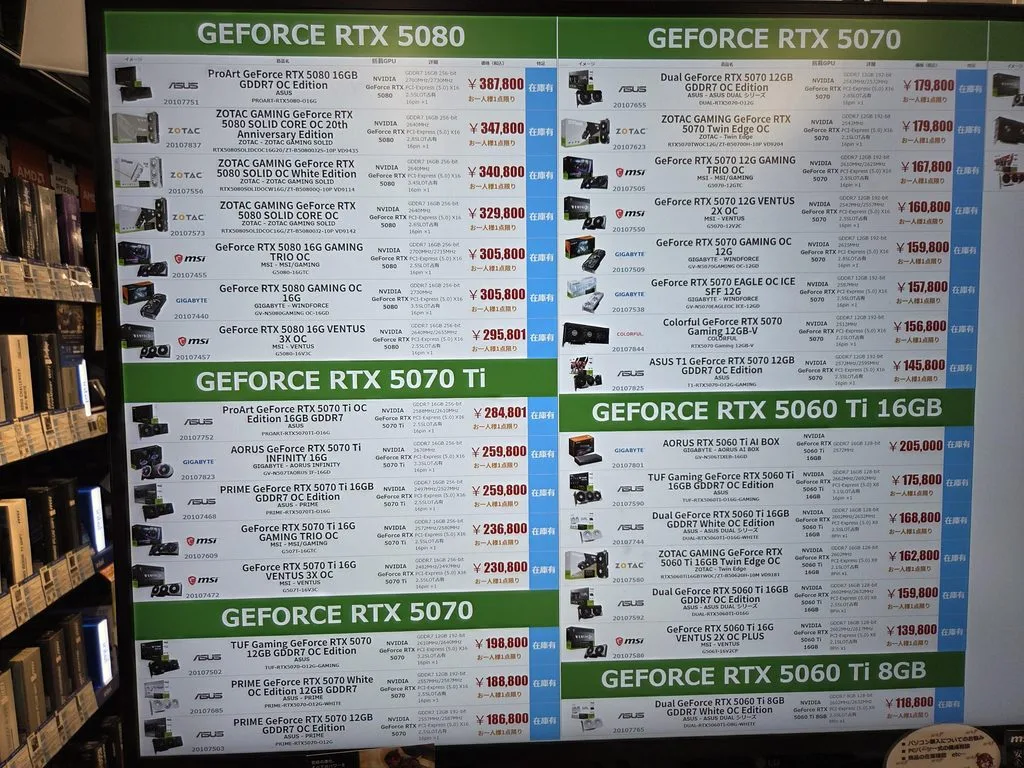
Per Wccftech, these prices convert as follows:
| GPU SKU | Launch Price | Current Selling Price | Price Increase |
|---|---|---|---|
| RTX 5060 Ti 8 GB | $472 | $749 | +59% |
| RTX 5060 Ti 16 GB | $530 | $881–$1,292 | +66% to +144% |
| RTX 5070 | $690 | $914–$1,253 | +32% to +82% |
| RTX 5080 | $1260 | $1,864–$2,444 | +48% to +94% |
As we can see, NVIDIA’s semi-budget-friendly RTX 5060 Ti 8GB/16GB cards are now anything but, with the lower VRAM model going for nearly $300 more than MSRP. It goes from bad to worse to right off a cliff, with the 16GB variation ranging in price from $300 more than launch price and over twice that for more premium models, which represents a roughly 144% increase. The current price of the mid-tier RTX 5070 tracks similarly, with prices ironically topping slightly lower than the highest-end RTX 5060 Ti 16GB. Meanwhile the rumored soon to be discontinued RTX 5080 16GB is averaging between $600 and nearly double that of its launch price. According to recent rumors, the 16GB model will at some point be replaced by a 24GB variant which will then be NVIDIA’s new flagship offering, as it drops the RTX 5090 in order to focus on supplying its GB202 dies for Pro model cards.
While these prices may be localized to Japan, it’s a known fact that overseas conditions are often early indicators of what to expect in the rest of the world. It’s likely only a matter of weeks until similar increases make their way to the Americas, which will make the potential upcoming holiday sales complicated as consumers try to seek affordable graphics card upgrades.
Discussion (1 reply)
Join Discussion →No, Mr. Bond, it's a game ender!