
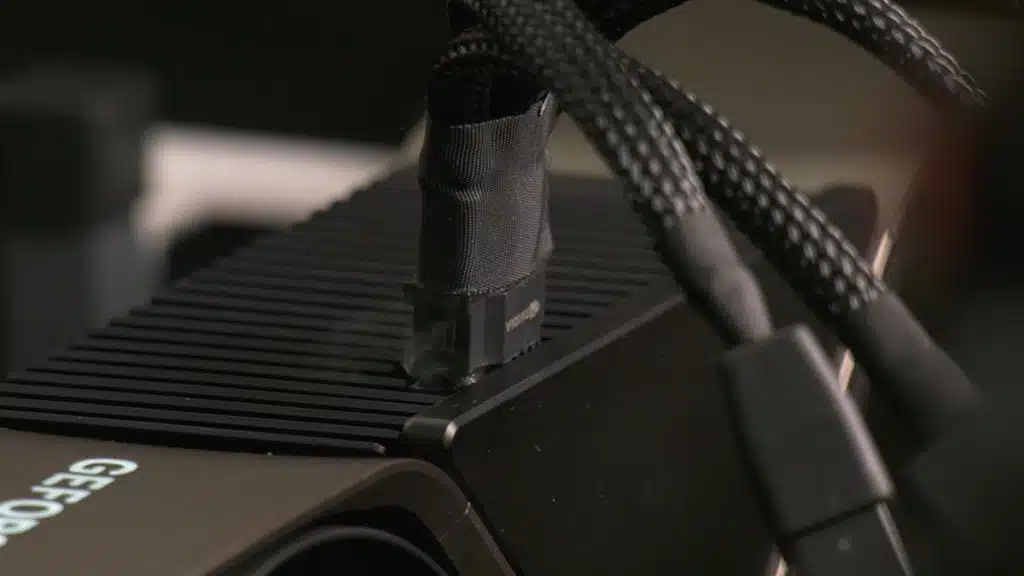
User error and foreign object debris are two of the main reasons why some GeForce RTX 4090 owners have ended up with melted connectors, according to a new in-depth investigation by GamersNexus’ Steve Burke that shows footage of a 12VHPWR power connector bubbling and smoking alongside one of NVIDIA’s Founders Editions cards. “We believe these […] to be the primary ones,” Burke wrote, cautiously noting that there could be even more reasons before warning enthusiasts that their cables should be seated properly and to ensure that they stay that way. NVIDIA is still investigating and hasn’t provided an official statement yet, but many critics continue to insist that design flaws are to blame.
Burke offered additional insight through his reddit account, echoing the idea that improper seating is one of the main issues:
The two primary ones, except it’s sort of like a 2+1 set of issues — 2 related to seating, 1 related to FOD. The seating one seemed to most effectively trigger failures when combined as a bad, specific angle on the cable route (towards the ‘a’ in the NV logo, since they’re oriented differently on some cards) PLUS a poor mount. We had trouble forcing failures when it was just one or the other. The FOD one, as a note, could be debris deeper/not cleanable by the end user also. We saw some molded into the strain relief. But it could also be burrs and damage from the dimples, according to the third-party failure analysis lab we sent it to.
(oh, one other thing – the high power contributes as well, maybe being the reason this one is failing more often than we heard about 3090 Tis fail or something)
Discussion (19 replies)
Join Discussion →Very interesting investigation.
As much as Steve likes his high horse, this is hardly conclusive. Rambling half an hour about foreign debris inside of the plastic casing, that doesn't even do anything. Then basing his entire conclusion on one example they managed to burn by almost completely unseating the connector. And on the guesswork of some anonymous test lab. Guesswork that doesn't seem to make any sense. What is a high resistance alternative route? I thought electricity will take the path of lowest resistance. As long as there is a lower resistance path for electricity to flow it will go that way. So the only way this works, is if all other pins have no contact while one has a high resistance contact. Hence why they had to almost completely unseat the connector.
Now I'm not saying that this is not what happened to the examples in the wild. But his almighty test jesus is trying to make it sound they performed rocket science.
New investigation, if the debris is pieces of tiny copper wire, and they happen to entangle themselves between several pins, it might burn.
Complete bullshit.
It's clearly a combination of poor design (dumb port location) and manufacturing issues (adapter cable quality control).
Nvidia has a long history of blaming their problems on others and not taking responsibility.
Anyone remember the Geforce 7800 - 9800 "wrong solder" issues? They completely dumped that shit sandwich on AIB's to handle under warranty, and abandoned customers who were out of warranty.
Nvidia is truly a shitty company, but they get away with it because of inadequate competition.
Exactly, inadequate competition and add in some level of Apple style cultism. This design is unacceptable, and needs to be phased out ASAP. Unless power supplies manufacturers also want to be caught in the fire, they should announce they are phasing it out, and not supporting it, requiring the user to use adapters if they want to keep things hot. In theory its a 600w plug used still at a fraction (large percentage, but still less) of that 600w , imagine failures at the rated 600w, you would probably have actual fires then.
It's an up to 1200W plug.
Guat? The hell....
Though I agree with you on their practices at times, I don't believe it's Nvidia directly blaming the end user for this as it's been circulating amongst the PC community for some time since the 4090 came out. I even stated it may be user error when I got my card a while ago. Al in all it is a poor design that should have been made better for the less than careful do it yourself PC builder IMO.
That's one of the reasons for switching connectors - that the PSUs now have to be able to handle the transients. 450W is nothing for these connectors.
I have to say that yesterday when I was installing the new PSU I was a bit nervous walking out the adapter from the card. I don't have the full experience as some others here in our forums but definitely have far more than an average user and can say that in my 30-40 years of working with PC equipment the amount of tension needed to get that thing out would've been enough to break pin solder points on a PCB. It all worked out but I was as concerned with that as with everything else we already know.
Clearly up to means it can catch fire at any point up to 1200 :p
Per plug, I think it's only 600W
Note the 'sustained' column header. Not expected to sustain more than 600W, but transients are a different issue.
Unless you are talking car amplifiers, I think most people are thinking sustained power draw. That's what TDP / TBP refers to now at any rate.
They very well may be only thinking of sustained power draw, but sustained power draw hasn't really been an issue.