

The FCC has adopted new rules that require broadband providers to display easy-to-understand labels to help consumers more easily comparison shop for broadband services. Resembling the well-known nutrition labels that appear on food products, these labels must display key information, including prices, speeds, data allowances, and other information. The new label is based on voluntary labels that the FCC previously approved in a 2016 Public Notice, according to a press release from the agency.
The new broadband labels will empower consumers with the following features:
- Prominent Display. The Order ensures that consumers see their actual label when purchasing broadband by requiring providers to display the label – not simply an icon or link to the label – in close proximity to an associated plan advertisement.
- Account Portals. The Order requires ISPs to make each customer’s label easily accessible to the customer in their online account portal, as well as to provide the label to an existing customer upon request.
- Machine Readability. To further assist with comparison shopping, the Order requires that providers make the information in the labels machine-readable to enable third parties to more easily collect and aggregate data for the purpose of creating comparison-shopping tools for consumers.
- Further Refinements. The Commission also adopted a Further Notice of Proposed Rulemaking on ways that it can further refine and improve its rules in order to ensure that we further our consumer transparency goals.
“Broadband is an essential service, for everyone, everywhere. Because of this, consumers need to know what they are paying for, and how it compares with other service offerings,” said Chairwoman Rosenworcel. “For over 25 years, consumers have enjoyed the convenience of nutrition labels on food products. We’re now requiring internet service providers to display broadband labels for both wireless and wired services. Consumers deserve to get accurate information about price, speed, data allowances, and other terms of service up front.”
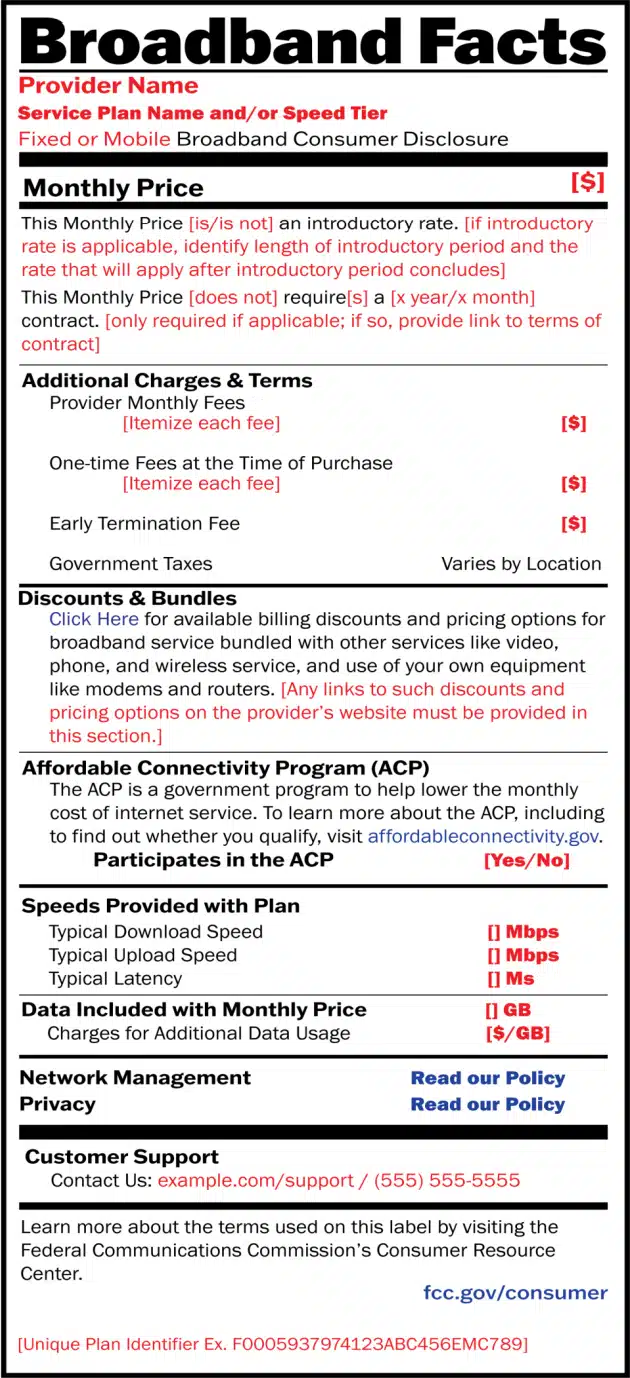
From an FCC press release:
The Infrastructure Investment and Jobs Act directed the FCC to require providers to display consumer-friendly labels with information about their broadband services. The new label is based on voluntary labels the Commission previously approved in a 2016 Public Notice. In adopting the label, the Commission stated that access to accurate, simple-to-understand information about broadband internet access services helps consumers make informed choices and is central to a well-functioning marketplace that encourages competition, innovation, low prices, and high-quality service. The FCC also sought comment on ways it can enhance the newly-adopted label in the future, including different ways to display broadband performance information.
Discussion (4 replies)
Join Discussion →"Typical latency" "typical download speed".
Jeez. Don't they think this might just be dependent on what is on the other end, and not just the service being provided?
Maybe if you are lucky and have GB+ Fiber, that might be an issue.
I'm sure it will be caveated as "Measured at the router", not end user device. I know the Starlink app makes a very clear distinction between what the speed between the satellite (router) is, and the speed your end device is able to see; which is somewhat pertinent now that the latest generation of Dishy is WiFi-only (unless you buy a RJ45 dongle seperately)
Well even if there are loopholes or some details that can affect the endpoint I'm glad they're doing this. My stomach cringes every time I hear someone say they got offered broadband and was told it was blazingly fast, or some such, but didn't have any #s, and then it turn out to be ~30-50 Mbps. We can't help those who may not fully understand the ramifications of the specs but at least it will be in print.
Reminds of me my dial-up days through the early 2000s. Paid for 56k and was lucky if I saw 6k. I currently have a 800/30 connection with Comcast and have seen some days where it's below but most moments when I need it are at or more than those #s but I know most people are not so fortunate to live within a mile or two of the CO.