
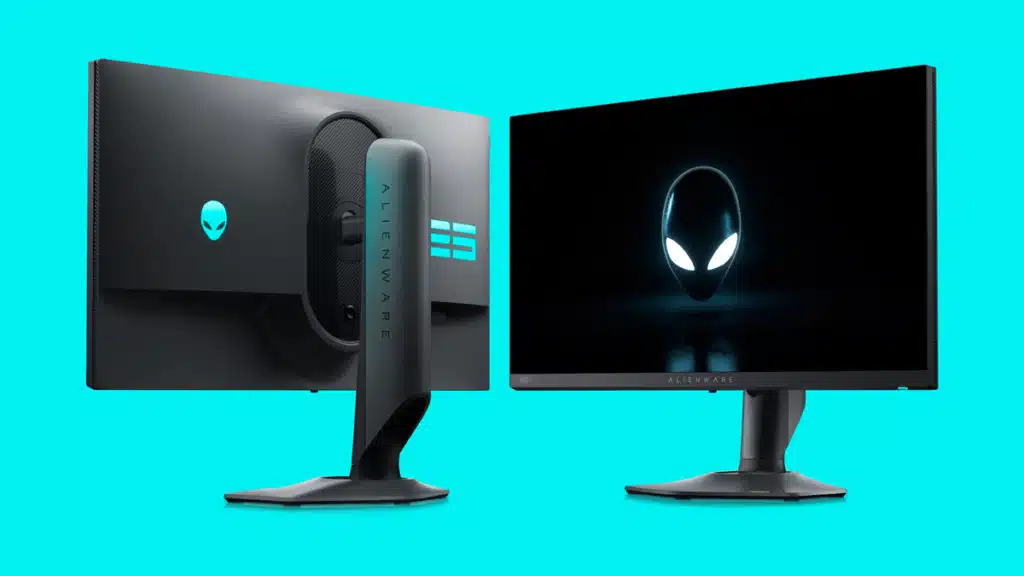
Alienware has announced the AW2524H, a new IPS gaming monitor that supports refresh rates of up to 500 Hz, making it a world’s first, according to the company, which can also confirm that the display has already earned a CES 2023 Innovation Award and is a Best of Innovation winner.
Alienware AW2524H 500 Hz Fast IPS Gaming Monitor
- 500Hz (OC) / 480Hz (native) refresh rate delivers new category of speed and motion clarity, making even fast-paced games look supremely fluid
- Fast IPS panel features sRGB 99% color coverage for consistent, accurate colors and wide viewing angles
- 0.5ms min GtG (gray-to-gray) response time eliminates ghosting and blurring
- NVIDIA Reflex Latency Analyzer technology lets players optimize their systems for lowest possible latency so they can play at their highest potential
- VESA DisplayHDR 400 certification provides vibrant, lifelike visuals
- NVIDIA G-Sync ensures tear- and stutter-free gaming with high levels of visual clarity
- TUV-certified ComfortView Plus Low Blue Light hardware solution reduces harmful blue light while maintaining true-to-life colors
- Esports-inspired Legend 2.0 design features new base for a smaller desk footprint, plus a fully-adjustable stand with height adjustment markers
- AlienFX RGB lighting evokes premium look and feel
- New integrated headset hanger keeps desk tidy
- Eco-conscious packaging uses ~50% less EPE, with an ocean bound plastic handle on the box and no plastic clips. Box uses at least 75% recycled cardboard, while display’s enclosure/stand incorporate at least 25% post-consumer recycled plastics.
Pricing for the AW2524H will be announced closer to its shipping date, which is slated for the first quarter of 2023.
Alienware Aurora R15 Updates
Alienware has also revealed that its new Aurora R15 desktops can soon be configured with AMD Ryzen 7000 Series and Intel 13th Gen Core 65-watt processors, with AMD Radeon RX 7000 Series graphics options coming later this winter.
- 1/5/23: Alienware Aurora R15 with AMD Ryzen 7000 Processors starts at ~$1,599 (US), $2,199 (CA)
- 1/5/23: Alienware Aurora R15 with Intel 13th Gen Processors starts at ~$1,599 (US), $2,199 (CA)
- Later this winter: Alienware Aurora R15 with AMD Radeon 7000 Graphics will be made available. Pricing will be shared closer to availability.
Alienware Clothing Line
Rounding off Alienware’s announcements today is the introduction of “Interstellar,” a new clothing line from the manufacturer that will comprise hoodies, shirts, and other sorts of apparel with the familiar alien logo.
- Availability: January 17, 2023 only in United States
- Zip Hoodie – $100.00 USD
- Pullover Hoodie – $90.00 USD
- T-Shirt – $40.00 USD
- Snapback Hat – $30.00 USD

“Alienware is offering fans the opportunity to express their passion for the brand and the gaming lifestyle with premium quality apparel that never goes out of style,” Alienware explained. “Designed with comfort in mind, Alienware’s iconic brand aesthetic provides a subtle way for loyal fans and gaming fanatics to rep the brand with minimalist designs across hats, t-shirts, and hoodies.”
Discussion (9 replies)
Join Discussion →Oh, whatever man.
If kids want to waste their money out of FOMO, let them waste their money.
Ignoring the extreme uselessness of such high refresh rates, I'm just surprised that someone was able to bust out a 500Hz display that is NOT a piece-of-sh1t TN panel.
You know, come to think of it, where something like this might actually be useful, is if they were set up to do what good TV's used to do, update the same frame multiple times at a higher refresh rate.
I don't quite claim to understand why this improves display quality, but reportedly it at least did in the past.
If it supports up to 500hz, you could - for example - run at 120fps, and update the same static frame 4 times at 480hz.
If this still works as it did back in the old HDTV panel days, maybe it would reduce the type of motion blurring my Asus XG438Q is prone to at high refresh.
Didn't know about any of that but makes sense to me. Plasma days?
I think it was LCD. It came up in my searches back in ~2015 when I was looking into what the point of 120hz panels on TV's with interfaces that only supported 60hz inputs were, other than marketing and printing "wow 120hz" on the box.
I think my old Samsung JS9000 TV does this. It has an VA panel. Samsung called it SuperVA or SVA.
The only thing I'm familiar with when it comes to "120Hz" or "240Hz" LCD HDTVs is motion interpolation, where HDTVs look at the previous frame, the upcoming frame, and make up a frame in between those. Some HDTVs used a black frame, and some HDTVs used a frame made up of the previous and next frames. Samsung called it AutoMotion. LG called it TruMotion, and I'm sure the other manufacturers had their own names for the tech. It was very handy for 30fps games, but it used to cause hella input lag. I first started seeing motion interpolation in HDTVs around 2007. But the shiznit @Zarathustra is talking about is something I am completely unfamiliar with, and don't recall hearing about before.
I remember TruMotion and etc all being supposedly ~the thing~ for live sports for some reason. I think it's still on my LG OLED as Sports mode.
I've been trying to google it without success.
I might just be thinking of black frame insertion. Not sure.
But I do not remember a black frame being mentioned.
I've never owned such a TV, but what @DrezKill described is familiar. Though manufacturers had unique marketing names for the technologies, some review sites preferred the label "fake refresh rates", because the advertising was often deceptive, and one couldn't rely on the published refresh rate to make an informed buying decision. I haven't been shopping for a TV lately, so the use of past tense may have been a mistake, but at least the practice is now well known.