
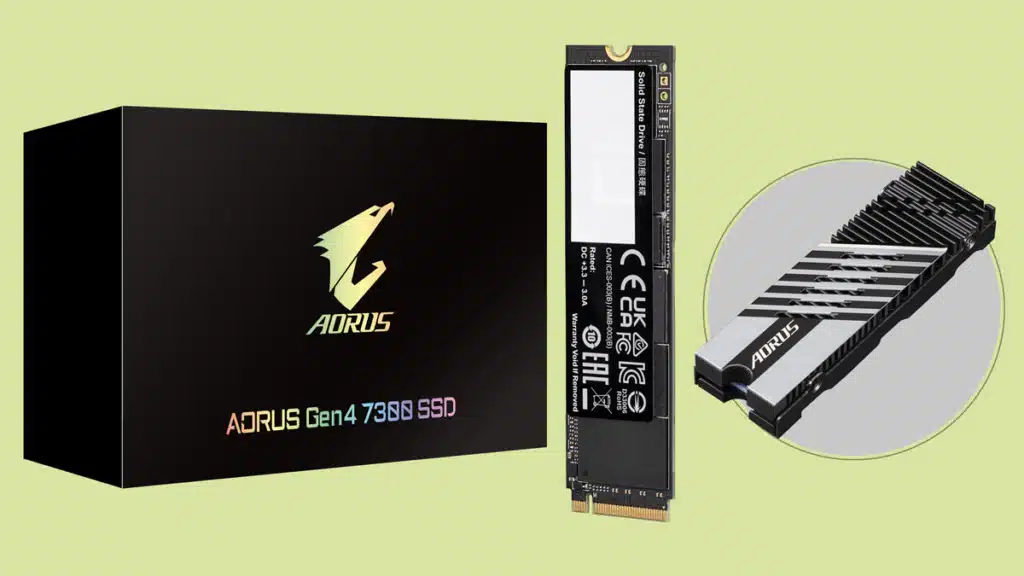
GIGAYTE has announced the AORUS Gen4 7300 SSD, an upgraded PCIe 4.0 SSD that features advanced 3D-TLC NAND flash and read speeds of up to 7,300 MB/s. It will be available in 1 TB and 2 TB capacities, along with “a unique packaging design of separated SSD and heatsink packing to offer more flexible thermal solutions.” Pricing and dates of availability were not shared.
“With the rapid evolution of semiconductor process, the transfer speed of PCIe 4.0 SSD upraise from 5000MB/s to 7300MB/s and above which benefit greatly users who pursue storage performance and wish to avoid the bottleneck of system performance. “ Said Jackson Hsu, Director of the GIGABYTE Channel Solutions Product Development Division. “GIGABYTE has endeavored on SSD products in recent years and the shipments achieved the global top 10 with the ramp on self-brand products. Enhance by the technology evolution, the read speed of GIGABYTE PCIe 4.0 SSD boosts from 5000MB/s, 7000MB/s to 7300MB/s by AORUS Gen4 7300 SSD for impressive storage performance. In addition, the flexible design of a self-planned thermal solution for users reduces the chances of throttling and greatly improves the system performance.”
From a GIGABYTE press release:
Normally the high-speed SSD generates heat and results in throttling under full-speed operation, which puts limit on its transfer speed. In order to prevent possible throttling, most motherboards and SSD equip with heatsink to dissipate the heat of SSD. AORUS Gen4 7300 SSD adopts a unique packaging design of separated SSD and full-coverage heatsink packing, which allows users to choose the built-in heatsink on their motherboards or the enclosed heatsink of AORUS Gen4 7300 SSD in line with their needs. This enables more flexible thermal configuration whether for PC system installation or PS5 capacity expansion.
AORUS Gen4 7300 SSD supports motherboards with PCIe 4.0 NVMe M.2 interface design. To release the breakthrough performance of 7300MB/s read speed, the latest AMD motherboards, especially GIGABYTE motherboards are highly-recommended. With GIGABYTE R&D’s professional adjustment, comprehensive verification, and software enhancement, GIGABYTE motherboards offer more stability with superior performance, which is definitely the best choice for users. For more information, please visit GIGABYTE’s official website: https://www.gigabyte.com/SSD/Gen-4
GIGABYTE’s other SSDs include those in the AORUS Gen4 5000E, Gen3 2500E, M.2, and M30 series, according to its official website.
Discussion (19 replies)
Join Discussion →I really wish they would start using the 4k random results as the headline number instead of the sequential results.
In all honesty, the 7300MB/s number here is mostly useless. It is not a good measure of how the drive will perform other than in large file copy operations.
Booting? Loading programs? Loading games/maps? Scratch drives? Pretty much any practical use is going to come down to 4k random numbers.
Mine look like this:
Samsung 980 Pro 2TB (Gen 4)
Sabrent Rocket 4 2TB (Gen 4)
Samsung 970 EVO 1TB (Gen 3)
Intel SSD 750 400GB (Gen 3)
That RND4K Q1T1 read number is the best predictor of relative overall performance, IMHO. That's why for most uses, it's 980 Pro >>> 970 EVO > Rocket 4 > SSD750.
It's notable that because the 4K random results are so far below the interface speed, whether they are Gen 4 or Gen 3 doesn't even matter. Heck, you could design a SATA SSD with a super fast controller, and it could perform better than any of these three NVME drives, if you up the Random 4k performance.
I remember learning about all the different approaches with controllers for different use-type scenarios when doing research on SSDs years ago when the dram cache-less drives came out. At the time I was replacing all the platters for our workstations and laptops and was looking into best value but also concerned about longevity. I was honestly shocked at how difficult it can be to research which drives are truly optimized for various needs beyond enterprise and consumer.
Meanwhile, although I have seen improvements with my NVME drives, both 3.0 and 4.0, it's not as drastic as I'd hoped beyond seq. read/write so it proves @Zarathustra's about random. Especially when you see those #'s and how close some are.
I'm actually kind of curious to test how close SATA SSD's come in Random 4K reads.
I may ahve to load a few into the testbench and run Crystal Disk Mark on them for reference.
You got me curious but I'm not sure when I'll have time to do it but I can run some on my 4930K rig since the OS and game drives are both SATA III.
I'm in the process of running it on the handful of drives that are in my spare parts bin, just for fun, I'll report back here in a little bit.
It's been nearly 50 minutes exactly how ling is a BIT IN YOUR WORLD!? j/k thanks this should be interesting.
The 970 pro should be faster than the 980 pro, as the 970 is mlc NAND with lower latency than the TLC in the 980 pro
I wish I still had my X25-e SLC Intel drives from Way back. I’ll bet they hold up surprisingly well… If you only need 64GB
Could be. I don't have a 970 Pro to test though.
I have a lot of drives kicking around, but that's not one of them.
MLC tends to be faster, especially in writes, but as time goes on this improves too. New QLC drives are WAY faster than old SLC drives :p
Random 4k read on the X25-e looks like it was around 55MB /sec, but I didn’t see how Anandtech measured it. In any case, it seems like the old E drives could still be competitive in random performance.
[URL unfurl="true"]https://www.anandtech.com/show/2808/4[/URL]
Edit - the random read was done at QD 3
Alrighty, I went a little crazy, but I started digging through my spare parts bin and kept finding drives, so I figured, why the hell not test them?
I've attached all the images of the test results for reference, but I have summarized them below:
First by high queue depth sequential speeds:
Drive[/TD]
Type[/TD]
Seq (Q8T1)[/TD]
Seq (Q1T1)[/TD]
Rnd 4k (Q32T1)[/TD]
Rnd 4K (Q1T1)[/TD]
[/TR]
Samsung 980 Pro 2TB[/TD]
NVMe 4x Gen4 TLC[/TD]
6881.03[/TD]
4077.2[/TD]
511.21[/TD]
83.16[/TD]
[/TR]
Sabrent Rocket 4.0 2TB[/TD]
NVMe 4x Gen4 TLC[/TD]
4795.94[/TD]
2141.76[/TD]
647.71[/TD]
42.66[/TD]
[/TR]
Samsung 970 EVO 1TB[/TD]
NVMe 4x Gen3 MLC[/TD]
3289.19[/TD]
2565.27[/TD]
538.67[/TD]
48.81[/TD]
[/TR]
Intel SSD750 400GB[/TD]
NVMe 4x Gen3 MLC[/TD]
2248.19[/TD]
1123[/TD]
283.19[/TD]
31.86[/TD]
[/TR]
Samsung 850 Pro 512GB[/TD]
6Gb/s SATA MLC[/TD]
569.42[/TD]
518.23[/TD]
334.06[/TD]
26.15[/TD]
[/TR]
Samsung 870 EVO 250GB[/TD]
6Gb/s SATA TLC[/TD]
569.08[/TD]
500.43[/TD]
329.72[/TD]
31.65[/TD]
[/TR]
Samsung OEM CM817a 256GB[/TD]
6Gb/s SATA TLC?[/TD]
561.77[/TD]
496.19[/TD]
273.77[/TD]
26.08[/TD]
[/TR]
Samsung 840 Pro 128GB[/TD]
6Gb/s SATA MLC[/TD]
554.85[/TD]
521.01[/TD]
299.93[/TD]
25.71[/TD]
[/TR]
Samsung 850 Pro 128GB[/TD]
6Gb/s SATA MLC[/TD]
554.12[/TD]
502.77[/TD]
342.18[/TD]
26.87[/TD]
[/TR]
Samsung 840 EVO 120GB[/TD]
6Gb/s SATA TLC[/TD]
553.94[/TD]
488.64[/TD]
286.13[/TD]
25.32[/TD]
[/TR]
Sandisk 64GB[/TD]
6Gb/s SATA MLC[/TD]
545.47[/TD]
484.22[/TD]
38.95[/TD]
16.43[/TD]
[/TR]
OCZ Vector 256GB[/TD]
6Gb/s SATA MLC[/TD]
531[/TD]
453.33[/TD]
318.75[/TD]
23.24[/TD]
[/TR]
Samsung OEM PM830 128GB[/TD]
6Gb/s SATA MLC?[/TD]
518.68[/TD]
417.34[/TD]
245.12[/TD]
19.31[/TD]
[/TR]
Intel S3700 100GB[/TD]
6Gb/s SATA MLC[/TD]
499.52[/TD]
451.67[/TD]
305.99[/TD]
26.21[/TD]
[/TR]
ADATA SP600 32GB[/TD]
6Gb/s SATA MLC[/TD]
409.18[/TD]
368.04[/TD]
135.91[/TD]
27.66[/TD]
[/TR]
Intel 320 160GB[/TD]
3Gb/s SATA MLC[/TD]
284.55[/TD]
261.14[/TD]
160.16[/TD]
17.67[/TD]
[/TR]
WD Blue 1TB WD10EZEX[/TD]
6Gb/s SATA 7200rpm[/TD]
192.38[/TD]
192.25[/TD]
2.35[/TD]
0.71[/TD]
[/TR]
WD Green 3TB WD30EZRX[/TD]
6Gb/s SATA 5400rpm[/TD]
132.13[/TD]
130.04[/TD]
1.87[/TD]
0.57[/TD]
[/TR]
WD Blue 250GB WD2500AAJS[/TD]
3Gb/s SATA 7200rpm[/TD]
94[/TD]
95[/TD]
1.67[/TD]
0.64[/TD]
[/TR]
[/TABLE]
And second by low queue depth random 4k reads:
Drive[/TD]
Type[/TD]
Seq (Q8T1)[/TD]
Seq (Q1T1)[/TD]
Rnd 4k (Q32T1)[/TD]
Rnd 4K (Q1T1)[/TD]
[/TR]
Samsung 980 Pro 2TB[/TD]
NVMe 4x Gen4 TLC[/TD]
6881.03[/TD]
4077.2[/TD]
511.21[/TD]
83.16[/TD]
[/TR]
Samsung 970 EVO 1TB[/TD]
NVMe 4x Gen3 MLC[/TD]
3289.19[/TD]
2565.27[/TD]
538.67[/TD]
48.81[/TD]
[/TR]
Sabrent Rocket 4.0 2TB[/TD]
NVMe 4x Gen4 TLC[/TD]
4795.94[/TD]
2141.76[/TD]
647.71[/TD]
42.66[/TD]
[/TR]
Intel SSD750 400GB[/TD]
NVMe 4x Gen3 MLC[/TD]
2248.19[/TD]
1123[/TD]
283.19[/TD]
31.86[/TD]
[/TR]
Samsung 870 EVO 250GB[/TD]
6Gb/s SATA TLC[/TD]
569.08[/TD]
500.43[/TD]
329.72[/TD]
31.65[/TD]
[/TR]
ADATA SP600 32GB[/TD]
6Gb/s SATA MLC[/TD]
409.18[/TD]
368.04[/TD]
135.91[/TD]
27.66[/TD]
[/TR]
Samsung 850 Pro 128GB[/TD]
6Gb/s SATA MLC[/TD]
554.12[/TD]
502.77[/TD]
342.18[/TD]
26.87[/TD]
[/TR]
Intel S3700 100GB[/TD]
6Gb/s SATA MLC[/TD]
499.52[/TD]
451.67[/TD]
305.99[/TD]
26.21[/TD]
[/TR]
Samsung 850 Pro 512GB[/TD]
6Gb/s SATA MLC[/TD]
569.42[/TD]
518.23[/TD]
334.06[/TD]
26.15[/TD]
[/TR]
Samsung OEM CM817a 256GB[/TD]
6Gb/s SATA TLC?[/TD]
561.77[/TD]
496.19[/TD]
273.77[/TD]
26.08[/TD]
[/TR]
Samsung 840 Pro 128GB[/TD]
6Gb/s SATA MLC[/TD]
554.85[/TD]
521.01[/TD]
299.93[/TD]
25.71[/TD]
[/TR]
Samsung 840 EVO 120GB[/TD]
6Gb/s SATA TLC[/TD]
553.94[/TD]
488.64[/TD]
286.13[/TD]
25.32[/TD]
[/TR]
OCZ Vector 256GB[/TD]
6Gb/s SATA MLC[/TD]
531[/TD]
453.33[/TD]
318.75[/TD]
23.24[/TD]
[/TR]
Samsung OEM PM830 128GB[/TD]
6Gb/s SATA MLC?[/TD]
518.68[/TD]
417.34[/TD]
245.12[/TD]
19.31[/TD]
[/TR]
Intel 320 160GB[/TD]
3Gb/s SATA MLC[/TD]
284.55[/TD]
261.14[/TD]
160.16[/TD]
17.67[/TD]
[/TR]
Sandisk 64GB[/TD]
6Gb/s SATA MLC[/TD]
545.47[/TD]
484.22[/TD]
38.95[/TD]
16.43[/TD]
[/TR]
WD Blue 1TB WD10EZEX[/TD]
6Gb/s SATA 7200rpm[/TD]
192.38[/TD]
192.25[/TD]
2.35[/TD]
0.71[/TD]
[/TR]
WD Blue 250GB WD2500AAJS[/TD]
3Gb/s SATA 7200rpm[/TD]
94[/TD]
95[/TD]
1.67[/TD]
0.64[/TD]
[/TR]
WD Green 3TB WD30EZRX[/TD]
6Gb/s SATA 5400rpm[/TD]
132.13[/TD]
130.04[/TD]
1.87[/TD]
0.57[/TD]
[/TR]
[/TABLE]
Surprisingly strong showing from the little 32GB Adata drive :p
Probably best to ignore the write speeds on all of these. They are old, anywhere from mostly untouched to partially or mostly used up write cycles, and I didn't run trim on them in advance.
Generally in client loads, low QD is what matters as you are usually running fewer things at the same time. In servers (like with databases and stuff) high queue depth is generally more important.
Sequential is important for copying large files from one place to another. Random 4k is more important for pretty much everything else.
While I am tempted to say that RND4K Q1T1 are the numbers to look at, I guess I could be persuaded to compromise and use the RND4K Q32T1 figures.
Either way, the random data best matches at least my subjective experience with drives, and completely explains why the shift from hard drives to SATA drives was revolutionary for system resposiveness and load times, while every advancement since has been mostly evolutionary. Because if you look at it, the slowest random 4k SSD on the list is 23x faster when it comes to RND4K Q1T1, but the slowest sequential SSD on the list is only about 48% faster than the fastest sequential hard drive on the list.
Yeah, that means it performed worse than every SSD in my test above, except the 64GB Sandisk drive :p
My 980 PRO 1TB seems in line with yours
Read
6605.04 - 4190.85 - 980.01 - 86.62
Write
4940.73 - 4221.84 - 783.84 - 250.64
970 EVO 2TB
Read
3572.96 - 3057.86 - 1005.97 - 52.98
Write
3361.61 - 3209.20 - 852.25 - 280.59
960 QVO SATA 6Gb/s
Read
560.00 - 549385 - 385.83 - 38.37
Write
525.27 - 517.25 - 333.62 - 142.31
That's all I cba to test
They used QD 3, not 1 or 32, so it’s hard to compare. it’s also 14 years old and has a 210 microsecond latency, which isn’t terrible still today. Based on the AT bench numbers, it should be better than that Intel 320 but less than the OCZ vector. Compared to , say, a 14 year video card, I’d say the old X25-E would do pretty well :D
Yeah, my bad, I spaced out there for a moment and equated QD3 with 32 ?