
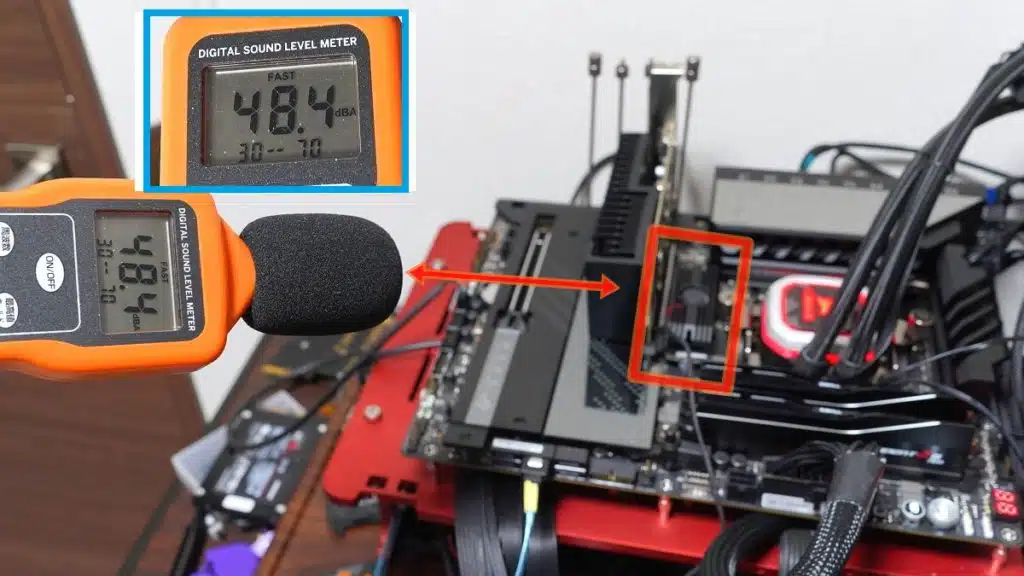
CFD Gaming recently launched the PG5NFZ, a PCIe Gen 5 M.2 NVMe SSD that features up to 10 GB/s of sequential read speed and up to 9.5 GB/s of sequential write speed—but that’s not the only thing that the drive has to offer. According to reviews and reports from early owners, the SSD also comes with a very loud heat sink fan, an unadvertised feature that many have noticed while stress testing the 49,980 yen (~376 USD) drive, currently available in 2 TB capacity. Images shared by the @jisakuhibi account suggest that the fan can reach noise levels of nearly 50 dB.
From an AKIRA PC Hotline! report (machine translation):
The series was announced in October 2022, and the 2TB was scheduled to be released in November 2022, but the release was postponed. In addition, 1 TB “CSSD-M2M1TPG5NFZ” and 4 TB “CSSD-M2M4TPG5NFZ” are also available for CFD sales, but this time they have not arrived.
The performance values (maximum) for 4TB and 2TB are sequential read 10GB/s, sequential write 9.5GB/s, random read 1,500K IOPS, and random write 1,250K IOPS.
The performance value (maximum) of 1TB is sequential read 9.5GB/s, sequential write 8.5GB/s, random read 1,300K IOPS, random write 1,100K IOPS.
The board is equipped with a fan-integrated heat sink “Phnix” with a thickness of 20 mm. High cooling performance suppresses heat generation and exhibits stable high-speed performance. The cable length is 45cm and equipped with a 5V connector.
In addition, there is a note in the product information that “Please pay attention to the air flow in the PC case so that the heat of the heat sink can be dissipated.”
CFD CSSD-M2M2TPG5NFZ
— 188号 (@momomo_us) February 5, 2023
2TB , Gen5 x4 , PS5026-E26
CPU : Core i7-13700K
MB : Z790 Steel Legend WiFi
MEM : DDR5-4800 16GBx2 pic.twitter.com/qCMmaLRNI9
ギュ-ン⬇️ギュ-ン⬆️ギュ-ン⬇️ギュ-ン⬆️ pic.twitter.com/JhCaRBJcDy
— 188号 (@momomo_us) February 5, 2023
CFD CSSD-M2M2TPG5NFZの冷却ファンはSUMON製、型番:MF17080V1-1000C-A99で、定格回転数”21,000”RPMです。
— 自作とゲームと趣味の日々 (@jisakuhibi) February 6, 2023
回転数2万越え、常時フル回転なので、普通に煩い。https://t.co/M9YG9CsDL1 pic.twitter.com/i2nF1m9iX7
Discussion (19 replies)
Join Discussion →Holy crap that's loud for an M.2 SSD fan.
I'd sooner run a leg from my loop than throw a ~20mm, 20kRPM screamer in my desktop
Just cant wait to see the 1 U Petabyte storage units running so many of those fans in parallel and series as a push pull config as you'll have to have a warning about not blocking the intake.
I am so glad I don't care about PCI-e Gen 5 NVME drives. I haven't felt my Gen 3 drive has held me back at all and it looks like it's a good thing.
Most people are never going to notice a difference in desktop use. Now if you were running a SQL cluster getting hammered with a ton of reads and writes you will.
Gawd, it reminds me of the annoying-@ss fan in my dad's old laptop that drives me f*cking nuts.
Yeah, that's going to be a nope for me.
I hated the chipset fan on my gigabyte motherboard.
I'm OK with large slow case/radiator fans, but I'm not adding small fast fans to any of my system components.
If I have to I'll get creative with small water blocks but even that irks me as they will make loops more complex, and reduce flow.
THey need to get their shit together. RAM and SSD's shouldn't need big loud cooling implementations.
Some of my friends are using Asus TUF X570 boards, which have a chipset fan, but that fan is pretty dang quiet, so props to Asus there.
I never hear the chipset fan on my Aorus X570 board.
Yeah, this was an issue on my first Gigabyte TRX40 Aorus Master board. Out of the box the chipset fan was obnoxious, but it did offer a pretty need fan curve editor in the BIOS which I used to improve things. It was never perfect but I was able to improve it.
The two or three fans (can't remember) in my Asus ROG Zenith II Extreme Alpha have never been a problem though. I never had to modify the settings.
I do hear a very low amount of white noise style fan noise at idle (in other words just very low whoosh, no hum) but I think that is from the 16x 120mm fans and 8x 140mm fans, not from a chipset fan.
It's probably only 20db at my ears distance from the case and it is a neutral white noise whoosh, so it doesn't bother me. It probably wouldn't be audible at all of my room weren't as quiet as it is.
To be clear, I have to hold my breath and listen if I want to hear it, otherwise it is silent. At least at idle :p
It's only because I've manually set the chipset fan on the MSI X570 board to full during testing that I even know what it sounds like. It's mostly inaudible but if a game does some kind of full-speed load I'll hear it, the rear intake, and CPU pump/fan, kick in. Usually only for a matter of seconds but all of that does get my attention.
LOL. Chipset fan. Not hipster fan. :p
ASUS saw fit to put two of these screamers on their Strix X570I - they're inaudible on a desk, but when put into an ITX case (which are usually hotboxes one way or another), they happily spin up to >5,000RPM and become the loudest thing in the room.
Really disappointed to find out that this was the answer to figuring out why the room sounded like a datacenter. Swap for a far cheaper Gigabyte B550 ITX board, problem solved.
(I do have to admit that I did not experience any stability issues, so presumably the fans did their jobs keeping the chipset and the VRM cool, but still, really wish AMD would find a better solution for their chipsets...)
I think that's why the NZXT H7 Flow that I wrote about last weekend will probably be the smallest I can go for a high-end gaming rig.
WHAAAAAAAAAAAAAAAAAAAAAAAAAAT
Dude that's insane, good gawd!
Yyyyyeeeeeaaaaahhhhh maaaaaan...