
Power and Temperature
To test the power and temperature we perform a manual run-through in Cyberpunk 2077 at “Ultra” settings for real-world in-game data. We use GPU-Z sensor data to record the results. We report on the GPU-Z sensor data for “Board Power” and “GPU Chip Power” when available for our Wattage data. For temperature data, we report the GPU (Edge Temp of the GPU or Package Temp) as well as Hot Spot (Junction Temperature) when available for our temperature data.
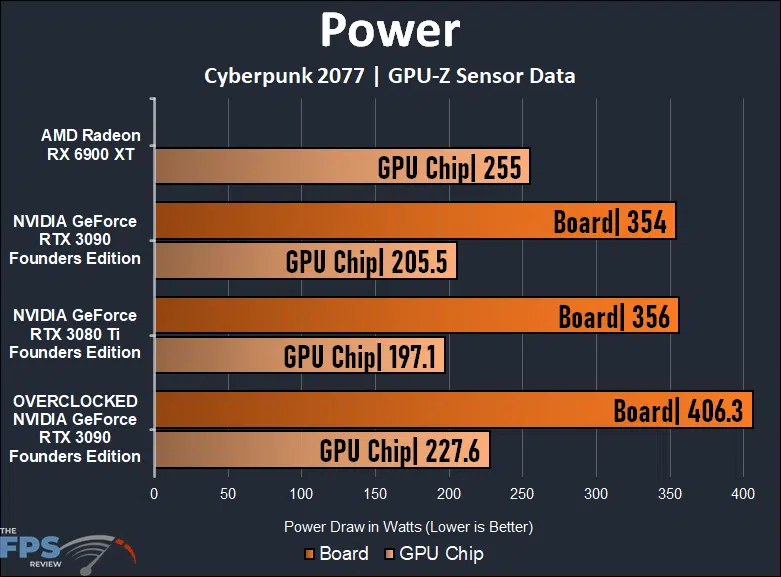
Naturally, overclocking means the board power and GPU chip power are going to increase, and they did increase, by a large degree on the GeForce RTX 3090 Founders Edition Overclocked. The board power shot up from 354W to 406W, an increase of 15% more board power, which includes the GDDR6X memory. Remember, this is a 350W TDP video card, and we have just made it a 400W+ TDP video card by overclocking it. The GPU chip power increases from 205W up to 227W, an increase of 11% power. The AMD Radeon RX 6900 XT still has the highest GPU chip power draw by far.
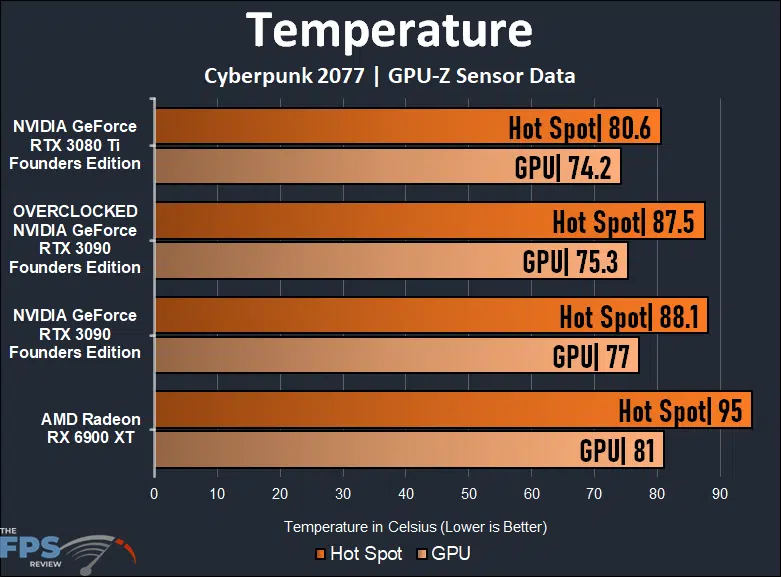
For our overclocking results, and the temperature results above, we have the fans set at 100% fan speed on the GeForce RTX 3090 Founders Edition video card. Even with the fans at 100% the overclocked GPU temp and hot spot temp are close to default with the fans set at default. This indicates a very hot running card, where even with the fans at 100% it is not doing the best job at keeping the board and GPU cool with the highest overclock.
This indicates a weakness in the Founders Edition design, as far as overclocking goes, it takes a very high fan speed to keep it near what it sits at not overclocked. Therefore, you will most likely be running hotter while overclocked, if you use an automatic fan speed. We suggest dialing in a faster than automatic fan speed on the Founders Edition if you are overclocking and pushing the card as high as possible, else, you may find that it gets very hot in your case and potentially thermal throttles.
Also, a point worth noting is that with the fans at 100% they are incredibly loud, and annoying. You would be able to hear them with this video card installed in a case, even with headphones on. The noise level they output at full RPM is very loud, this is understandable considering their size of 110mm and large fan blades, but they can get to 2620RPM which is both fast and loud. For comparison, on automatic at default settings, they are around 1715RPM or 65% while gaming.
Discussion (4 replies)
Join Discussion →Hello Brent, greetings from Spain.
I recently get myself a new system that includes the following components:
- RTX 3090 FE with new padding (extreme Odyssey) and Artic MX4 paste.
- I5 12600K
- DRR5 Corsair 5600Mhz 2x16 GB
-1000w Corsair 80 Plus Gold
- Msi Z690 A-Pro
-1Tb 980 Pro Samsung Nvme SSD
I want to OC my 3090 with MSI afterburner and i cannot understand completely your article.
I want to copy your OC setting on the afterburner, may you help me?
Just 114% Power limit, +140Mhz Core clock and +750 Mhz Memory clock is that right?
Thanks a lot love your work.
Yes - that should work, however, every card is different. You may have to adjust your core and memory clocks. @Brent_Justice also tests overclocks with fans at 100%, so you can switch over from Auto to Manual and set to 100% if you'd like.
I usually try to max out the core clock first (which will be in the +100 to +150 range), then raise the memory. Since GDDR6X has ECC, you won't crash right away - you'll see performance start to drop if you go too fast with it before it crashes.
Okei, i’ll try like that. I wanted to copy a know OC setup since i trust all the test that Brent has done. About the fans speed, a custom curve from 30% to 100% ( maxed out at 83 GPU degrees Celsius) will work?
Thanks for your reply.
@Brent_Justice could you gimme a hand mate? Thnks ?