
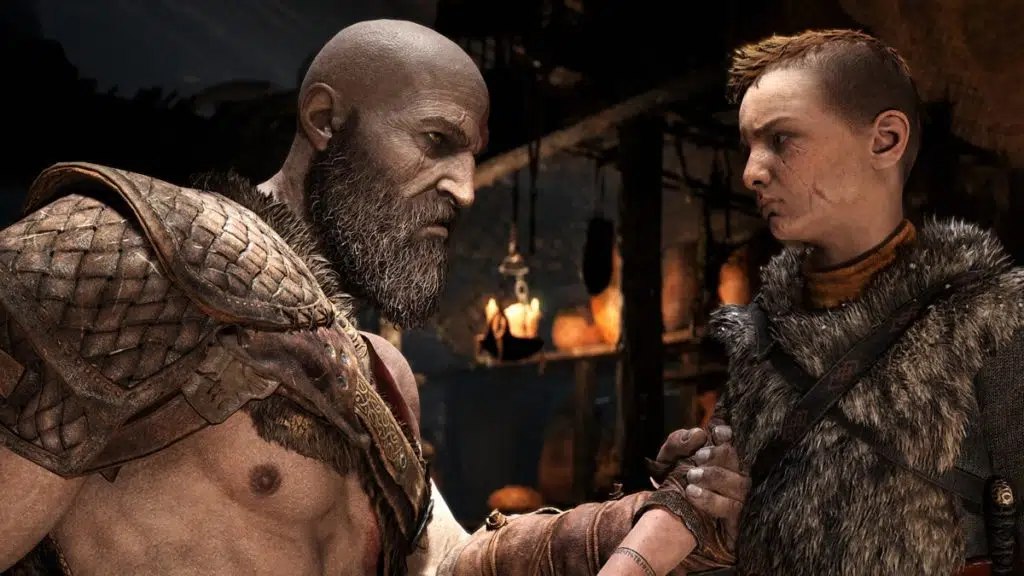
TechEpiphany has shared a new YouTube video that demonstrates how much of a boon modern upsampling technologies can be for gamers who have to cope with weaker graphics hardware. The video shows God of War hitting frame rates of over 30 FPS at 1080p on a Radeon 660M—a relatively weak RDNA 2 iGPU that can be found in select AMD Ryzen 6000 Series mobile processors (i.e., Ryzen 5 6600H, Ryzen 5 6600HS, Ryzen 5 6600U)—with the help of FidelityFX Super Resolution 2.0, the latest version of red team’s upscaling technology that leverages temporal techniques for greater image quality versus its predecessor. This iGPU features only six graphics cores and an ultra-low power specification of 15 watts but can run God of War at frame rates as high as 35 FPS under a combination of low, medium, and high settings settings with FSR 2.0 activated in balanced mode. Santa Monica Studio and Jetpack Interactive added the feature to the game last week as part of the 1.0.12 patch.
Unfortunately, FSR 2.0 in performance mode did not change performance, with frame rates still in the 30 FPS range in the same scene. However, when the scene changed from an outside forest to a home interior, frame rates improved from 35 to 38 FPS. The Radeon 660M is far below the recommended requirement of a Radeon RX 5700 for 1080P gaming with FSR 2.0. In addition, FSR 2.0 needs far more compute overhead than FSR 1.0 ever did due to the increased demands of its temporal scaling algorithm.
Source: TechEpiphany (via Tom’s Hardware)
Discussion (7 replies)
Join Discussion →Uh, congratulations I guess? They used every trick in the goddamn book, and only got to "almost playable" frame rates?
Maybe if you play with a controller you won't notice, but on mouse and keyboard this would still be unbearable.
It doesn't matter what the control scheme is, 30fps is not 60+ fps. It hurts the same way no matter what.
I've always found that the most noticeable part of low frame rates is the lag in mouse response as it is so precise.
The lite thumb joysticks on a console controller are horribly imprecise, so they hide some of the lack of frame rate.
Unfortunately not anywhere near enough. I've played too many controller-based games at 30fps on consoles, and getting to play some of those at 60+ fps (on either PC or a newer console) is a massive world of difference. You're right though, mouse input does suffer the most, given its extreme precision. Also a reason why I usually like to play with VSYNC off, cuz I don't like what VSYNC does to mouse feel. VSYNC off is not often a choice you get to have on consoles.
Just get some form of adaptive sync monitor (G-Sync, Free-Sync, VRR) and have the best of both worlds. V-sync off and no tearing.
Having experienced it myself, I would never go back. I consider it a must now.
Already using such a monitor on my PC. Got it last year (actually it's my second VRR monitor, I had one before that for less than a year, ended up selling it). I first experienced VRR in 2019. VRR is probably my favorite display technology of the last 20 years. Like you, I would never go back, and I too consider it a must-have feature on every display I get in the future.
VRR Is very nice. I think HDR probably takes my top as most impactful - it's a shame that it's really only ~great~ on consoles, and on the PC it sees very little use with a high bar for entry. VRR is a close second though.