
GPU Frequency NVIDIA GeForce RTX 3090 FE Ti
We need to find out what the default GPU clock speed of the video card is. With both NVIDIA and AMD GPUs, the GPU frequency is dynamic. NVIDIA has GPU Boost, and AMD has its Game Clock and Boost Clock quoted frequencies. Typically, GPUs today can exceed the “Boost Clock” dynamically. We need to find out what it actually runs at, so we can compare the benefit of overclocking. To do this we will record the GPU clock frequency over time while playing a game. We use Cyberpunk 2077 for this with a very long manual run-through at “Ultra” settings recording GPU-Z sensor data.
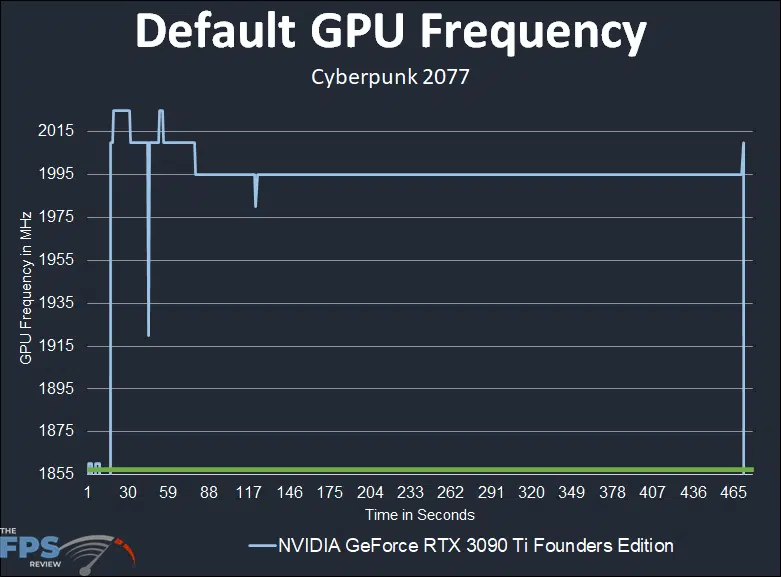
In the graph, above the green bar represents the official GPU Boost clock on the GeForce RTX 3090 Ti Founders Edition which is 1860MHz. We can see from this graph that the GPU Boost clock speed while gaming is operating well above the official quoted GPU Boost clock. It starts off above 2GHz but then drops down to a very consistent and sustained 1995MHz, flat-lined.
First of all, this flat-line consistent performance is unique to see, because the GeForce RTX 3090 did not behave like that, it fluctuated more. However, on the GeForce RTX 3090 Ti Founders Edition it seems to be locked in pretty tightly. Also, at 1995MHz the video card is operating well above the GPU Boost of 1860MHz, it’s 135MHz higher or 7%. The GeForce RTX 3090 Founders Edition, for example, runs at around 1770MHz on average. Therefore, the GeForce RTX 3090 Ti Founders Edition is running about 225MHz or 13% higher GPU Clock. That’s a pretty decent clock speed increase.
GPU-Z Sensor Data
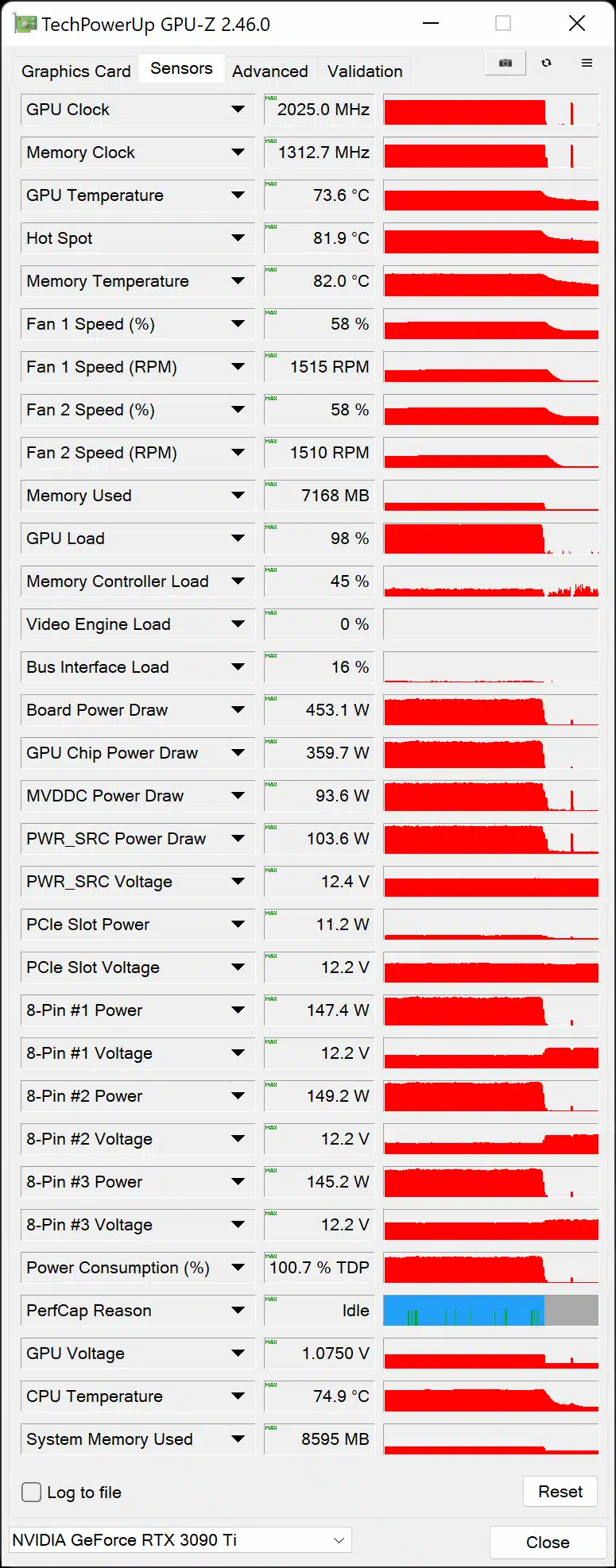
One thing that we did notice is that the GPU Voltage is running lower on the GeForce RTX 3090 Ti Founders Edition versus the GeForce RTX 3090 Founders Edition. On the GeForce RTX 3090 Ti Founders Edition GPU Voltage is at 1.0750V and on the GeForce RTX 3090 Founders Edition it is 1.0810V. Therefore, it seems NVIDIA was able to lower the voltage a bit, which will help with a reduction in temperatures.
Discussion (8 replies)
Join Discussion →It's actually more of an improvement than I expected, but not enough to make me buy one over an existing RTX 3090. Furthermore, I think that while it's a great card, I'm not sure it makes sense to buy at this late stage of Ampere's life cycle. Aren't we supposed to see its successor late this year?
Thanks @Brent_Justice for the great review.
I couldn't rightly recommend one of these to anyone unless they had the money laying around and really wanted it now, especially since the next-gen should be out sometime in the next 6 months. Anyone with a 3080 Ti or better can potentially OC their cards for almost the same performance.
However, I was able to use the EVGA step-up program to upgrade from a 3090 to an FTW3 Ultra 3090 Ti. I figured in for a penny, in for a pound, and went ahead and did it. I've been really happy with it. For the 1st time since I've gotten into 4K gaming (~ 4-6 years ago), I can just leave everything at stock settings. This card replaced a Suprim X 3090 that's now in my other rig and performs the same at stock vs. when I was overclocking that card. It's been so long since I've been able to game without all my case fans cranked that I'd forgotten how nice it can be. The only caveat, as Brent said repeatedly, is that DLSS is still needed if cranking ray tracing settings to the max in demanding games and wanting to go over 60 FPS. I'm o.k. with that since the games I play have DLSS 2.0 and the quality setting looks great to me. I've tinkered with overclocking it but the gains are minimal as it's fairly optimized right out of the box and I see it boost to 1925 MHz-2010 MHz while not exceeding 70c. For me, the fans rarely go more than 82% and are even able to drop into the 50s-60s now and then-same for temps. I spent a lot of time gaming on it last week and can confirm. ;)
For me, it's been like upgrading from a tricked-out V6 to a well-built midsize V8, without the extra stuff to do the same amount of work.
Same here. Card runs much cooler than my non overclocked EVGA 3080 Ti I stepped up from as well.
Agreed. I was only expecting like 2-5% at most.
This is certainly the greatest card of this generation. Only problem is, this generation is almost over. If you buy one of these now, you are going to have 40xx cards on the shelves in the not too distant future that perform better for less money.
That's why I generally buy at the beginning of a new product cycle when new architectures are released.
Same.
It's also the hardest time to buy :p
That remains to be seen about the cost. I have no regrets stepping up to my current card, but I have a feeling there is going to be the same issue with inventory and price of the new cards as their was with the 3000 series cards when they were launched.
Agreed @Niner51 . If it wasn't for the step-up I wouldn't have tried to even get the 3090 Ti I got but now but I'm already thinking about how my next card is likely to be an EVGA 4090 of some sort with plans to upgrade it down the road via the same path again. For now, though, I'm happy I can wait it out and let the market settle. This will be the 1st new GPU launch in years that I won't be scrambling to get something at around launch.
It'll be nice to sit back and just watch how things develop, especially since NV has changed its rollout strategies considerably since Maxwell. I remember how I was shocked how the 2080 Ti came out relatively early during Pascal and they never really released a more powerful consumer card for that gen and even, in the end, there was a great deal of speculation about what coming next after the 2080 Super came out. Ampere, in terms of release progression, was a bit more normal but who knows what NV is really planning for the next.
From pandemic to supply chain to the battle of fab dominance, and competition, there's a lot in play that can affect how the next-gen will be rolled out. Plus we could also see some kind of unexpected random surprise with the next round of consoles too since news of them should start to ramp up about the 2nd year of the 40 series cards. AMD has been riding pretty high with MS and Sony while NV has partnered with Nintendo but things do change in those markets as well.