
Ray Tracing Performance
We are going to focus on Ray Tracing 1440p gameplay performance with the NVIDIA GeForce RTX 3090 Ti Founders Edition video card. We will include DLSS and FSR performance on the same graph in the games that are supported. We will use DLSS on NVIDIA GPUs and FSR on AMD GPUs. For video card comparisons we are using an NVIDIA GeForce RTX 3090 Founders Edition and NVIDIA GeForce RTX 3080 Ti Founders Edition video card and an AMD Radeon RX 6900 XT video card.
Dying Light 2
Dying Light 2 was released in February 2022 on the PC and uses Techland’s C-Engine. The game supports Ray Tracing, DLSS and FSR. This game supports Ray Tracing environmental effects including Ray Traced Soft Shadows, Ray Traced Ambient Occlusion, Ray Traced Global Illumination, and Ray Traced Reflections. We utilize the built-in preset option to set “HIGH QUALITY RAYTRACING” which enables the games highest graphics settings plus the environmental effects explained above at the highest values. The game is run in DX12 Ultimate mode with ASYNC Compute turned on. For our benchmark, we are using a custom manual run-through at the end of the game hopping between rooftops, as well as free-roaming on the ground city level, as well as a forested area, in the daylight.
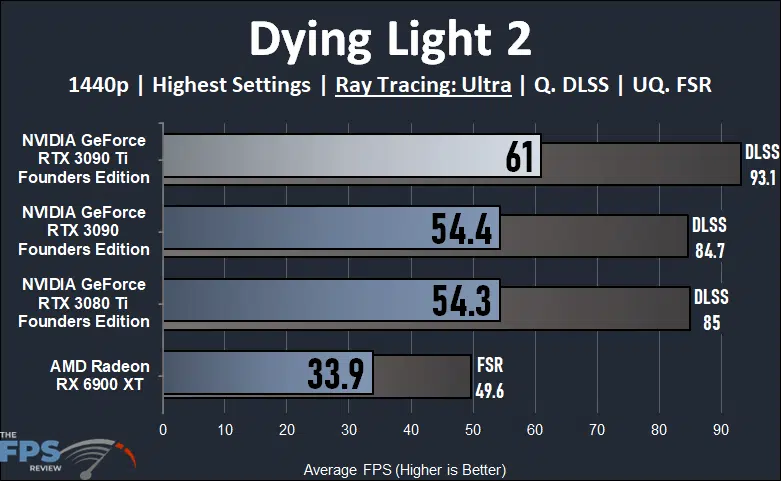
In Dying Light 2 we are running the game at 1440p, but we have the highest quality setting of Ray Tracing enabled now. As you can see above, only the GeForce RTX 3090 Ti Founders Edition allows the game to be playable at 60FPS with full Ray Tracing and without having to use DLSS. However, if you do include DLSS that will improve performance by 53% and jumps to 90FPS performance.
At 61FPS the GeForce RTX 3090 Ti FE is 12% faster than the GeForce RTX 3090 FE and RTX 3080 Ti FE. The RTX 3090 Ti FE is 80% faster than the Radeon RX 6900 XT.
Far Cry 6
Far Cry 6 was released in October of 2021 and uses the Dunia Engine. We utilize the built-in benchmark for testing. We have the HD Texture pack installed and turned on. We utilize the “Ultra” graphics preset which sets all options to the highest game settings. This game supports Ray Tracing via two DXR settings, one for Reflections and the other for Shadows, we turn on both for testing. This game supports FSR upscaling.
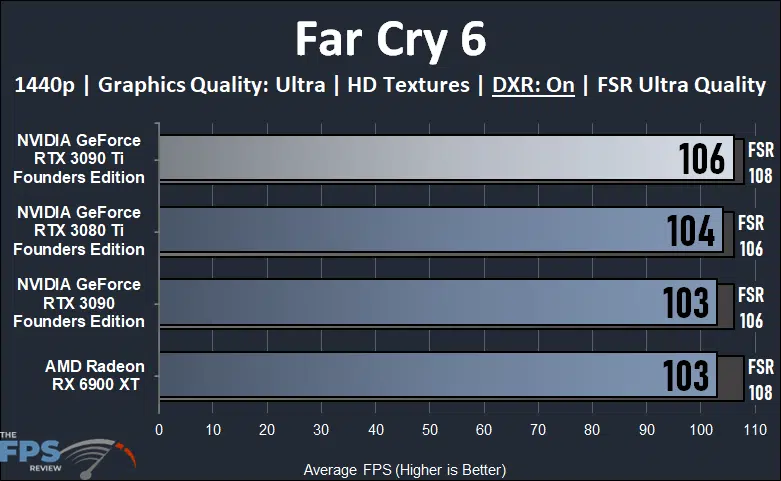
In Far Cry 6 we actually run into a CPU bottleneck in this game with these fast video cards. Even at 1440p with all the DXR options turned on the video cards bunch up close to each other and our Ryzen 7 5800X is actually the thing holding back performance now. The GeForce RTX 3090 Ti FE is very playable at 106FPS and doesn’t need FSR, but with it, we get a little bump. In fact, FSR is only providing a small bump at 1440p because again the CPU is holding it back. Remember, FSR renders at an even lower resolution, and upscales, so more CPU bottlenecking is occurring at a lower resolution when it’s doing that. Therefore, in this game, you are able to run at 4K with DXR Ray Tracing turned on and the game will be playable on every video card here even at 4K and Ray Tracing.
Cyberpunk 2077
Cyberpunk 2077 was released in December of 2020 and uses the REDengine 4. We have the game patched to version 1.52 and perform a long manual run-through driving in the game’s open world. We test using the Graphics Preset option to set graphics settings. We use the Ray Tracing Graphics Preset of either: “Ray Tracing: Low”, or “Ray Tracing: Medium” or “Ray Tracing: Ultra” as indicated. This game supports DLSS and FSR.
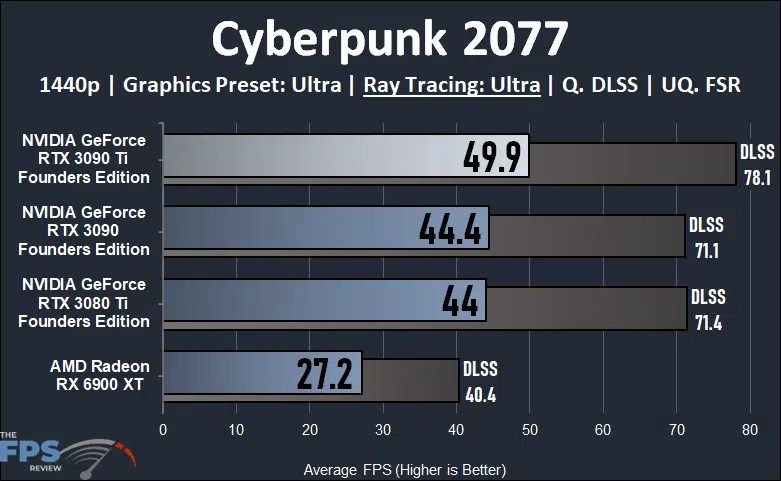
In Cyberpunk 2077 we are running the game at 1440p but with the highest quality Ray Tracing option turned on. This game once again needs DLSS or FSR to even be playable with Ray Tracing at 1440p. The GeForce RTX 3090 Ti FE is the fastest video card here, but without DLSS it still isn’t playable with full Ray Tracing quality at 1440p. However, enable DLSS and the game is very playable at 78FPS, an increase of 57%.
At 50FPS the GeForce RTX 3090 Ti FE is 12% faster than the GeForce RTX 3090 FE and RTX 3080 Ti. The RTX 3090 Ti FE is 83% faster than the Radeon RX 6900 XT.
Watch Dogs Legion
Watch Dogs Legion was released on the PC in October of 2020 and uses the Disrupt game engine. We utilize the built-in benchmark for testing. We have the HD Texture pack installed and enabled for testing. We use the built-in graphics preset of “Ultra” for testing. We utilize the “Ultra” preset quality option for Ray Tracing. This game supports DLSS upscaling.
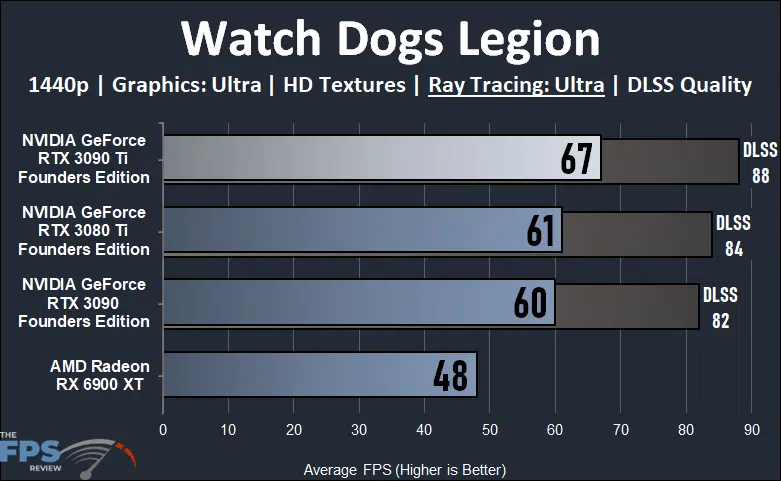
In Watch Dogs Legion we are running the game at 1440p with the highest level of Ray Tracing. Now in this game the GeForce RTX 3090 Ti FE is very playable with full Ray Tracing at 1440p without the need for DLSS. So is the RTX 3090 and RTX 3080 Ti, but the RTX 3090 Ti FE has higher averages, which means higher minimums. With DLSS performance improves by 31% up to 88FPS.
At 67FPS the GeForce RTX 3090 Ti FE is 12% faster than the GeForce RTX 3090 FE. The RTX 3090 Ti FE is 40% faster than the AMD Radeon RX 6900 XT, which is not playable.
Metro Exodus Enhanced
Metro Exodus Enhanced is being run with Shading Quality at “Extreme” and Ray Tracing at “Ultra.” This is a demanding game, that heavily focuses on Ray Tracing utilization, including Global Illumination. We are utilizing the built-in benchmark.
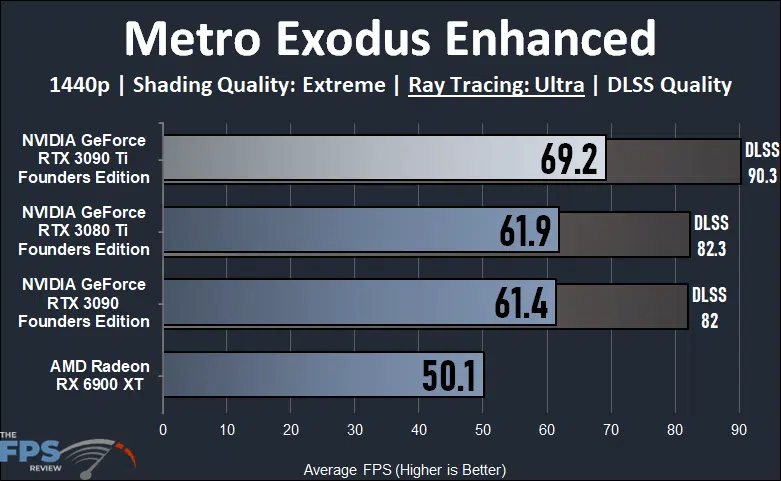
In Metro Exodus Enhanced we are running the game at 1440p and with the highest level of Ray Tracing. In this game the GeForce RTX 3090 Ti FE is very playable at near 70FPS average, well over the other cards here. It also supports DLSS which can improve performance by 30% and brings it up to 90FPS.
At near 70FPS the GeForce RTX 3090 Ti FE is 13% faster than the GeForce RTX 3090 FE. It’s 38% faster than the AMD Radeon RX 6900 XT.
Discussion (8 replies)
Join Discussion →It's actually more of an improvement than I expected, but not enough to make me buy one over an existing RTX 3090. Furthermore, I think that while it's a great card, I'm not sure it makes sense to buy at this late stage of Ampere's life cycle. Aren't we supposed to see its successor late this year?
Thanks @Brent_Justice for the great review.
I couldn't rightly recommend one of these to anyone unless they had the money laying around and really wanted it now, especially since the next-gen should be out sometime in the next 6 months. Anyone with a 3080 Ti or better can potentially OC their cards for almost the same performance.
However, I was able to use the EVGA step-up program to upgrade from a 3090 to an FTW3 Ultra 3090 Ti. I figured in for a penny, in for a pound, and went ahead and did it. I've been really happy with it. For the 1st time since I've gotten into 4K gaming (~ 4-6 years ago), I can just leave everything at stock settings. This card replaced a Suprim X 3090 that's now in my other rig and performs the same at stock vs. when I was overclocking that card. It's been so long since I've been able to game without all my case fans cranked that I'd forgotten how nice it can be. The only caveat, as Brent said repeatedly, is that DLSS is still needed if cranking ray tracing settings to the max in demanding games and wanting to go over 60 FPS. I'm o.k. with that since the games I play have DLSS 2.0 and the quality setting looks great to me. I've tinkered with overclocking it but the gains are minimal as it's fairly optimized right out of the box and I see it boost to 1925 MHz-2010 MHz while not exceeding 70c. For me, the fans rarely go more than 82% and are even able to drop into the 50s-60s now and then-same for temps. I spent a lot of time gaming on it last week and can confirm. ;)
For me, it's been like upgrading from a tricked-out V6 to a well-built midsize V8, without the extra stuff to do the same amount of work.
Same here. Card runs much cooler than my non overclocked EVGA 3080 Ti I stepped up from as well.
Agreed. I was only expecting like 2-5% at most.
This is certainly the greatest card of this generation. Only problem is, this generation is almost over. If you buy one of these now, you are going to have 40xx cards on the shelves in the not too distant future that perform better for less money.
That's why I generally buy at the beginning of a new product cycle when new architectures are released.
Same.
It's also the hardest time to buy :p
That remains to be seen about the cost. I have no regrets stepping up to my current card, but I have a feeling there is going to be the same issue with inventory and price of the new cards as their was with the 3000 series cards when they were launched.
Agreed @Niner51 . If it wasn't for the step-up I wouldn't have tried to even get the 3090 Ti I got but now but I'm already thinking about how my next card is likely to be an EVGA 4090 of some sort with plans to upgrade it down the road via the same path again. For now, though, I'm happy I can wait it out and let the market settle. This will be the 1st new GPU launch in years that I won't be scrambling to get something at around launch.
It'll be nice to sit back and just watch how things develop, especially since NV has changed its rollout strategies considerably since Maxwell. I remember how I was shocked how the 2080 Ti came out relatively early during Pascal and they never really released a more powerful consumer card for that gen and even, in the end, there was a great deal of speculation about what coming next after the 2080 Super came out. Ampere, in terms of release progression, was a bit more normal but who knows what NV is really planning for the next.
From pandemic to supply chain to the battle of fab dominance, and competition, there's a lot in play that can affect how the next-gen will be rolled out. Plus we could also see some kind of unexpected random surprise with the next round of consoles too since news of them should start to ramp up about the 2nd year of the 40 series cards. AMD has been riding pretty high with MS and Sony while NV has partnered with Nintendo but things do change in those markets as well.