
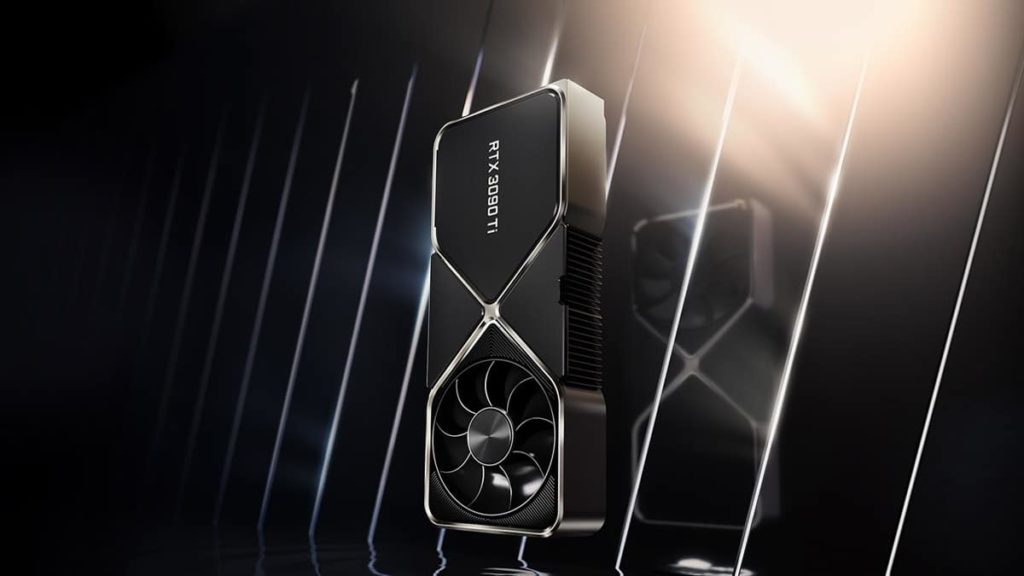
NVIDIA may be prepping an especially monstrous product for PC gamers.
Tweets shared by leaker kopite7kimi today have alluded to “the beast,” a flagship Ada Lovelace product that will not only feature a new board design in the form of the PG137, but a particularly extreme set of specifications.
These include 18,176 CUDA cores, 48 GB of GDDR6X memory running at 24 Gbps speeds, and an incredible TBP of 800 watts. This figure is nearly twice as high as the graphics card power that NVIDIA has listed for its current flagship, the GeForce RTX 3090 Ti, which sits at 450 watts.
"the beast"
— kopite7kimi (@kopite7kimi) July 25, 2022
PG137-SKU0
AD102-450-A1
18176FP32
48G 24Gbps GDDR6X
total board power ~800W
The GeForce RTX 3090 Ti features 10,752 CUDA cores and 24 GB of GDDR6X memory in comparison.
Kopite7kimi didn’t have much more to share regarding NVIDIA’s “beast,” but the alleged power demands would suggest that the graphics card will require dual 16-pin power connectors. This product may also be one of the chief reasons as to why NVIDIA decided to develop a new triple-fan cooler design for its GeForce RTX 40 Series, which was teased by kopite7kimi back in June.
In a separate tweet, kopite7kimi has suggested that NVIDIA might be sharing official details relating to the GeForce RTX 4090 “soon.”
About RTX 4090, we will see her soon. Nothing to say.
— kopite7kimi (@kopite7kimi) July 25, 2022
NVIDIA’s “beast” is speculated to be a Titan-class graphics card. The company’s most recent Titan product designed for gamers was the GeForce Titan RTX, which released in December 2018 for $2,500.
Source: kopite7kimi
Discussion (19 replies)
Join Discussion →I caught a Jayztwocents video that he stated from one of his sources that these cards could be delayed. This would not surprise me. Also 800W is starting to get to space heater territory..
The new RTX 5090Ti now in electric fireplace form factor!
That is truly bonkers. We need someone to make a BIG efficiency leap.
I think...
neither major camp has been ignoring efficiency, I don't think. It's just that we're in that wierd spot where the nodes aren't jumping as quickly as they were, so you have that leading to smaller gains from manufacturing that you once had.
That said, the competition hasn't stopped, and our appetite for progress has only gotten larger.
So the only avenue left is to stack on more cores and crank up the power. Eventually that too will hit limits - monolithic chips will get too big, multichip module interposers will get too complicated, data transfer speeds will eventually start to cap things off... something.
But yeah, I'm pretty sure if you were to look at stock designs over the last few generations, for a given level of performance, efficiency has gone up. Often by a good bit. It's just that performance hasn't really followed, so they throw more cores and push power limits.
Going to need a PSU just for your GPU...
Kind of reminds me of that time Intel demoed their 28 core Xeon at Computex 2018...
...and neglected to tell anyone it required an industrial chiller to stay cool.
They get more efficient most generations. What we're looking at is not an efficiency regression, in terms of getting lower performance per watt, but rather seeing an increase in the maximum power draw limits that accompany some performance gains.
Unlike an efficiency regression - or even efficiency improvement (velocity) regression, we're just seeing higher-performance options being available for those that are willing to foot the cost of purchasing and running them.
For those worried about efficiency or just energy thriftiness, lower-powered models are certainly available :)
I had posted this in the funniest pic thread but seems appropriate here as well.
[embedded media]
GeForce RTX 4090? Titan?
Great way to turn those unused hydronic baseboard heaters into a central GPU heating system. Not terribly efficient but MOAR FPS!
All of this has happened before, and all if it will probably happen again - with the improvement in both wired and wireless interlinks, for those that need on-site computing power, a move back toward centralized big iron starts making sense. Even at home!
And why not integrate it into HVAC? If there's a heating need but not a compute need - sell the compute!
I sure hope there's an implicit smiley face in there. Sometimes it's hard to tell. ;)
Nope - serious, if not somewhat far-fetched at the moment.
I don't think I posted about it but I remember reading about 6 months ago about a country, I think in the EU, that had a data center that was plumbed into the local community heating setup.
They need to bring the Titan branding back. It was never cheap which should alleviate some of the confusion about the pricing and performance for them. I know the x90 cards predated them were halo products unto themselves and used to feature 2x GPUs on the same PCB but the Titan nomenclature always separated it from the pack. The whole stack is just so confusing now between x80, x90, TI, and Super, and then the absence of the Titan. From Maxwell to now NV has really gotten messy with its branding, especially when the refresh cycles kick in towards the end of a product generation.
This I agree with, it would have made much more sense for the 3090 / 3090 Ti, and would have highlighted the main driver for the product - the extra VRAM for content creators. Though I do get the 8K angle, from a marketing perspective. Don't agree with it, but it was valid.
Makes it confusing for reviewers and consumers - as well as for competitors and competitor marketing teams.
Not sure if that really works for Nvidia, but it does allow for some flexibility for the marketing / branding folks when dealing with competition, reception, and production issues.
Not really there were companies that were making 'heaters' for offices that were nothing but compute engines they would pay you to host for the benefit of generating heat in colder climates for effectively free. They even looked like fancy wall mounted radiators. Not sure if it ever went anywhere. Lets see if my google foo can find them...
No I can't find it but it was a thing... dang.