

Raja Koduri spoke with Gadgets 360 about a number of topics spanning from current and upcoming products, to thoughts about the future of the PC industry. In the interview, Raja Koduri talks about multiple goals for the Intel Arc graphics cards and integrated graphics solutions. One topic that has been on the minds of many PC builders is the increasing amount of power that modern high-end graphics cards use. When asked about this he explained that it was a goal to provide optimal performance, sticking with one power connector, while aiming for a “sweet spot” of 200-225 Watts of power consumption.
“High-end has no limit right now. What is the definition of high-end? Is it 600 Watts? Obviously our partners and our customers want some halo SKUs for bragging rights, and we always like to figure out ways to enable that. But my priority at this point is getting that core audience, with one power connector. And that can get you up to 200-225W. If you nail that, and something a little above and a little below, all that falls into the sweet spot.”
Raja Koduri
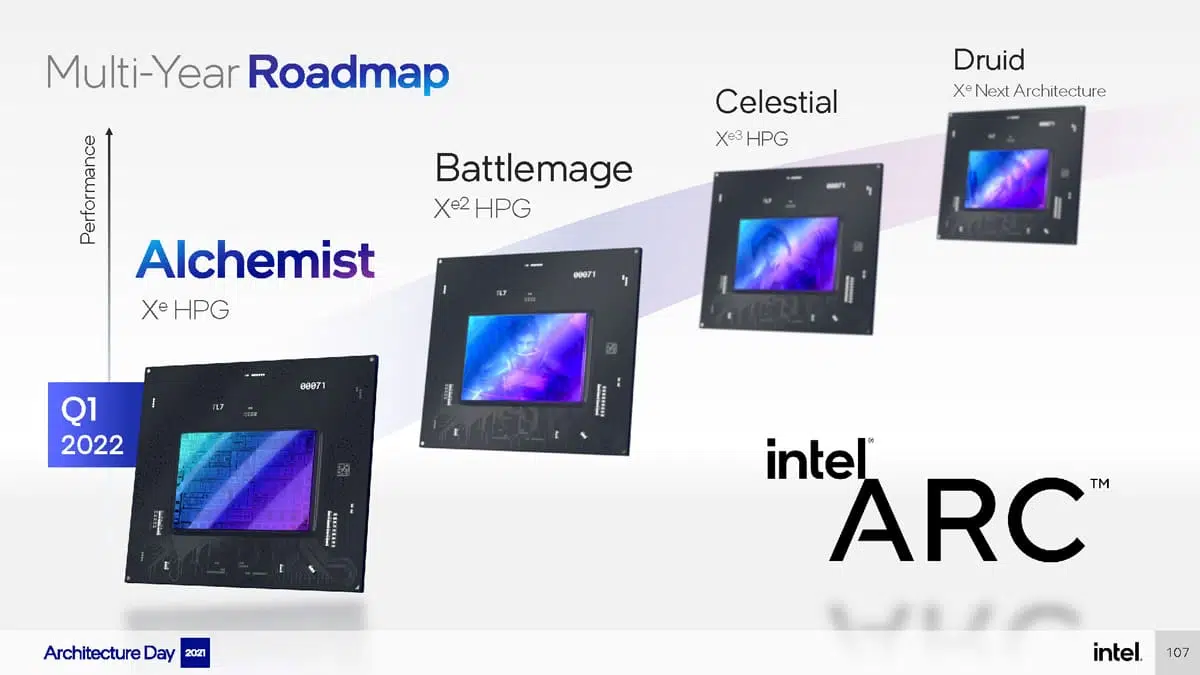
He does share that ultimately Intel does plan for the Arc GPU line to compete at every level but also acknowledges the gap between low-end discreet GPUs and more powerful CPU-integrated graphics is shrinking. He said that he believes some segment of the low-end market will go away but there will always be BOM factors at play in determining the cutoff between integrated and discreet solutions. Raja also shares that by perhaps 2024 we’ll begin to see a significant shakeup in the PC industry with integrated solutions.
“My hope, frankly, even though I am a bit conflicted on this, is that integrated will eliminate some of the bottom end of the discrete [GPU market]. I think that’s a good thing for consumers because you get smaller form factors, lower power and lower cost. A discrete GPU needs memory that you have to pay for, and power delivery [circuitry], so there is a bill of materials cost. With integrated, you already have memory for the CPU that you’re sharing, and power delivery. So overall cost-wise and performance-per-dollar-wise it will be so much more compelling than a CPU plus a discrete GPU. This is what Meteor Lake’s focus is.”
Raja Koduri
In terms of competing with high-end cards such as the recently released NVIDIA GeForce RTX 4090 he explains that while it is a goal to get there, it is also a priority to stay focused on lower power consumption.
Meteor Lake
Meteor Lake is the next line of processors that will succeed Raptor Lake. As Raja Koduri talks about it he shares that the next node of Advanced Xe graphics had already been ready for rollout but delays in moving from 10nm to 7nm (aka Intel 4) prevented its debut.
“Meteor Lake was always the plan but what happened, and this is something we have publicly said, was delays in our Core CPU roadmap and 10nm process. We stayed on 10nm for a couple more generations [than intended]. Advanced XE graphics were on the next node, ready to go, but the Meteor Lake platform is the one that is going to ship that new Xe graphics and all those great features”
Raja Koduri
He adds that Meteor Lake will also see Intel mix-matching architectures such as graphics, I/O, and multiple fabbed processes similar to what other competitors have done. Intel plans to begin shipping Meteor Lake processors beginning in 2023.
“Yes. With Meteor Lake, you’ll see that mixing and matching. Graphics and IO can be on different process technologies.”
Raja Koduri
Discussion (4 replies)
Join Discussion →I think he’s kinda missing the picture. Which is typical for Raja.
He states the sweet spot is 200-250W because it only has one power connector.
Both of those statements happen to be true, but it isn’t that people go out and try to buy GPUs with just one connector. They buy the best the can afford, and that old $250+/- price bracket happens to be this power point.
Based on my energy bill lately I would be very happy if Intel were to come up with a much higher fps/watt solution in a discreet card that has reasonable 4k fps.
My understanding is that the biggest energy suck/heat creator is ram cells being shorted out to set them back to 0. I suspect a holy grail of computer would be a way to eliminate this or find a way to recycle the energy which would lower heat and energy costs significantly.
While I want to play my games with everything maxed out and ay 4k (or eventually 8k) I dont want to go into debt to the local energy company.
I want to go 150mph and get 45MPG while doing it.
Some things are just mutually exclusive until the technology can catch up.
Yea really... tell that to modern sport hatch backs compared to sport cars from the 1960's. Technology hasn't made them faster, more reliable, and more powerful, all while consuming considerably less fuel. Sometimes by a factor of 3 or more.
It'll get there. Imagine if we just gave up because nobody has done it yet.