
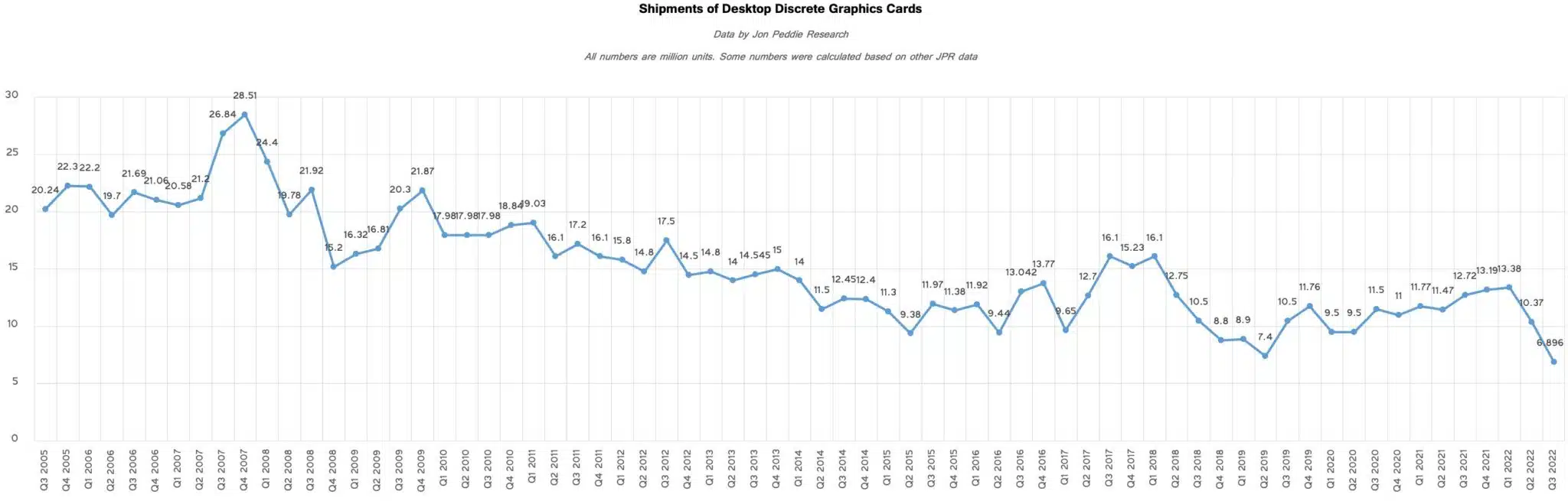
A new paywalled report from Jon Peddie Research shows that desktop graphics card sales have hit their lowest point since 2005. In the “JON PEDDIE’S 2022 GPU ROUNDUP” report, statistics show a major downward trend for discreet graphics card shipments with a decrease of 42 percent since Q3 2021. The lack of demand for GPUs by crypto miners is largely attributed to the decline from last year, which saw roughly 12.72 million units shipped then. This current decline has happened despite AMD, NVIDIA, and Intel, all shipping a new generation of cards in Q3 2022.
According to the report (via Tom’s Hardware), there were approximately 6.9 million desktop cards shipped in Q3 2022, along with a similar quantity of discreet laptop GPUs for a grand total of around 14 million units. By comparison, the report shows a total of 20.24 million discreet desktop GPUs shipped back in Q3 2005, or nearly 3x as the same time in 2022. GPU shipments reached their all-time high back in Q4 2007 with 28.51 million units shipped but have since steadily declined.
During this time, from 2005-2022, NVIDIA has managed to not only maintain a lead over AMD but has in fact gained more ground and now has about 86 percent of the market share. Intel surprisingly, with its limited amount of shipped Arc graphics cards, managed a 4 percent foothold while AMD lost close to 10 percent of its market share.
Many factors to consider
Despite seemingly clear numbers to look at in the report there is still a lot to consider with the current state of GPU sales. In the last few years, sales were driven by crypto mining plus the pandemic as users sought to upgrade and/or build new PCs while at home. During this time numerous other factors such as supply chain issues, limited fab production, tariffs, and economic recessions, all combined to affect the ability of manufacturers to develop and ship products. One last detail regarding desktop graphics card sales that cannot be ignored is price. MSRP for desktop GPUs has reached all-time highs leaving many to reconsider their potential purchases and it only gets worse for the average user when they have to contend with many sellers raising prices even further due to market demand.
Discussion (19 replies)
Join Discussion →Guess people do vote with their wallet
Just saw an article that the big players all cut orders from TSMC. Guess flying off the shelves in only some places isn't enough.
And, yet, AMD 7000 series are selling out the second drops occur.
Title should be "Nvidia GPU sale have hit their lowest point since 2005".
Integrated graphics have become much more capable over the years and have all but eliminated most low-end discrete GPU purchases, which makes interpretation somewhat less straightforward.
If you make two cards a week of course they sell out.
Integrated graphics was good enough for office work and basic usage for 15 years, but it's still not good enough for anything else, I don't see a change there.
Well, i suppose there is a price point that will start cracking the market, even though appearances seem to be the opposite. When a gaming computer ends up being multples of top end consoles you know you are being ripped off. Hell the gpu alone can be multiples of top end consoles.
Also used to be that you could put together your pc for very near in price ( could be even lower if you got some stuff on sale) to the equivalent of oem , you could tweak it how you liked and you would still be right there in price, or very close. This hasn't been so for very long, I know, but it gotten so bad.
The prices are out of whack. Doesn't help that neither Nvidia nor AMD want to focus their engineering into price/ performance... Nvidia is.much much worse, but AMD ain't that great either. Focus on saving like, how about a mid/ low range card, with a mere 4gb memory, but of the fastest, widest imaginable ( low amount should keep price down), and they come up with some decent compression techniques... Something like this, a very powerful very cheap 1080 or 1440 card or whatever, not 4k but price to sell at 199, i mean cheap. What they do instead is come up with a mammoth card, and cut it down to oblivion, but it doesn't even scale too well in price, performance.
I
I agree, and it seems very much intentional. There is no technological reason as to why AMD doesn't produce APUs at cosole level power. I guess like always they are waiting for Intel to go for it and be successful, so then they can try and fail hard since Intel will have all they players tied down.
You can play a bunch of games on an APU. I logged over 1000 hours of gaming on my A10 7870k
This happens when you only release cards at the highest price points, keep raising prices across the board, and you decimate the price structure that previously held the most popular cards. @Uvilla is right.
I don’t think it has anything to do with IGP.
NVidia has what, 85% market share now? You may be entirely correct, but even at “sellout instantly” AMD doesn’t have enough cards to make a dent in overall sales right now.
An APU is not the same thing as an iGPU. APU still has real graphics hardware. You can game on an APU. You can't do jack sh1t on an iGPU.
That’s the low to low-mid range market now isn’t it? No need need for, say, a GTX-3030 or maybe even a 3050 when you have a $175 Ryzen 5700G.
APU is a marketing term for AMD's CPUs with integrated graphics. E.g., Ryzen 7000-series CPUs are APUs. Intel has its own marketing terms, but they're both IGPs (or IGPUs). Wikipedia uses <em>integrated graphics processing unit</em> to encompass various vendor implementations, including but not limited to those by AMD and Intel, and is thus in agreement.
At any rate, low-end discrete GPUs have basically evaporated from the market. Regardless of how awesome or terrible people think IGPs are, it seems like an oversight to dismiss their potential impact on discrete graphics card sales from 2005 to present. But the recent slump? Yeah, I doubt IGPs were much of a factor.
I wonder if sales numbers include laptops with dedicated GPU's in them, or only cards sold individually.