
Gameplay Performance at 1080p with Ray Tracing
We are going to focus on 1080p gameplay performance with Ray Tracing on the Intel Arc A770 Limited Edition video card on this page. We will include XeSS, FSR, and DLSS performance on the same graph in the games that are supported. For video card comparisons we are using an EVGA GeForce RTX 3060 XC BLACK GAMING, MSI Radeon RX 6600 XT GAMING X, and SAPPHIRE PULSE Radeon RX 6600 GAMING.
Forspoken
Forspoken was released on January 24th, 2023, on the PC and uses the Luminous Engine. The game supports all upscaling methods, including NVIDIA DLSS, AMD FSR, and Intel XeSS, and Ray Tracing. We are going to customize the settings and enable the highest graphics settings, including Ultra High Texture Memory. We are going to enable both Ray Tracing options, Shadows, and Ambient Occlusion. We use the built-in benchmark.
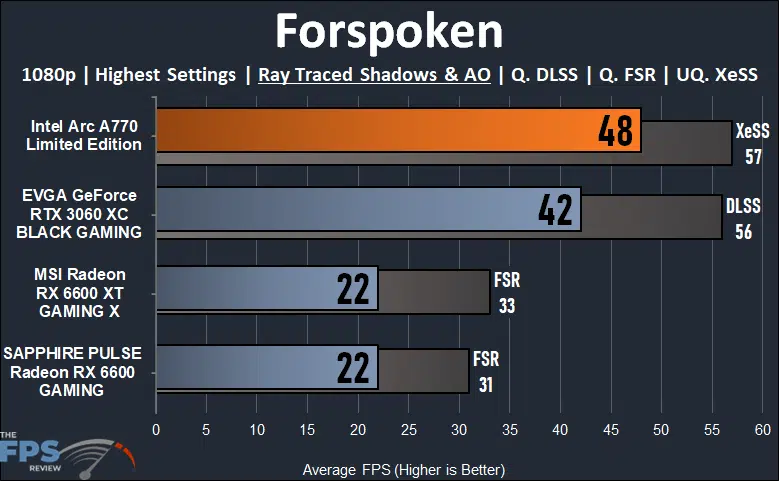
Now we are testing at 1080p with Ray Tracing, and we are hoping some games will be playable with Ray Tracing without the need for upscaling. Starting in Forspoken this game is new and demanding with Ray Tracing. While none of the cards are playable with Ray Tracing, there are two cards that are playable with upscaling, and the Intel Arc A770 Limited Edition is one of them. In fact, even without upscaling, the Intel Arc A770 is the fastest video card, outperforming the GeForce RTX 3060 by 14% with Ray Tracing. This again boads well for its Ray Tracing performance. Turning on Intel XeSS boosts performance to 57FPS and this game is very smooth and playable with Ray Tracing at 1080p.
F1 2022
F1 2022 was released on June 28th, 2022 on the PC and uses Codemasters Ego engine. The game supports Ray Tracing, DLSS, AMD FidelityFX, and FSR. We are going to run the game with the highest quality settings of “Ultra High” and TAA+FidelityFX. We will enable all Ray Tracing options in the game to “On.” We will enable DLSS and FSR as needed at the Quality setting for both. We will utilize the built-in benchmark in the Imola track, in dry conditions with a far chasing cam.

Remember, F1 2022 performance wasn’t so great compared to the competition at 1080p on the Intel Arc A770, but turn on Ray Tracing and now it competes very well. It was at the bottom of the graph at 1080p without RT, but with RT it is near the top. That’s a testament to its Ray Tracing performance. With RT enabled, the Intel Arc A770 is a bit faster than the Radeon RX 6600 XT but is 16% slower than the GeForce RTX 3060. However, once we turn on FSR performance jumps well over 60FPS and is very playable at nearly 80FPS with Ray Tracing.
Dying Light 2
Dying Light 2 was released in February 2022 on the PC and uses Techland’s C-Engine. We have updated the game to patch 1.90. The game supports Ray Tracing, DLSS, and FSR2. This game supports Ray Tracing environmental effects including Ray Traced Soft Shadows, Ray Traced Ambient Occlusion, Ray Traced Global Illumination, and Ray Traced Reflections. We utilize the built-in preset option to set “HIGH-QUALITY RAYTRACING” which enables the game’s highest graphics settings plus the environmental effects explained above at the highest values. The game is run in DX12 Ultimate mode with ASYNC Compute turned on. We use the built-in benchmark.

In Dying Light 2 the Intel Arc A770 does very well, once again beating the GeForce RTX 3060 in performance by 15%. When we turn on Intel XeSS upscaling, performance boosts to nearly 70FPS at 1080p with maximum Ray Tracing in this game.
Far Cry 6
Far Cry 6 was released in October of 2021 and uses the Dunia Engine. We utilize the built-in benchmark for testing. We have the HD Texture pack installed and turned on. We utilize the “Ultra” graphics preset which sets all options to the highest game settings. This game supports Ray Tracing via two DXR settings, one for Reflections and the other for Shadows, we turn on both for testing. This game supports FSR upscaling.

Far Cry 6 is very playable at 1080p with DXR Ray Tracing enabled. The Intel Arc A770 is outperforming the GeForce RTX 3060 by 9% and the Radeon RX 6600 XT by 34%. With FSR enabled performance boosts another 14%.
Cyberpunk 2077
Cyberpunk 2077 was released in December of 2020 and uses the REDengine 4. We have the game patched to version 1.61 and use the built-in benchmark. We test using the Graphics Preset option to set graphics settings. We use the Ray Tracing Graphics Preset of either: “Ray Tracing: Low”, or “Ray Tracing: Medium” or “Ray Tracing: Ultra” as indicated. This game supports DLSS and FSR2.

Unfortunately, Cyberpunk 2077 is not playable even at 1080p with Ultra Ray Tracing, and even with upscaling is still not enough. Only the GeForce RTX 3060 even comes close to playable using DLSS at 1080p with Ray Tracing. That said, the Intel Arc A770 is holding its own in performance, only 8% slower than the GeForce RTX 3060 and 97% faster than the Radeon RX 6600 XT! Turning on FSR2 improves performance by 47%.
Watch Dogs Legion
Watch Dogs Legion was released on the PC in October of 2020 and uses the Disrupt game engine. We utilize the built-in benchmark for testing. We have the HD Texture pack installed and enabled for testing. We use the built-in graphics preset of “Ultra” for testing. We utilize the “Ultra” preset quality option for Ray Tracing. This game supports DLSS upscaling.
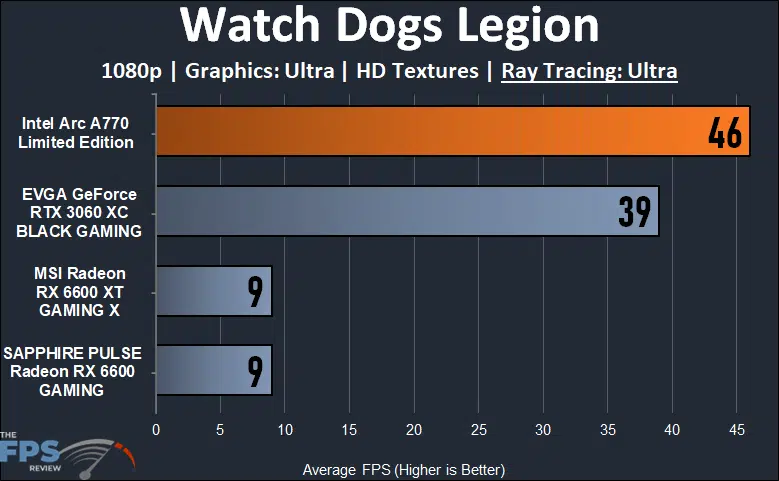
In Watch Dogs Legion at 1080p with Ultra Ray Tracing, the game is barely playable on the Intel Arc A770 Limited Edition, and it is the fastest video card in this lineup. The Intel Arc A770 is 18% faster than the GeForce RTX 3060 which is pretty amazing.
Metro Exodus Enhanced
Metro Exodus Enhanced is being run with Shading Quality at “Extreme” and Ray Tracing at “Ultra.” This is a demanding game, that heavily focuses on Ray Tracing utilization, including Global Illumination. We are utilizing the built-in benchmark.
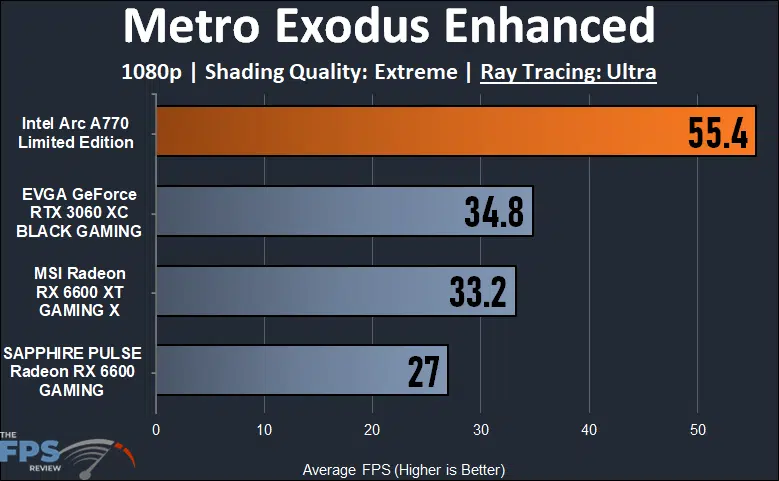
This result above really shocked us, because the Intel Arc A770 Limited Edition is actually able to provide a playable gameplay experience in Metro Exodus Enhanced at 1080p with “Extreme” quality Ray Tracing. We are getting a 55FPS average, and the Intel Arc A770 beats the socks off the competition here. The Intel Arc A770 is 59% faster than the GeForce RTX 3060 and 67% faster than the Radeon RX 6600 XT. This is amazing, and what this shows is how good the Intel Arc’s Ray Tracing performance can be. This game is unique because it tests a robust implementation of Ray Tracing and Global Illumination. The Intel Arc A770 is ahead in Ray Tracing performance in this implementation.
Discussion (16 replies)
Join Discussion →Nice review. I had no idea Intel would be able to put out something that is actually competitive, AND at a lower price point than Nvidia. And I have been reading how the drivers are improving. Let's hope they keep cracking the whip on the driver team.... there is more to life than just CS:GO and F1 numbers.
I doubt this is going to supplant my 1080ti, but for someone on a budget or building new, this is interesting. We really do NEED competition in the GPU field to get the prices down. I know it won't compare to a $800+ 4070ti, but it seems to be holding up well to the $400+ 3060.
Oh almost forgot.... does this one provide any benefit to video compression work, since it supports all the common high end codecs?
I have not personally tested video encoding, but it does famously support AV1, and according to YT videos I've watched, it's competitively fast at it.
I'm really impressed with RT performance. It absolutely crushes AMD and is very competitive with nvidia.
Thanks, @Brent_Justice for the great review. I really am bummed with how the launch of this card went because I do believe that it is a good card and deserves better. Here's hoping the next launch goes better. I've been following the stories about the driver updates and how they've helped close the FPS gap with many games and have improved overall performance.
Wow the benches are all over the place -- not necessarily a bad thing, it's a new third-party entry. Just interesting to see it doesn't boil down to the usual camps of "plays well on Green" or "plays well on Red".
Hard to really compare anything with RT - the numbers are barely playable even at best, and we are looking at only last-gen stuff from AMD/nVidia (rightfully so, neither has released anything in the lower price tiers on current-gen architectures, but those current gen things have much different RT performance). That, and... I don't really care a whole lot about RT performance in the first place.
Nice review. This entry by Intel is definitely interesting. Truth be told it's a lot more impressive than anything I expected out of them considering how new they are in this space. The gains from drivers is also impressive. When it was first released a lot of people commented that it seemed the hardware was quite good overall but the drivers were holding it back and that definitely seems to be the case in plenty of instances. While the card is far from perfect it does show that Intel has promise in the GPU space.
I'd like to get my hands on one just to mess around with it and see what it does for my uses.
[embedded media]
Wow, I was impressed the A770 pretty much keeps pace with 1080ti. Yeah I know that's old hat by now, but still an awesome card. And for under $400 is impressive.
Lol.
Is there any combination of title, resolution and settings in which this thing is fast enough to be playable, where it will actually use 16GB of VRAM?
I have to wonder why they decided to release this product instead of just the 8GB version.
That said, $349 is by far the cheapest 16GB video card I can think of, so if you have the need for a large amount of VRAM (and not much else) maybe this is your best choice?
Well, if you think about when this card was being designed - Etherium mining could use all the VRAM you could throw at it, and that was really the market Intel was planning on chasing. So... yeah, that's why.
I thought Ethereum liked more memory bandwidth than memory size.
I never mined it myself but yeah, what you say probably makes more sense - but I know there's certainly a floor for it where you have to have a minimum amount of VRAM to play.
I tinkered with mining during its peak since I had so many old cards laying around and was in the process of updating a few as well. It does like more ram but favors speed even more once you're at/over the 8GB mark. I have an EVGA RTX 2080 Super with (GDDR6) that did pretty well because of the faster ram. My older cards, the 1080s (from my last SLI setup) and 1080 Ti did ok but that Super was about 20% better than the 1080 Ti even though it had more VRAM. The cards that did the best were the 2080 Ti and a 3090 but that's not including power usage although undervolting/underclocking could do a lot to balance that.
In the end, before I stopped altogether, the optimal setup on my old X79 motherboard was using the 2080 Super, 2080 Ti, and a 3090. I have to say that the Super was an interesting beast in that while on some levels it was only just more powerful in terms of rasterization of the 1080 Ti, the tensor cores+DLSS allowed it to take a step further and that combined with the faster VRAM gave it just a bit more to boot. The other neat thing is that it only needed 2x 8-pin connectors while the 1080 Ti used 3. I originally bought that Super to use with my original 3700X build with the LG C9 since it was the only thing I could afford to be able to use the C9's 120Hz HDR g-sync, albeit at 1440p. It was also a nice BF deal in that it cost less than the 1080 Ti did at launch.
I had a GTX1070 and later a GTX1070Ti that paid themselves in just a few months with ethereum. Both mined pretty much the same, I figured it was because they had the same bandwidth.
Nicely done!
It is good to see Intel doing very well in the low/mid range gpu space. Perhaps less profit per unit, a whole lot more units sold per year though.
Once Intel is comfortable with its silicone and drivers I am hoping for them to come out swinging with a high end GPU. Looks like they will be able to compete against the raster performance of AMD and the Ray Trace/AI of NV - or so I hope.
Not this generation - I am thinking this was their test run and unofficial Beta testing. In 6-18 months I expect to see second generation Intel GPU's.
Now that Raja Koduri is gone, I don't know if even a next gen is in the works.