
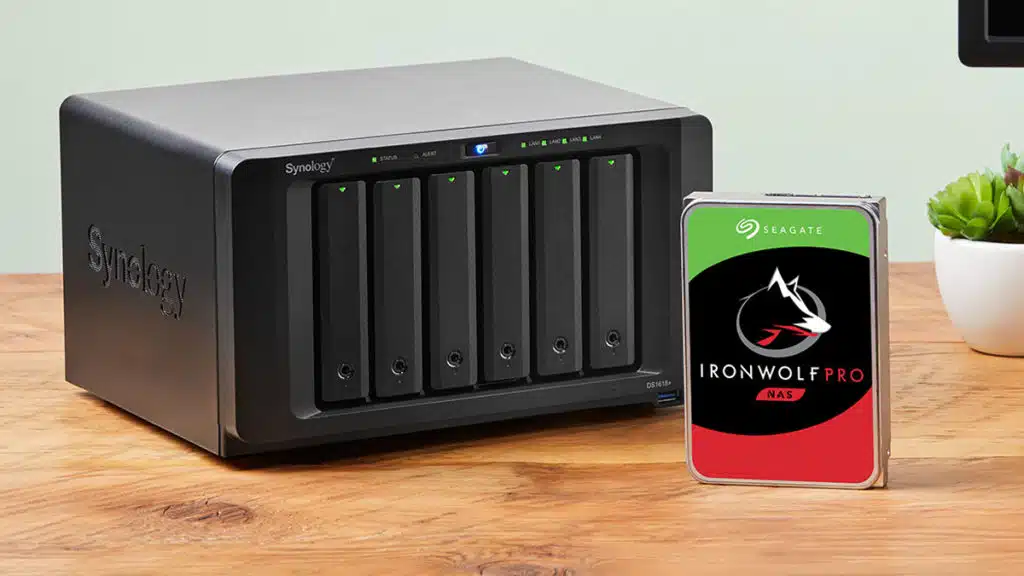
Seagate has announced that the IronWolf Pro 22 hard disk drive (HDD) is available now for a list price of $599.99. This is a conventional magnetic recording (CMR)-based HDD that represents Seagate’s highest-capacity CMR HDD offering, designed to deliver what the manufacturer says is market-leading capacity, dependability, and powerful performance for multi-user workloads and enterprise RAID solutions. The IronWolf Pro 2 features a workload rate limit of 550 TB/year and includes a five-year limited warranty.
From a Seagate press release:
Optimized with Seagate’s AgileArray technology, the new Seagate IronWolf Pro 22TB HDD provides exceptional network-attached-storage (NAS), direct-attached-storage (DAS) performance and RAID reliability in multi-bay and multi-user environments. With user workload rates of 550TB/year, the IronWolf Pro 22TB HDD enables commercial and enterprise NAS users to seamlessly store, share, and collaborate on large amounts of data over a network. It also offers an SDR of up to 285MB/s so users can seamlessly share files, back up, and tackle heavy workloads in multi-user NAS environments. With built-in rotational vibration (RV) sensors to provide RV mitigation, the HDD consistently delivers high performance and reliability in multi-bay systems.
The drive delivers a five-year limited warranty and up to 2.5M-hr MTBF for hassle-free data storage and best-in-class TCO. Also equipped with Seagate’s IronWolf Health Management system and three years of complimentary Rescue Data Recovery Services, the Seagate IronWolf Pro 22TB HDD gives users peace of mind knowing their data is secure.
Discussion (5 replies)
Join Discussion →Obligatory "that's a lot of data to lose on one drive...blah blah blah"
I refuse to buy Seagate drives ever since I had about a dozen of their 1TB* drives fail on me within' 1 month. Never again.
*Might not have been 1TB. I can't remember the capacity anymore, been many years ago circa ~2007. I was building a NAS and they had the cheapest option for the number of drives I wanted. So I purchased around 8 or 10 of them IIRC. I remember they were 7200.1 or something like that in their part number, serial number, or something. Every single drive failed within' 1 month. Every single replacement drive they sent me failed within' 6 months. I threw them all away and went with HGST drives, most of which probably still work today if I can find them.
Hehe, which is true, but you are right sarcasm is merited, of course not all data is the same. This is perfect drive to hold at least 5 games with the way things are going.
This isn't designed to be used in a single drive environment. It's more for RAID in a high density NAS cold storage.
That said we have a ton of their Exos drives. Several hundred of them. Think we lost one in the last 5 years.
Reminds me of their infamous drives from ~2012, shortly after the Thailand flooding. It's hard to believe it's been so long. Scary!
The 3 TB drives seemed to have received the most attention, but I don't think the high failure rates were confined to them. The model number of the 3 TB drive was ST3000DM001. Here's a Backblaze report from April 2015:
[URL unfurl="true"]https://www.backblaze.com/blog/3tb-hard-drive-failure/[/URL]
I bought four of the drives during what I thought was 2013, but I'm too lazy to verify the date at the moment. I put them in an inexpensive self-built NAS.
I speculated that the aggressive head-parking behavior might've contributed to the premature failure of the drives, so I modified the drive firmware with a low-level tool to disable the automatic power-saving behavior completely. That allowed me to tune the power-saving modes at the OS level. It was impossible to disable the head parking from the OS prior to hacking the firmware.
No failures yet, but I cheated by leaving the NAS powered off for almost the entire duration. I'm not kidding, either. My attention has been elsewhere, and it's just been much easier to ignore than to risk having to troubleshoot yet another device. At least creating the OS for the NAS was a fun project at the time.