
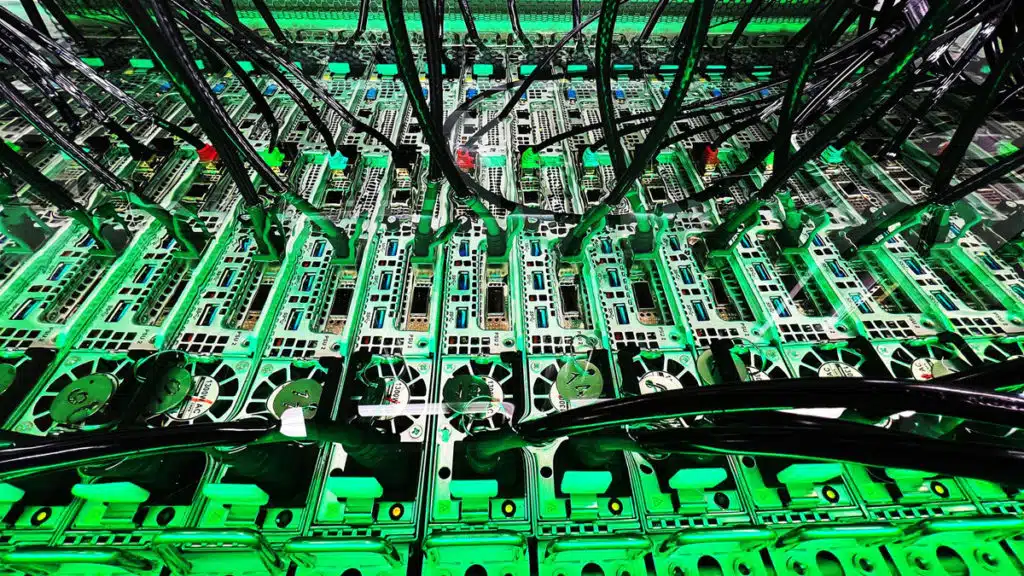
Intel and its researchers are developing new ways of cooling down next-generation architectures, including power-hungry devices that are capable of drawing up to 2 kilowatts, according to a new article that the chipmaker shared today titled “Intel Dives into the Future of Cooling.” One of the methods that Intel is looking at include 3D vapor chambers, which appears to complement the concept of boiling, while another is using fluid jets, a customizable solution, to route fluid. Critics of Intel say that this is all par for the course for the company, with desktop CPUs like the Core i9-13900K typically appearing pretty high in power consumption rankings.
From an Intel Newsroom post:
Among the solutions they are looking at are 3D vapor chambers (sealed, flat metal pockets filled with fluid) to spread the boiling capacity using minimal space and improved boiling enhancement coatings, which reduce thermal resistance by promoting high nucleation site density (where bubbles of steam form on a metal surface).
Boiling is one of the most effective methods to cool high-power electronic devices and maintain a uniform temperature distribution. Boiling enhancement coatings made of advanced materials can facilitate effective nucleate boiling. Today, these are applied on a flat surface, but research shows a coral-like heat sink design with internal groove-like features has the highest potential for external heat transfer coefficients with two-phase immersion cooling.
Intel envisions these ultra-low thermal resistance 3D vapor chamber cavities integrated within coral-shaped immersion cooling heat sinks created using additive manufacturing.
Another approach Intel researchers are pursuing uses arrays of fluid jets to cool the highest-power devices. Unlike typical heat sinks or traditional cold plates that pass fluid over a surface, the cooling jets route fluid directly at the surface. The thermal lid that contains the jets can be attached directly to the top of a standard lidded package, eliminating thermal interface material and reducing thermal resistance. With multi-chip modules becoming increasingly difficult to cool, this technology can be customized for each construction and can target hot spots effectively, enabling the processor to run at a lower temperature with a 5% to 7% increase in performance for the same power.
From its processor designs to the data center system level, Intel remains focused on extending Moore’s Law while increasing energy efficiency.
Discussion (14 replies)
Join Discussion →How about....not?
Anyone remember the space movie "Sunshine"? Where the spaceship computers were liquid cooled by dipping the entire computer core into some supercooling fluid vat? I get the feeling Intel is headed that direction....
We're gonna need those mini nuclear reactors designed for the moon/mars in our homes instead.
2000 watt PC's. 10 years ago I would have said never.
2000 watt servers... I have already.
Right now we in many segments are in the turbo charged bigblock era of computing and gpu computing. A lot more effort needs to go into efficiency. But I guess when these segments just keep chewing up processing power like a joke, well you keep seeking more that than the other.
They're not necessarily inefficient - the target CPUs are likely the big server packages that have many individual compute dies. These in turn are more efficient at the varying tasks for which they've been designed, Intel is putting discrete application accelerators on separate dies in their CPUs alongside compute dies, than if they were to be placed in separate sockets or across the PCIe bus in an expansion card.
What this means is that Intel is able to scale up / scale out effectively moreso than that they're getting less efficient.
Exactly :)
When we think about '2000W CPUs', I tend to start looking at what the future of computing might be. One of the bigger questions over the last decade has been, 'why would we need powerful computers at home?'. Aside from gaming and content creation, and those with counter examples already (Geforce Now etc., online media editors), what do we need 'computing resources' for at home?
The emergence of ChatGPT seems to answer that a bit. Assuming that compute resources continue to expand, and that the software behind these machine learning systems becomes more effective and more efficient itself, there does seem to be a place for at-home compute.
If you could run a 'personal ML matrix' at home, something that was secure enough that you could feed it all of your personal information / family information, and could use it as a genuine 'online assistant', wouldn't that have significant value?
Hell yea it would. You could also vpn into your home system and have a peivars ai helper. With proper security of course.
Thus keeping it at home!
Sony or Ms will start the ability to run a home AI assistant. Replace Alexa or bixbi or Cortana wth your ur own non glo... Naaa they will never do that. A home AI box like a converted ant miner might do it.
Converted ant miner? You mean one of those ASIC BITCOIN miner hardware?
Yea exactly. A ddvice like that go host a private home AI.
Uh, you can't. A Bitcoin ANTMINER only mines bitcoin. ASIC literally means Application-Specific Integrated Circuit and an bitcoin ant miner is specifically designed to mine... bitcoin.
You'd need to make a new ASIC device specifically designed for AI.
I bet it plays Doom.
Ok so repurposing existing ones is out but a AI specific host is still in the cards. :)