
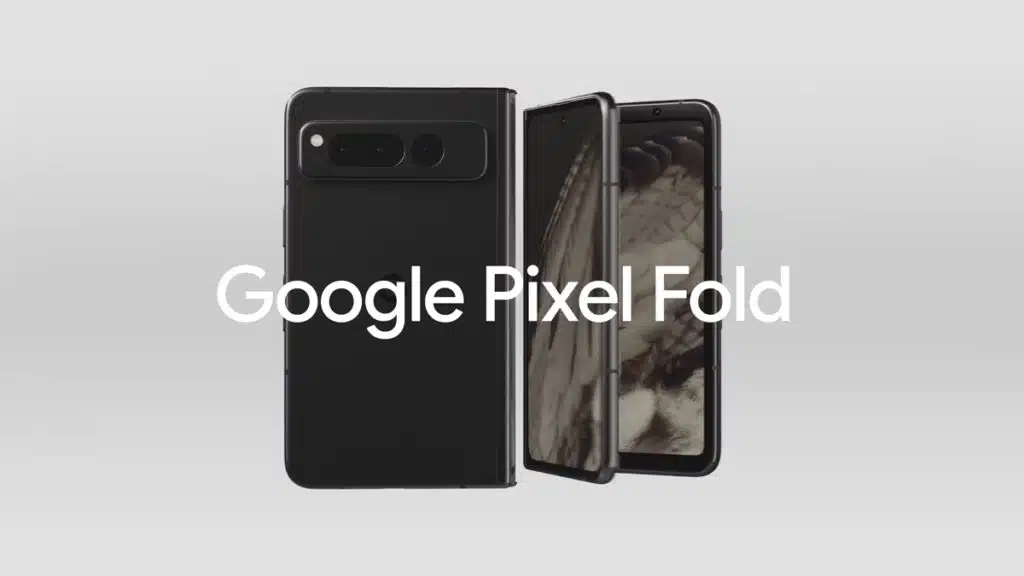
Google has announced that the Pixel Fold is now available to pre-order ahead of its release next month for $1,799.99 (256 GB) and $1,919 (512 GB). Billed as the company’s first foldable phone, the Pixel Fold is headlined by its internal OLED screen, which measures 7.6 inches when unfolded and offers a resolution of 2208 x 1840 at 380 PPI, while an external 5.8-inch 2092 x 1080 OLED screen can also be found on the outside of the device, providing a more traditional smartphone experience. Other devices that Google launched during its I/O event include the Pixel 7a, a more budget-oriented version of its premium smartphone that starts at $499, and the Pixel Tablet, which costs $499 and features an LCD display.
From The Keyword blog:
When closed, the exterior screen lets you do all the usual tasks you’d expect from a Pixel phone — like responding to Messages, browsing Chrome or using our suite of Call Assist features, like Direct My Call, Call Screen, Hold for Me and Clear Calling.
When fully open, the interior screen gives you all the benefits of a tablet. Many of your favorite apps are optimized to take full advantage of the larger screen. Immerse yourself by watching shows, reading a book, and playing games, or enjoy having space to get more things done. Use the Taskbar to easily switch between your apps or drag a compatible app into splitscreen mode to multitask with two apps side-by-side. When in splitscreen, you can easily drag and drop files across different apps, like Google Photos to Messages and Slides. Since the Taskbar is dynamic, it will disappear when you’re done using it so it doesn’t take up screen space.
That’s not all: you can also go hands-free with tabletop mode so you can sit back and relax while you watch content or capture photos or videos without a tripod. Tabletop mode is especially helpful with YouTube. The top half plays your video and, with an upcoming app update, you’ll also get playback controls on the bottom half.
Discussion (15 replies)
Join Discussion →As a fold user, I'm glad to see this because more apps will become foldable phone aware and not just half ass it.
I kind of resent that all of these new features are being forced on me.
I don't want any Assistant, AI, or cloud integration or folding screens.. I just want a basic phone capable of running a decent web browser, reading my email and a few other applications.
I want my phone to be more like my PC (or at least like my PC was in 2007) NOT my PC to be more like my phone.
I'd take something that works just like a Nexus 5, but fast enough for modern applications, and still patched for security.
I don't need nor want any new features. Just stop the nonsense. It's not a matter of cost. I would pay more to not have these modern "features".
It really grinds my gears that I will likely be forced to move to a Pixel 7a, because what I want is no longer being made.
Get something like a doogee and don't let google to creep in as much as you can.and
I think the 7a is a great value, if you don't need the camera or size of the 7 or 7 Pro.
Personally, I hope they release a full featured 8 in the size of the 7a. I'm currently using a 5 and really don't want a larger phone. If the 8 is large like the 7 and 7 Pro I'll most likely pick up a 7a.
I don't know what a Doogee is, but I will be googling it shortly.
I really want mainline Linux on the phone to be a success, but it just isn't there yet, and it is taking way too long.
Basic functionality is probably there, (web, email, etc ) but with so much mobile stuff being "app" ecosystem based we are a long way from daily driver land.
Maybe an Android app emulator in some sort of container could work as a transition, but that does not appear to be in place yet either.
I have toyed with the idea of buying something like a PinePhone Pro to play around with and see if I could make it work for my needs, but I have too many projects on my plate right now...
A linux phone will never be mainstream as there just is not financial backing to build an app ecosystem around it.
I tought the camera of the 7a was one of it's better features.
I guess a librem 5 maybe I don't know. Doogee I have and love. But still android, though its pretty pure as far as I can see, though I always change my launcher to nova. I love my v30. V30t is actually a bit better. But, again is android with all its security privacy issues whatever they may be. The hardware its pretty neat though.
Mainstream? No.
I don't want it to be mainstream. Just like with Desktop Linux, I prefer it to not appeal to the lowest common denominator, as that would require dumbing it down too much.
Personally I spend most of my phone time in the web browser or email client, and those are both native in most of the mobile Linux UI's.
For everything else, there are already Android emulation layers that work pretty well for mobile Linux, so that should be enough to get by on.
The only downside I see right now is the device hardware. The original PinePhone is desperately slow from the reviews I've read. The PinePhone Pro is much better performance wise, but seems to suffer from some significant build quality issues from what I can tell. I googled it and there are lots of complaints.
If one goes this route, one should not expect a seamless experience as it is under development, but I'd at least want reliable hardware which doesn't seem to be here yet.
Unfortunately just flashing it to a more mainstream android phone does not seem to be an option, as the mainstream android chip makers insist on keeping all of their driver's closed source and won't develop them for linux, so severely limits the SoC's that this will work on.
I'm hoping in a couple of years the options will be better.
I googled it. Looks like a not too bad design, but I have to admit, I have just about zero trust for any Chinese designed device, so I'll have to pass on this one.
The 7a and 7 share the same camera. And it's good. It's a carry over from the 6. The 7 Pro camera is really good.
I find it interesting that they are matching the galaxy folder with meh performance in comparison.
I thought Android was based on Linux.
iOS is loosely based on BSD...
Yeah, we are talking a mainline Linux, with fully open source conponents, UI and package base.
Android is based on a modified version of the Linux kernel, but that's about it. Same with iOS, which is based on a modified version of the BSD kernel.
The goal is to get away from the goals and objevtives of the likes of Google or Apple (or Samsung) etc. and have a fully independent experience on a phone without tracking, app stores, etc. much like Desktop Linux.
With the phone EcoSystem being such a MetaData gathering powerhouse I just don't see this happening easily, or getting a fully functional device without those additional bells and whistles.