
Test Setup
More information on our GPU testing can be found here. We are using the motherboard’s current default BIOS settings on the latest official release BIOS. We have enabled PCI-Express Resizable BAR in the motherboard BIOS. This means we are utilizing Resizable BAR on NVIDIA GPUs and AMD Smart Access Memory on AMD GPUs in all of our testing. We have enabled DOCP in the BIOS for the memory. We are using a fresh install of Windows 11 Pro with the latest Windows Updates, and drivers installed including the latest chipset drivers from AMD. We are using the “Best Performance” power profile in Windows Settings. We have Hardware Accelerated GPU Scheduling at the default setting, which is ENABLED. VBS is DISABLED and Game Mode is ENABLED.
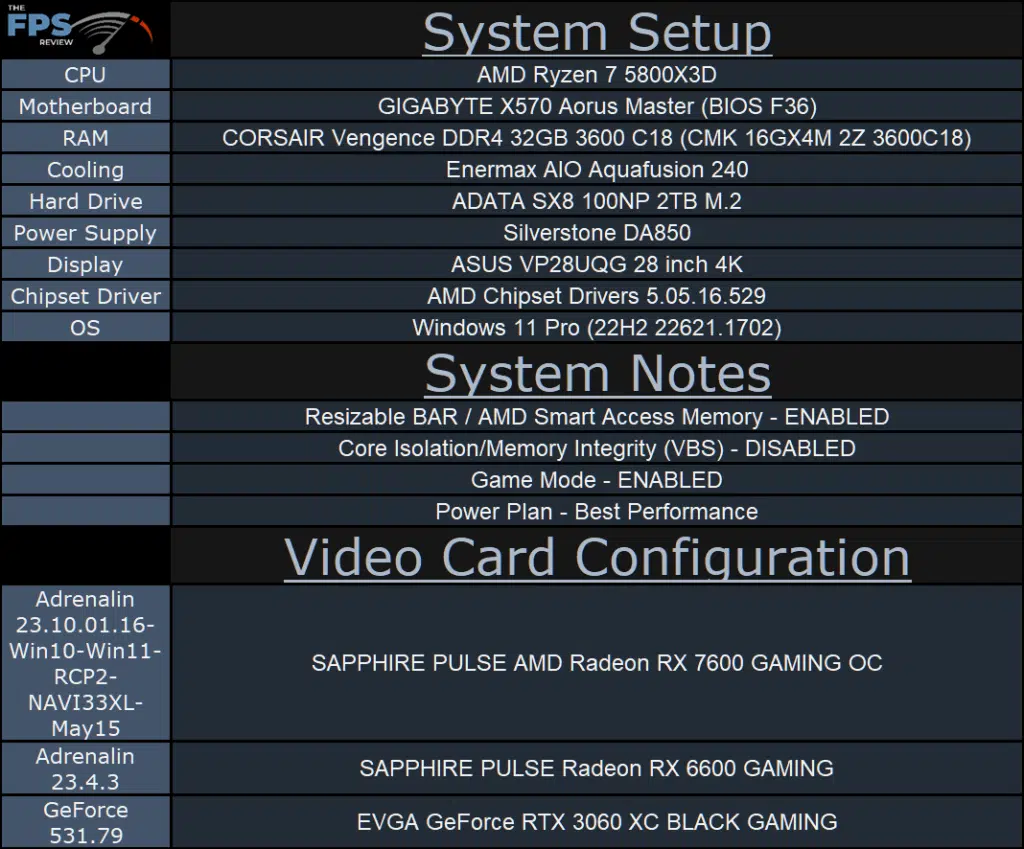
Our testing was performed with the AMD Press release driver. You can read our editor’s note here. The comparison video cards used in our review are the SAPPHIRE PULSE Radeon RX 6600 GAMING and the EVGA GeForce RTX 3060 XC BLACK GAMING 12G. Both cards were set to operate at their respective stock speeds.
Discussion (7 replies)
Join Discussion →Nice card for 1080p gaming all things considered.
Surprisingly so......it feels like it could really overclock well, if the maximum wasn't capped.
Maybe there could be a 7600 xt with extra 50w to 70w budget (& doubling vram to 16gb) for $330 to $350
But, not sure if increasing power budget massively will retain the profit margin for AMD
If AMD wants to compete with Nvidia they need to get into AI acceleration in a big way. That's really the big hurdle to their path as a Trillion Dollar company leaving Intel in their wake and bringing competition to the AI market space.
But It's clear Intel is on that game plan as well. Yet they are doing it via dedicated code paths on their CPU's. Unfortunately for Intel they are not at the forefront of this technology, and the big players have the resources to fab their own custom chips to do this if it REALLY comes down to it.
Depends on how you want to compete, moreso than who you want to compete with.
nVidia is definitely pivoting into commercial AI. AMD so far has not, and has went the path of consumer devices / custom SOCs
I don't know that you necessarily want to compete against a company against their strength unless you have no other choice -- AMD has a lot of other things they are doing well without necessarily needing to throw the Billions of dollars it will take to dump into AI-specific computer R&D.
Will they catch nVidia at AI? Probably not - but that isn't necessarily a bad thing.
Nice review!
vs 1080ti? Sidegrade or upgrade? I don't give a hoot about ray tracing. I mean not that I really need to, it's doing Diablo 4 on 4K high at 60+ and looks great. Ultra punishes it a bit and I don't really see much difference....
Remember we tested at 1080. If you can run your games at 4K with what you have, I'd stay put. This card is not a 4K performer.....maybe, some games would be OK at 1440 as demonstrated, but not 4K.