
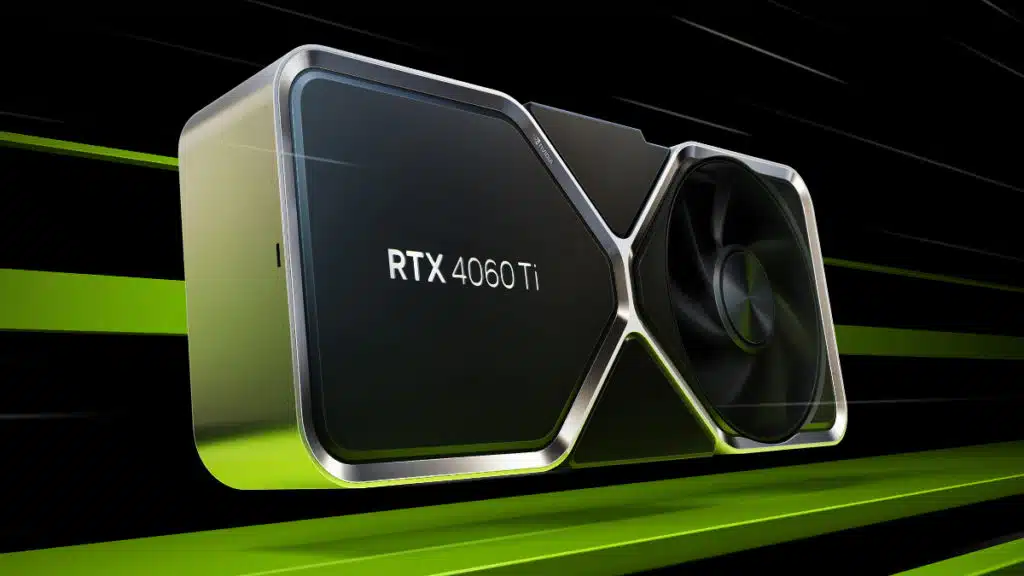
The developers behind Yuzu, a free and open-source Nintendo Switch emulator, have shared a new progress report that accuses the NVIDIA GeForce RTX 4060 Ti (8 GB) of being a disappointing graphics card, one that delivers worse performance than its predecessor in the realm of Switch emulation. Yuzu pointed out how the GeForce RTX 4060 Ti (8 GB) only has a 128-bit wide memory bus and GDDR6 memory, while the GeForce RX 3060 Ti features a 256-bit memory interface width and the option for GDDR6X memory. The Yuzu emulator has been popular for its ability to run Nintendo’s newest games on PC, including The Legend of Zelda: Tears of the Kingdom, which launched on May 12, 2023, for $69.99.
From a Yuzu post:
We don’t understand what kind of decisions NVIDIA took when deciding the Ada Lovelace GeForce product stack, but it has been nothing but mistakes. The RTX 4060 Ti 8GB with only a 128-bit wide memory bus and GDDR6 VRAM is a serious downgrade for emulation when compared to its predecessor, the 256-bit wide equipped RTX 3060 Ti. You will be getting slower performance in Switch emulation if you get the newer product. We have no choice but to advise users to stick to Ampere products if possible, or aim higher in the product stack if you have to get a 4000 series card for some reason (DLSS3 or AV1 encoding), which is clearly what NVIDIA is aiming for.
The argument in favour of Ada is the increased cache size, which RDNA2 confirmed in the past helps with performance substantially, but it also has a silent warning no review mentions: if you saturate the cache, you’re left with the performance of a 128-bit wide card, and it’s very easy to saturate the cache when using the resolution scaler — just 2X is enough to tank performance.
Spending 400 USD on a card that has terrible performance outside of 1X scaling is, in our opinion, a terrible investment, and should be avoided entirely. We hope the 16GB version at least comes equipped with GDDR6X VRAM, which would increase the available bandwidth and provide an actual improvement in performance for this kind of workload.
Discussion (3 replies)
Join Discussion →How big of a use case is emulation really? Big enough that Nvidia should even be thinking about it at all during product development?
Overall in 1080p and 1440p the 4060ti is ~13% faster on average than the 3060 ti at 1080p, which historically speaking, we have certainly seen worse generation over generation improvement. This goes down a little to ~10% at 1440p and a bit more to ~7% once we get to 4k, which seems to suggest that the narrow memory bus starts hitting its limitations as resolution goes up.
Nvidia is clearly positioning this as a 1080p to 1440p product though, so those are the numbers to look at.
They provided the memory bus they needed to support the intended target of 1080p, and possibly 1440p
Not exciting by any means like the huge leap from the 3090 to the 4090, but it is an improvement. More of an evolutionary improvement, and we have seen plenty of those in the past. We can't expect huge leaps every gen.
It is interesting to me that the memory bus is more of a limitation for emulation than it is for native games. I wonder why this is.
The 4060Ti is just a bad card. Period..
It probably trickles over into other use cases. I could easily imagine something like transcoding, compute performance, etc… all being impacted by lower bandwidth.