
Here’s another reminder not to skimp on that PSU and to purchase one from a recognizable, reputable brand.
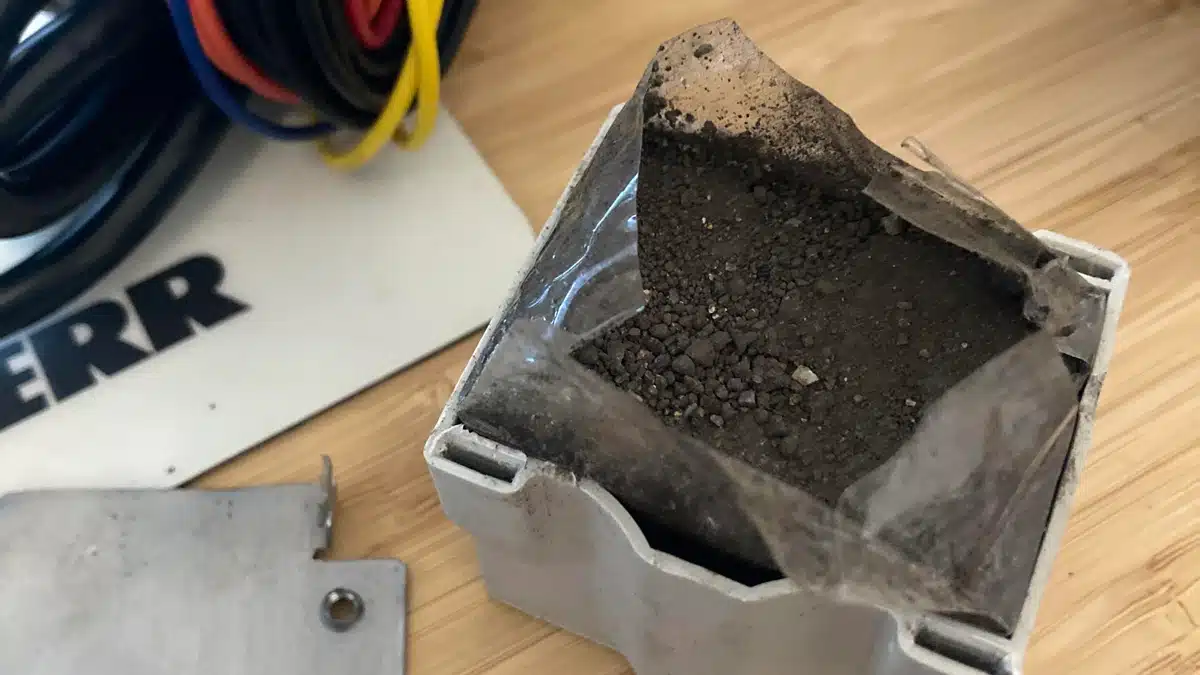
Over on the pcmasterrrace subreddit, a user by the name of “RedditCringe990” has shared photos of their Equites PSU after opening it up (which, by the way, can be pretty dangerous) and realizing that there was a mysterious block of iron fillings in there, apparently to make the unit seem more heavy and higher quality than it really was.
“lol if you’re gonna get anything brand name, it should be the PSU,” reads a top post from lordfappington69, prompting others to chime in about how a power supply is the most important part of a build, particularly for those who don’t enjoy house fires.
And as if that wasn’t bad enough, the photos from RedditCringe990 also provide a look at some of the PSU’s other components, which, according to some, are as laughable as the fillings themselves:
“That is not a 500W PSU. In fact, I’d barely call it a PSU,” explained Hattix.” It has no input protection, no output protection, doesn’t seem to have an OCP controller (you’d see the shunts) or anything a PSU needs. Heck, there’s no class-Y capacitor, no inrush limiting, and I’m fairly sure those two resistors aren’t discharge resistors.”
“If you add up its current output, it can do 168 watts on 12 V, 70 watts on 5V, and 43 watts on 3.3V, which gets you to 281 watts. This is a common total for a 250 wat PSU: Even its label says it is not 500 watts!,” they added.
“Best used with salt, a stake, and a lawyer. Do not use that PSU,” Hattix concluded, prompting someone else to say that “this guy PSUs.”
According to some of the listings for the Equites T500 that can be found online, this is a “500W” power supply that claims to offer the following features:
- 80 PLUS CERTIFIED
- INTELLIGENT TEMPERATURE CONTROL
- SILENT 120MM FAN WITH FAN GUARD
- 105°C INDUSTRIAL JAPANESE CAPACITORS
- PROTECTION FROM OVER CURRENT, OVER VOLTAGE, AND SHORT CIRCUIT
- BUILT & DESIGNED FOR HIGH PERFORMANCE
- RCM CERTIFIED
The PSU can seemingly be purchased for as little as $35, which might explain why there’s iron fillings in it, among other weirdness.
Discussion (9 replies)
Join Discussion →When you're just starting out or otherwise broke and have to build sometimes you sort by cheapest price.. That's unfortunate.
I will say this though. IF you need to run cheap hardware save yourself some headaches and put it all on a line conditioning UPS. YEa you'll buy a UPS, but even cheap hardware will perform longer and better on clean power.
Huh... I wonder if there is an article there. "Lind conditioned power, compared to wall Power" Does the condition of a watt matter to your Power supply and system?
[URL unfurl="true"]https://www.kemet.com/en/us/technical-resources/the-importance-of-filtering-for-power-supplies.html[/URL]
A decent power supply is less expensive and much easier to find than a high-quality UPS. It wouldn't take long for me to select a PC power supply of reasonable quality, whereas choosing a UPS for home/office that I would trust would take considerable research. I've never found one that checked the right boxes. Is there a site(s) that does good reviews of power protection equipment?
Not trying to knock your suggestion. Ideally, one would have both a clean source source of power and a high-quality PSU.
Oh my.... I just discovered that one can now buy a "Gaming UPS". I hope that none of you have been careless enough to play video games while connected to an ordinary non-gaming UPS!
APC Gaming UPS
[URL unfurl="true"]https://www.apc.com/us/en/solutions/home-solutions/gaming-ups-xbox-ps4-console-pc/[/URL]
APC used to be good until they got bought out by Schindler. Now they are consumer crap.
Yeah, I agree with this. Plus there is the consideration if you are on a budget than running power through an UPS will increase the electricity bill, unless you have an UPS with a bypass mode, but then it offers no protection for low quality electricity.
Must be as essential as a gaming router.
Not sure if it’s common in Europe, but in the US nearly all UPSes are “bypass” and run what it called “line-interactive” so they can still provide protection. They kick into protected mode only when they detect poor quality line power - and that would be the only time they consume fractionally more electricity than not having one.
Yeah, but when they run line interactive mode they aren't smoothing out the power, so shorter irregularities aren't corrected, which would be part of the point if you buy a UPS to make your equipment last longer.
Either way I think it is not really a good route to skimp on the PSU then try to compensate with a UPS, especially if you are on a budget as an UPS will eventually need its batteries replaced, so it's not even a long term investment that can outlast multiple PCs. And I'm saying this as someone who used PSUs at home in the past. I don't think it is worth the investment even if you are not on a strict budget. Gaming PCs weren't that power hungry back then, so I could get away with having 400-500VA UPS-es, but they only lasted 2-3 years, before they started crying for a new battery.
That thing is several steps beyond and above junk.
The don’t filter if it’s not needed. But they can detect an issue and switch to filtering in a fraction of a second. Unless your power is so bad it just filters all the time - then you have bigger issues and an actual double conversion unit, efficiency be damned, would be better. That may be the case in some off grid or third world situations - maybe some extremely rural or underserved areas. But most places hooked up to a larger grid - they stay mostly stable just by virtue of their size