
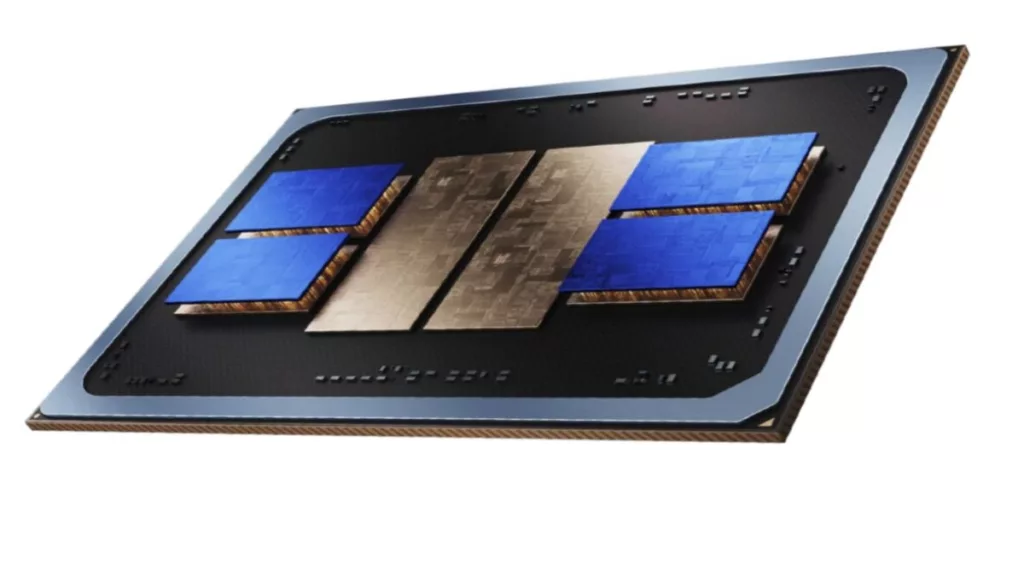
Details regarding Intel’s next flagship enterprise Xeon processor have emerged, showing a powerful 256-core CPU on one package with 1.28GB of cache memory. As reported by VideoCardz, with additional information from ComputerBase, Diamond Rapids was featured in a segment at yesterday’s Hot Chips 2026 event, which began on Sunday and concludes today in California. Intel is currently putting a great effort into developing “Coral Rapids,” which will see a return to enterprise processors supporting SMT (Simultaneous Multithreading) technology, but as the saying goes, time waits for no man, and CEO Lip-Bu Tan is well aware that Intel has to release a competitive product sooner rather than later, given the already high demand for processors.
Diamond Rapids will use a 16-chiplet design on one package built using Intel’s 18A-P process. Each chiplet has 16 cores for a total of 256 P-cores spread across 4x Intel 3-T base tiles. Intel has followed AMD’s approach in flipping some of the package components, but unlike what is seen with AMD’s 3D-Cache/CPU changeover, Intel has instead swapped its I/O tiles to the inside, with the CPU tiles moved to the outside, thus giving CPU tiles a shorter path to the I/O die, which is a change from the current Xeon 6 processors. The following slides from Intel (via VideoCardz/Hot Chips) detail Diamond Rapids specifications.
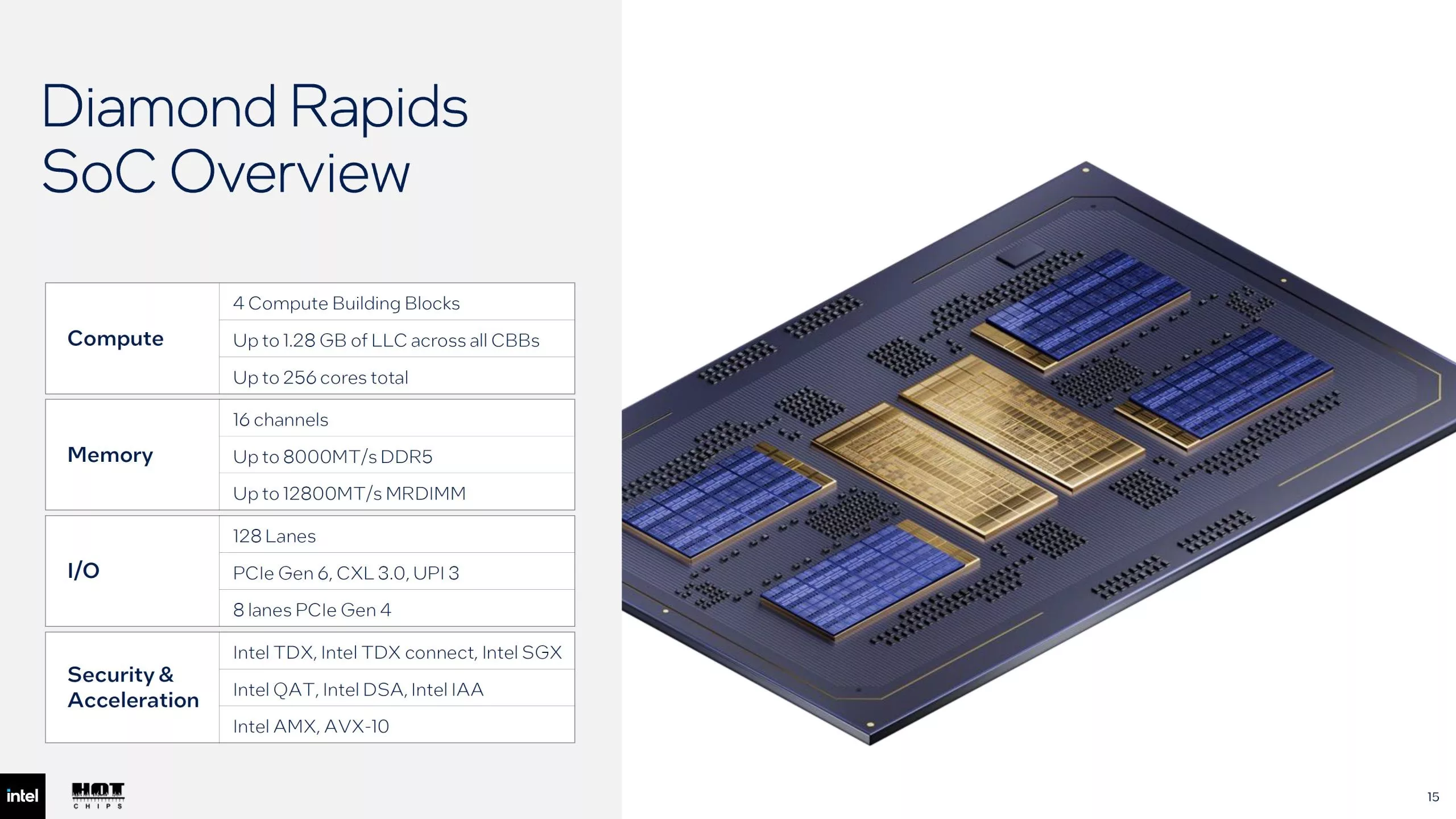


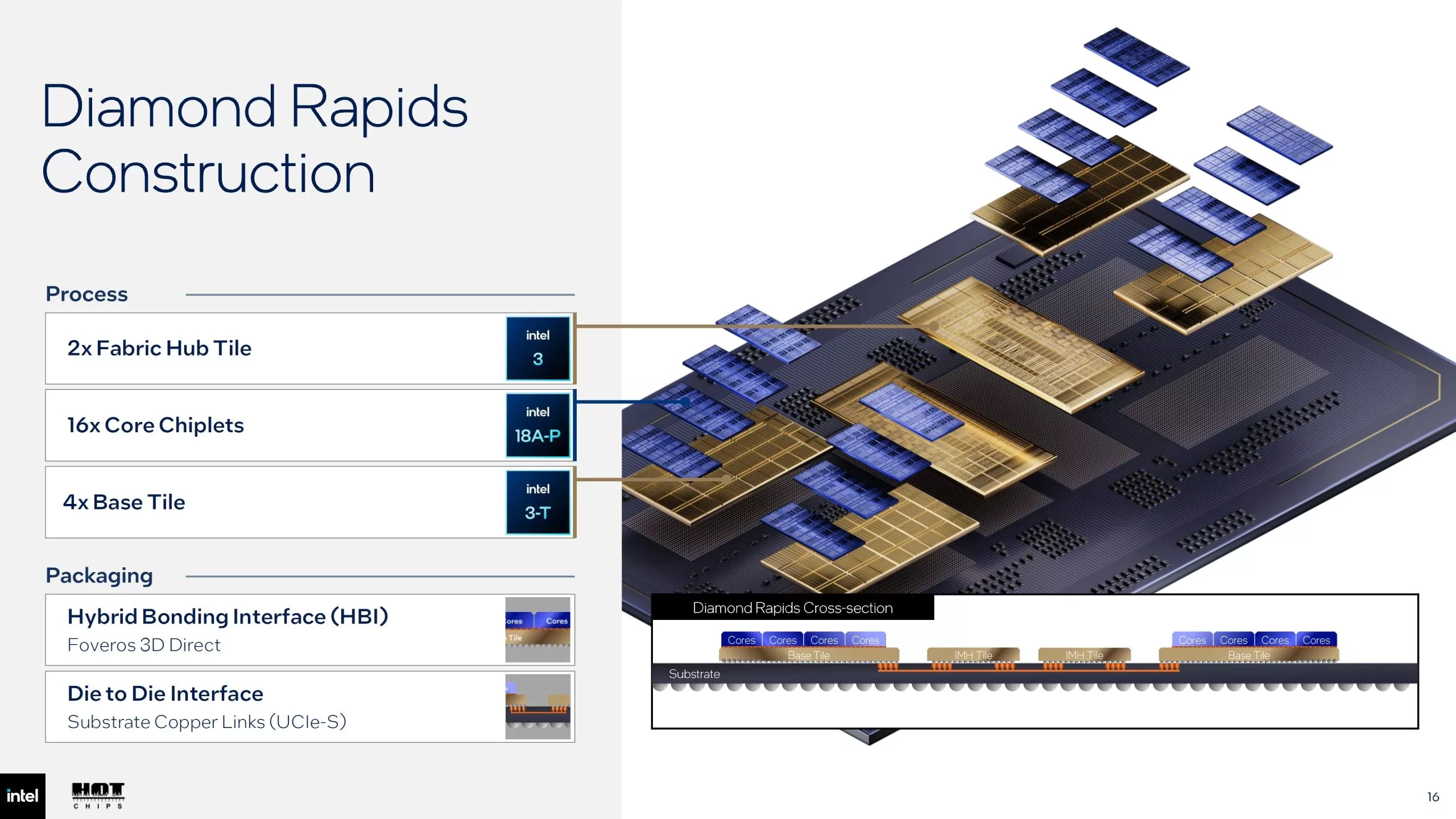
Other specifications for Diamond Rapids to note are support for up to 16 channels of DDR5 8000 MT/s or 12800 MT/s MRDIMM. Up to 128 lanes, PCIe Gen 6 supporting CXL 3.0 / UPI 3, and 8 lanes of PCIe Gen 4. AVX 10.2 and AMX acceleration are also supported, along with the Intel APC instruction extensions (Intel QAT/Intel DSA/Intel IAA). Security features include Intel TDX, Intel SGX, Improved RAS, and Enhanced QoS + Telemetry. The package substrate die-to-die interface is done via Foveros 3D direct process. Pricing and availability for Diamond Rapids, which will succeed Granite Rapids, have yet to be announced.
Discussion
Join Discussion →No replies yet. Be the first to reply on the forum.