
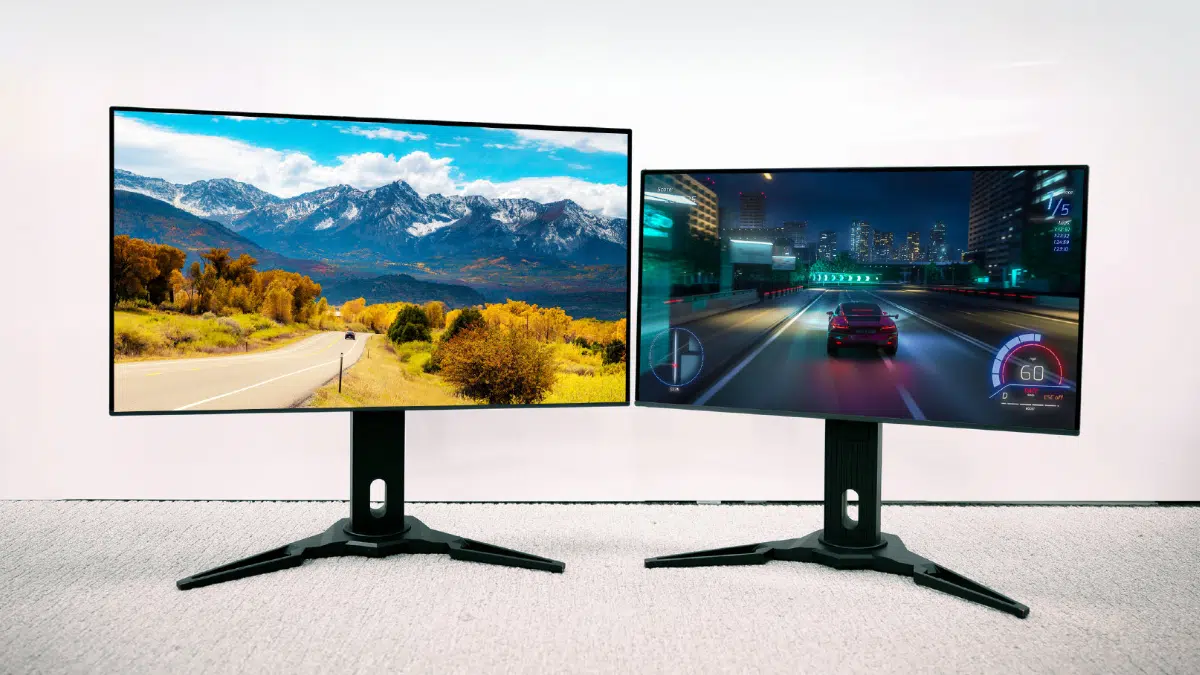
Samsung has announced that it will begin mass producing 31.5-inch UHD (3840×2160) resolution QD-OLED panels beginning this month for new monitors, and not only that, the company is also planning a new 27-inch QHD QD-OLED gaming monitor with a 360 Hz refresh rate—a solid improvement over the 240 Hz OLED monitors that can be found on today’s market.
Here’s what Samsung had to say about its 31.5-inch UHD QD-OLED panel, which features a 140 PPI, per a machine-translated post on Weibo:
To develop this display with ultra-high-definition resolution, Samsung Display applied advanced ultra-precision inkjet printing technology to the QD (quantum dot) light-emitting layer. By optimizing the inkjet nozzle and jet volume, the pixel density was successfully increased to 140PPI (pixels per inch) , which is equivalent to the pixel density of a 65-inch 8K TV currently on the market.
Samsung Display said: “Since the viewing distance of monitors is usually closer than that of TVs, users are more sensitive to picture quality. Currently, self-illuminating displays in the 30-inch range generally use QHD (2560×1440) resolution, and like Consumers of games and high-definition video content are more interested in UHD products.”
And here’s the word on Samsung’s 27-inch QHD QD-OLED with 360 Hz refresh rate, which is expected to release next year:
In addition to ultra-high-resolution products, Samsung Display also plans to launch the industry’s highest 360Hz refresh rate 27-inch QHD QD-OLED for the first time as a new product in 2024, focusing on the rapidly growing gaming monitor market.
The refresh rate of the display screen refers to the number of images that can be displayed per second. The higher the refresh rate, the faster the image transitions, resulting in a more natural image effect. So far, the highest refresh rate of self-luminous displays is 240Hz. Samsung Display has achieved a revolutionary increase in refresh rate with its unique artificial intelligence-based driving algorithm – Quantum Enhancer.
Samsung Display also said: “Combining the highest refresh rate of 360Hz with a fast response time of 0.03ms, especially in first-person shooter (FPS) games that require fast screen switching and precise aiming, this product can bring consumers An extraordinary gaming experience.”
Samsung’s current OLED gaming monitors include the Odyssey OLED G9, a curved, 49-inch ultrawide display with 240 Hz refresh rate that’s available for $1,299.99 at the time of this writing.
Another is the G85SB OLED Ultra WQHD, a 34-inch curved gaming monitor with 175 Hz refresh rate that normally retails for $1,499.99.
Discussion (10 replies)
Join Discussion →Meh, I'm fine with 240Hz
Seriously, I'd be happy at 120-144Hz, I just don't need more /shrug
Since I like gaming at 4K I won't be able to take advantage of 240Hz, much less 360Hz.
Just because you can't put out 240 or 360 frames per second doesn't mean you won't benefit from it. Much less motion blur. It's something I've always hated about LCD, all the damn blur. Something we didn't have to put up with on CRT, and even plasma.
If a game can't run at the refresh rate, then what's the point, you aren't getting the benefit /shrug
Motion clarity in fast paced games, like shooters and driving games. You don't need to push the frames for the display to not turn in to a blurry mess. We weren't pushing 140+ FPS back in the day on CRT's, yet games looked smooth as all get out because CRT's didn't suffer from motion clarity issues. Same with TV's when LCD's first came out. Fast paced action scenes looked terrible, now TV's are pushing 120hz+ to smooth out the image. Movies are 24 FPS.
Motion clarity.
I must have a misunderstanding: If you aren't pushing the game at the same framerate of the refresh rate, then how are you getting that benefit of the increased motion clarity?
If you are running 60 FPS on a 120Hz panel, you aren't going to get that motion clarity you are speaking of. You'd need to be running at 120 FPS at 120Hz refresh.
The increased motion clarity comes from the fact of you being able to run your game at so much higher frame rate (matching the monitors refresh)
So increasing refresh rate needs to go hand in hand with framerate, or else there is no point for improved clarity
Or am I out to lunch
Does OLED have the same issue?
So much of this is e peen territory.
' audiophiles' have oxygen free gold clad copper wires, pc gamers have refresh rates and 8k rez in 6 inch screens. Hey if it makes you happy I am all for it.
Ever gamed on a high end Plasma? They run at 600hz. Even console gaming at 60 FPS or less looked smooth as silk.
When I talk about motion clarity I'm talking about the display's ability to not smear an image. Same concept when watching a fast paced action scene on an older LCD, everything would get blurry during those scenes because the display just couldn't refresh the screen fast enough. Even though the movie is 24 FPS.
I think I get what is being represented here.
I think the logic here is that... even if you're pushing 100 frames a second... the time it takes a pixel to refresh isn't any different than if you were pushing 360 frames a second. So when a pixel refreshes... even though it's only being sent new data every 100'th of a second. In reality it's refresh time is 1 360th of a second. Meaning that pixel state change happens almost 4 times as fast. This means motion blur of your eyes tracking the time it takes for pixels across the screen to refresh is crisper and closer to reality rather than seeing a blur that wouldn't exist otherwise.
BUT... is it measured for monitors even if you drive them at a lower refresh rate that they are forcing pixel response times at the enhanced levels? That's what I would need clarity on.