
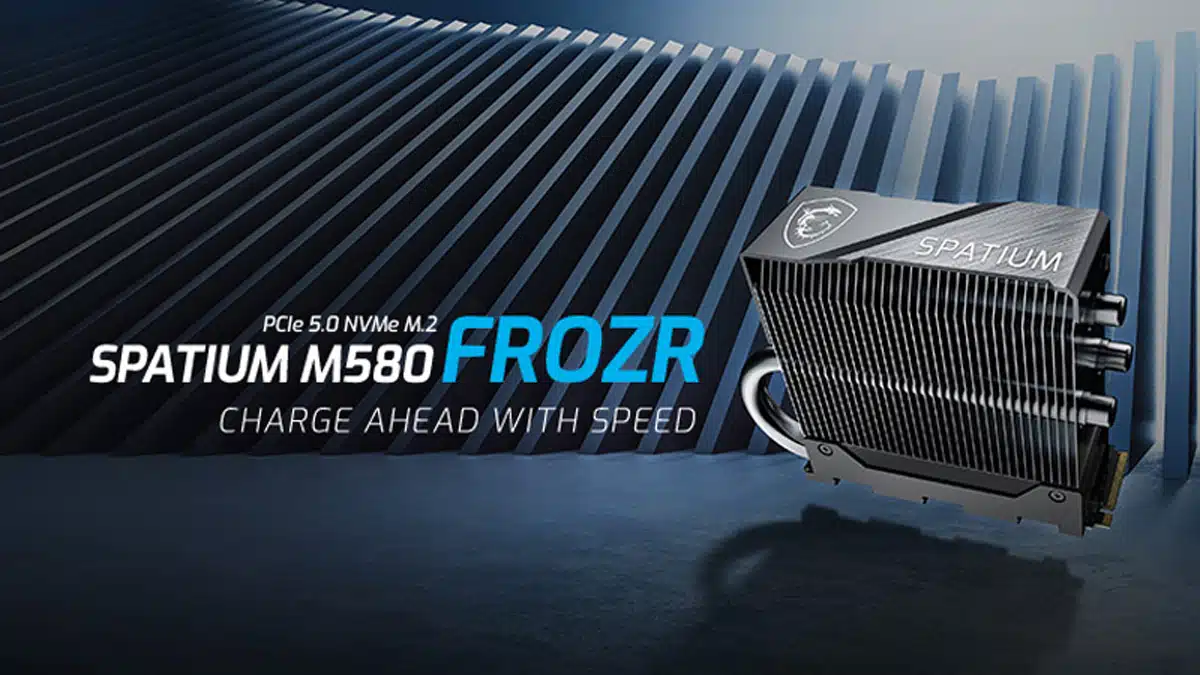
MSI has launched the SPATIUM M580 FROZR, a new PCIe Gen 5 SSD that features the state-of-the-art PHISON E26 PCIe Gen 5 controller and “mind-blowing” speeds of up to 14.6 GB/s. A key feature is its passive tower heatsink cooler, which MSI has described as being revolutionary, said to be capable of reducing temps by up to 20°C.
Capacities:
- 1 terabyte
- 2 terabyte
- 4 terabyte
Features:
- Read speeds of up to 14.6 GB/s
- Write speeds of up to 12.7 GB/s
- PHISON E26 PCIe Gen 5 controller
- 3D NAND flash modules with 232 layers
- Passive tower heatsink cooler with three heatpipes
- LPDC ECC and E2E data protection
- Backed by a 5-year warranty
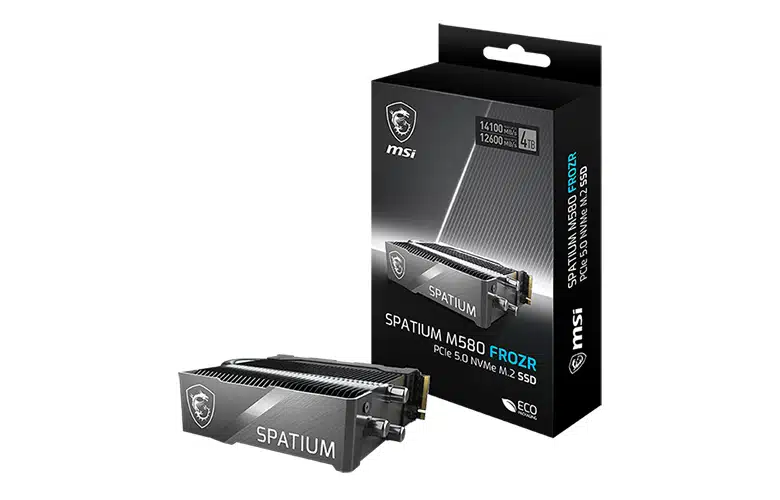
Box shot:
MSI on its new SSD and heatsink:
The SPATIUM M580 FROZR sets a new benchmark in storage performance with its revolutionary features. Powered by the state-of-the-art PHISON E26 PCIe Gen 5 controller and equipped with advanced 3D NAND flash modules boasting 232 layers, this SSD achieves mind-blowing read speeds of up to 14.6 GB/s and write speeds of up to 12.7 GB/s, up to 2 times faster transfer rates compared to current PCIe 4.0 SSDs. This represents a significant leap in speeds, boosted by a DRAM cache buffer and a SLC Cache, providing users with lightning-fast data access and gaining valuable milliseconds in latency for gaming, content creation, and professional applications. Additionally, the M580 FROZR is fortified with LPDC ECC and E2E Data Protection, ensuring data integrity and reliability. With a high TBW (Terabytes Written) value and backed by a comprehensive 5-year warranty, users can trust in the durability and longevity of the SPATIUM M580 FROZR in 1TB, 2TB and 4TB variants after an easy installation.
Complementing its exceptional performance, the SPATIUM M580 FROZR features a revolutionary passive tower heatsink cooler. This cooler, pre-mounted on the SSD, incorporates three heatpipes known as CORE pipes and a plethora of aluminum fins, maximizing surface area for enhanced cooling capability and airflow passthrough. By reducing operating temperatures by up to 20 degrees Celsius, this heatsink unleashes extreme performance and sustains maximum storage throughput even under heavy workloads.
Discussion (12 replies)
Join Discussion →When I see this name this is all I can think of:
Still thats impressively fast.
Truly fast but man that heatsink, as far as SSD stuff goes, looks taller than a skyscraper and something even Kong might think twice about before climbing.
Well that's one SSD that is NOT fitting in an M.2 slot that is directly under the graphics card.
Most Gen5 M.2 capable slots are in the top one anyway since they need access to direct CPU PCIe lanes.
I agree. I do not feel the need to get any of these gen 5 drives due to most having heatsinks like this.
If they want to give me mind blowing something, give me mind blowing latency. MLC or SLC NAND please
Of course they can, but you'll pay for it, it's not really cost effective for large capacity MLC drives, and SLC would be outrageous
We can get a 4TB drive Samsung 990 pro TLC drive for less than 350. That should mean we should be able to get a 1.25TB SLC drive for a similar price. Even if SLC commands a 50% markup from TLC, that would put a 1.25TB SLC drive at less than $550. I’d pay that in a heartbeat, and honestly 512GB would be plenty for an OS drive, so we could be talking even less for a very usable size.
Edit. Heck, thinking about it a bit, I’d pay 550 for a 512GB latency optimized 5 microsecond SLC drive. That’s 25 times less latency than typical TLC NAND - enough you’d notice the difference.
...now account for the cost of getting an additional SKU to vendors and the effects of lower production rates and lower demand.
Maybe a 4x increase in price? Would that be where enterprise SLC drives already land?
More interesting perhaps would be an option to run the drive as an MLC or SLC drive, and further, to be able to partition the drive into SLC and/or MLC sub-drives.
Like hey, give me the 4TB TLC drive but run it as a 2TB TLC drive and a 512GB SLC drive through the firmware (thus represented to the BIOS and OS as such).
I can’t imagine the SKU would add that much cost given how things like the WD Raptor series compared to WD blues 15 years ago. But sure, given a 990pro 2TB is sub 200, I could justify paying 600 for a 768GB drive (3x markup)
This would also be at least moderately interesting. It wouldn’t be latency optimized, but hopefully switching a TLC drive to SLC mode would yield a reasonable boost
The hope would be that it could be latency optimized. I'd expect there to need to be a new NAND design implemented to make it possible, but the basic idea is already there with some drives using part of their flash as SLC rather than / in addition to DRAM for their write caches.