
Power and Temperature
To test the power and temperature we perform a manual run-through in Cyberpunk 2077 at “Ultra” settings for real-world in-game data. We use GPU-Z sensor data to record the results. We report on the GPU-Z sensor data for “Board Power” and “GPU Chip Power” when available for our Wattage data. For temperature data, we report the GPU (Edge Temp of the GPU or Package Temp) as well as Hot Spot (Junction Temperature) when available for our temperature data.

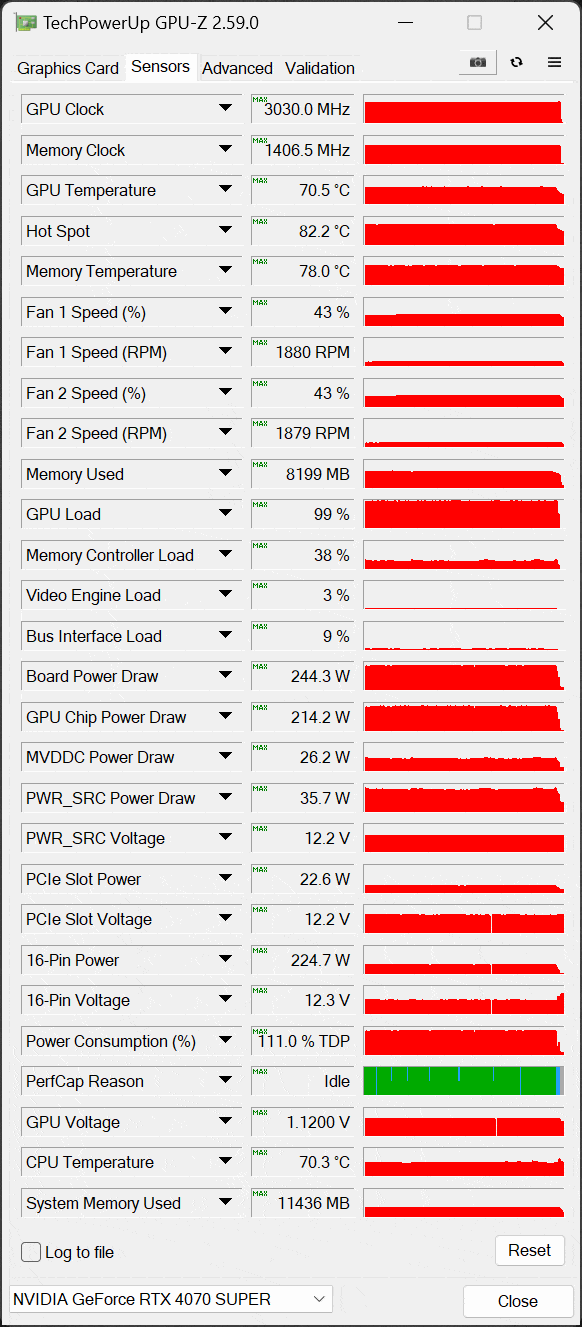
The TGP of the NVIDIA GeForce RTX 4070 SUPER is 220W. We can see that without overclocking, the GeForce RTX 4070 SUPER is hitting this target board power at 222.5W of board power according to GPU-Z. When we overclock the GeForce RTX 4070 SUPER board power increases by 10%. The PowerColor Hellhound Radeon RX 7900 GRE runs at a much higher 295W board power, which is 33% more power than the GeForce RTX 4070 SUPER at default speeds. Even when the GeForce RTX 4070 SUPER is overclocked, it still uses 17% less power than the PowerColor Hellhound Radeon RX 7900 GRE video card.
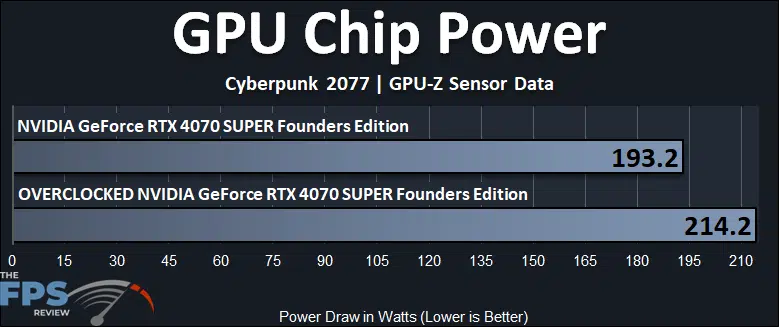
When looking at GPU Chip Power the overclocked GeForce RTX 4070 SUPER uses 11% more power than at default, and this is due to the Voltage being pushed to 1.1200V.
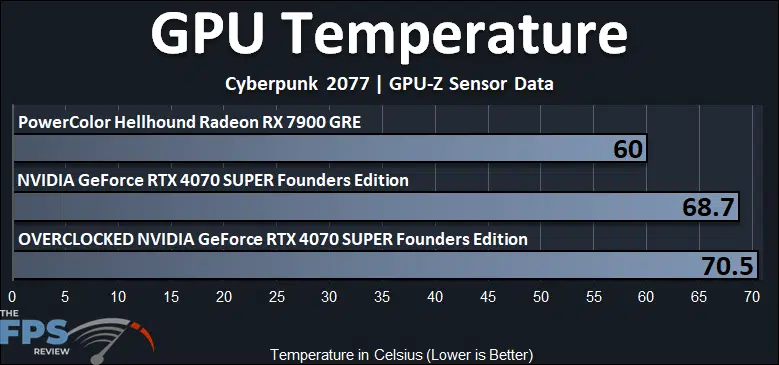
The PowerColor Hellhound Radeon RX 7900 GRE video card has a beefy custom cooler, and its temperatures are well maintained, as we’ve found this to be one of the coolest running Radeon RX 7900 GREs so far. The GeForce RTX 4070 SUPER is not hot either, at 68.7c and only raising to 70.5c when overclocking it’s well maintained as well, though technically warmer.
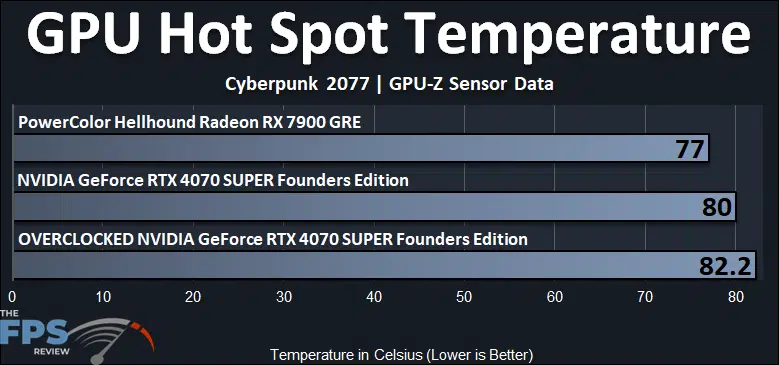
The same is true of the GPU Hot Spot as well, they are all not far off from each other. The GeForce RTX 4070 SUPER runs at 80c Hot Spot, and when overclocked with Voltage added it only went up two degrees at default fan speeds, so very commendable.
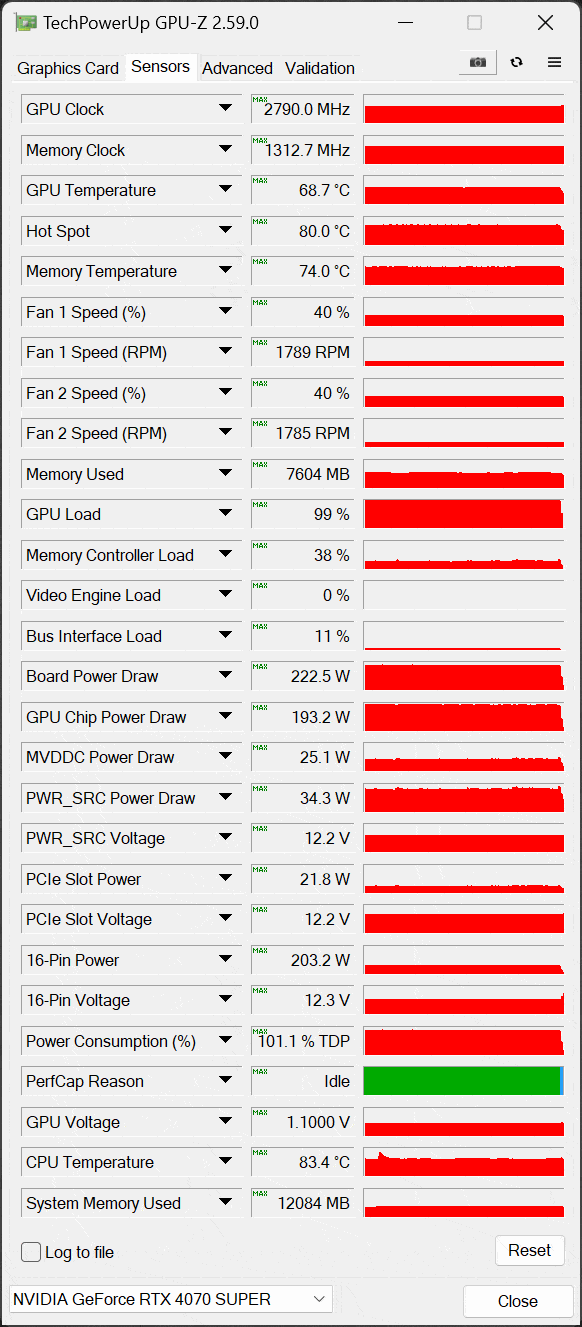
Below, you can see the default settings, and on the right screenshot the overclocked settings. You can see that at default fan speeds, with no changes, at default it hits 40% fan speeds, and when overclocked the GeForce RTX 4070 SUPER automatically increases to 43% fan speeds. At this very low fan speed, temperatures only increased a couple of degrees, showing how well the cooling is on this video card and how efficient the power draw is. You can see the Voltage increased from 1.1000V to 1.1200V when we pushed the Voltage up. We are definitely at the TDP wall with this overclock, with no more headroom. If you want to keep it lower, below the TDP then do not increase the Voltage, and settle with a +200 Core GPU clock speed increase which will lower the frequency by about 40-50MHz from what we showed you.
Discussion (7 replies)
Join Discussion →nice article. I wonder how far I can get on my non-super GB 4070
I haven't tried to manually overclock the GPU on my laptop which reportedly uses the same die as the non-super 4070 but using its max boost mode shows it hitting ~2560 MHz and some rare peaks in the 2800s. I did overclock the memory slightly but nothing to write home about. In the end, though, the AD104 is a beast at 1440p and even more so when using DLSS, and from looking at this review of the SUPER version it gets just a bit better at it as well.
It's really impressive that this card meets or beats the RTX3080 and gets really close to the RTX3090 in several games.
Yep, the refinement with the ADA GPUs, especially in the mid-high tiers is really impressive.
Remember when a 1070 was SUPPOSED to be faster than a 980? How far we have fallen.
IIRC the GTX 1070 IS faster than the GTX 980, not by much, but still.
That's my point for a short while there the x79 series was faster/better than the previous gens x80.