
NVIDIA’s next-generation products, including its successor to Blackwell for AI customers and what will presumably be many new generations of GeForce RTX GPUs for gamers, including the GeForce RTX 6000 Series and 7000 Series, may be arriving sooner than expected, according to Jensen Huang, NVIDIA Founder, President, and CEO, having told participants during a recent earnings call that his company is now on a 1-year rather than 2-year cadence for its next designs, which are said to include new GPUs, new CPUs, and more. The comments come as NVIDIA revealed that it had made record quarterly revenue of $26.0 billion for Q1 Fiscal 2025, up 18% from Q4 and up 262% from a year ago.
Huang told participants:
- “…I can announce that after Blackwell, there’s another chip. And we are on a one-year rhythm. And so and you can also count that — count on us having new networking technology on a very fast rhythm.”
- “We’re announcing Spectrum-X for Ethernet. But we’re all in on Ethernet, and we have a really exciting road map coming for Ethernet. We have a rich ecosystem of partners.”
- “We have a rich ecosystem of customers and partners who are going to announce taking our entire AI factory architecture to market. And so for companies that want the ultimate performance, we have InfiniBand computing fabric.”
- “New CPUs, new GPUs, new networking NICs, new switches, a mound of chips that are coming. And all of it, the beautiful thing is all of it runs CUDA. And all of it runs our entire software stack.”
Highlights of NVIDIA’s latest financials include:
- Record quarterly revenue of $26.0 billion, up 18% from Q4 and up 262% from a year ago
- Record quarterly Data Center revenue of $22.6 billion, up 23% from Q4 and up 427% from a year ago
- Ten-for-one forward stock split effective June 7, 2024
- Quarterly cash dividend raised 150% to $0.01 per share on a post-split basis
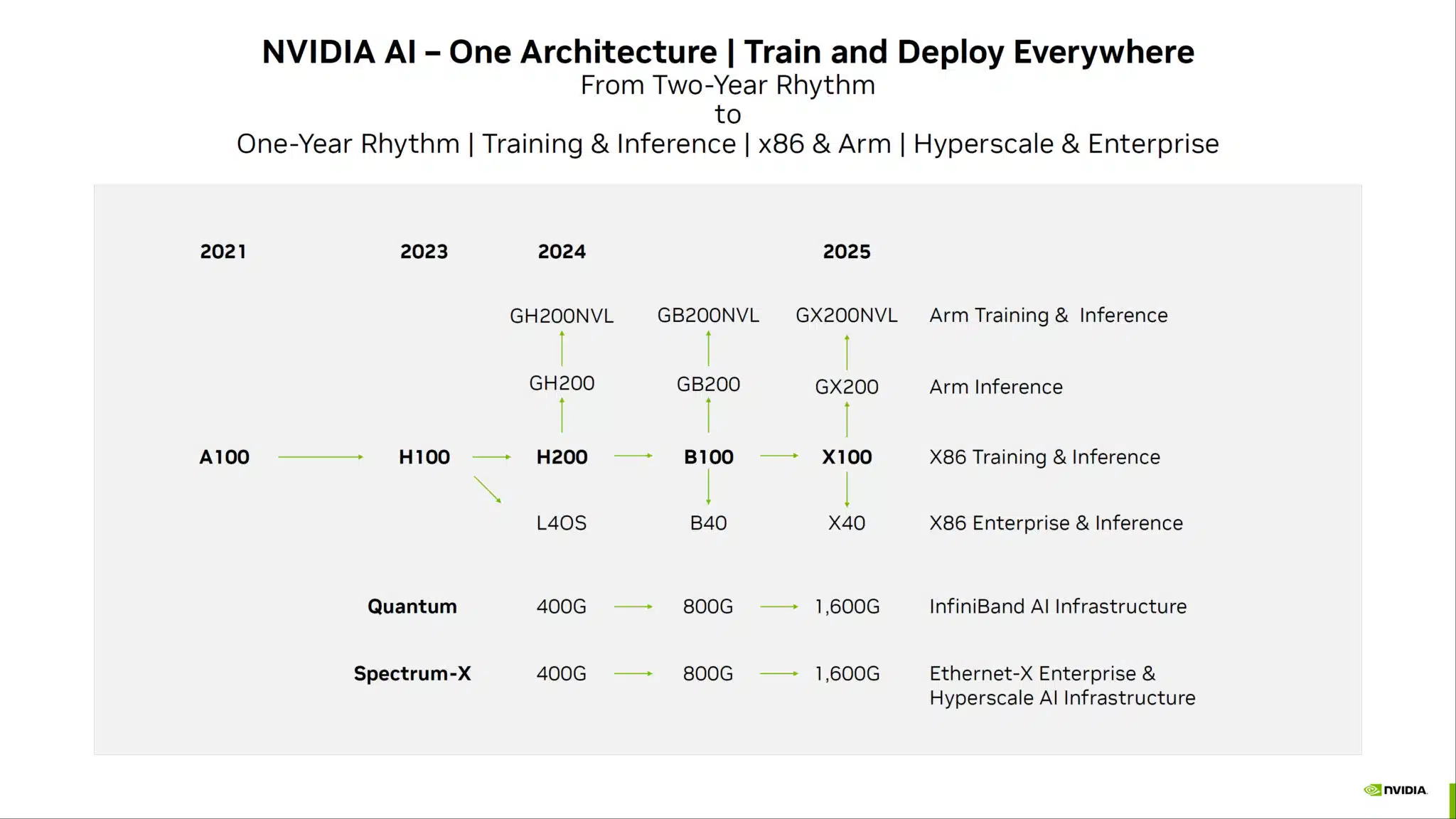
One of NVIDIA’s current roadmaps, which confirms a “one-year rhythm”:
Collette Kress, NVIDIA EVP and CFO, echocing some of the performance claims that have been presented for Blackwell:
The Blackwell GPU architecture delivers up to 4x faster training and 30x faster inference than the H100 and enables real-time generative AI on trillion-parameter large language models.
Blackwell is a giant leap with up to 25x lower TCO and energy consumption than Hopper. The Blackwell platform includes the fifth-generation NVLink with a multi-GPU spine and new InfiniBand and Ethernet switches, the X800 series designed for a trillion parameter scale AI.
Discussion (15 replies)
Join Discussion →Its been a while since nvidia had a 1 year cadence and I remember a time when there was a 6 month cadence.
I wonder how long will nvidia be able to sustain such a cadence, though, I assume they will release a different kind of product each year. Like gaming then AI, then HTPC et al.
No doubt this will put pressure not only on both AMD and Intel but also qualcomm and maybe even apple now that apparently nvidia is going for the android (mini?)PC/mobile market.
We'll see...
BTW remember that nvidia is THE dominant player in pretty much every market its in, so having them on the Android pc/mobile front is pretty huge.
Pretty close to that now
3080, 6 months later 3090, 6 months later 3060, 6 months later 3070, 6 months later 3080 Ti, 6 months later 3090 Ti, 6 months later 4080... etc etc
actually the cycle is of a brand new architecture like fermi to maxwell to pascal et al, not card models of the same family.
I put this in another thread but it also has relevance here since it details both NVIDIA and AMD's release cycles.
[embedded media]
I was thinking the same thing here but I'm not sure that is sustainable. The chip design is getting ridiculously complex and despite the assistance of AI, it still takes a while to design, engineer, test, redesign, reengineer, test, etc.
Yup, I'm pretty sure nvidia will find a "loophole" to claim it has a 1 year cadence, but as I mentioned it will probably release different architectures for different segments yearly, we'll probably have to wait a couple of years to get the next gen gaming architecture.
Also, just moving to a smaller process or even different foundry can take months. In such a case 6 months would be out of the question.
Increases to the cadence frequency increase opportunities to skip purchasing the latest generation.
Would you get as attached to a Sony PlayStation if a better one is going to be released every 6 months?
I was trying to be satirical. Apparently I failed.
And yet AMD nor Intel is willing to price war.
A sustained price war, keeping margins low, but a margin nonetheless should be sustainable for either of them.
Until one of them feels a sting, no one is inclined to start that war off. Both of them, right now, are selling everything they can make with their fat margins just riding a sliver under nVidia. Who is also selling everything they can make charging whatever they want.
I think they have all learned that artificial scarcity is more profitable than low margin high volume. And everyone in the GPU space has been bitten, in some form or fashion, by the lure of overproduction during mining booms that everyone is gunshy to do it again.
nVidia could afford to walk away entirely from the gaming segment if they wanted to - AI is booming so big that it's completely dwarfed their consumer segment, almost overnight. AI is the break nVidia has been trying to create for decades, but never could really gain traction-- it finally did. I don't think they will abandon the consumer market entirely, but I think it's inevitable that we see a de-emphasis from it, similar to how AMD has de-emphasized their GPU market as well in favor of their more profitable segments.
That's not good for gaming GPUs at all...
There needs to be at least ONE f*cking GPU maker who is mainly focused on making gaming GPUs. Intel has their CPUs, AMD has their CPUs, nVidia has AI sh1t. So who the f*ck is out there being all about GPUs for gaming purposes?!
Agreed, but unfortunately, all three are eyeing the golden AI pot these days. On the flipside, though it still looks like AMD/Intel are both focused on the affordable side of things which will help keep things more in check there plus competition for all three. However, the halo segment is all NVIDIA, although AMD isn't that far behind but who knows how committed they are going to be with that tier in the next round.
I don't think anything has really changed in the last... almost 10 years.
Before AI, they were all chasing the cryptomining craze - just there there was at least at the illusion of it being "consumer" cards. Now with AI they aren't even going to do that I fear.
I find it more likely that AMD lessens its efforts on PC gaming rather than nvidia and focus on consoles and the mainstream market. If Navi40 is any indication that's what it would seem
No way nvidia will abandon a market it leads comfortably, specially when they can charge whatever they want for their cards and people will buy them.