
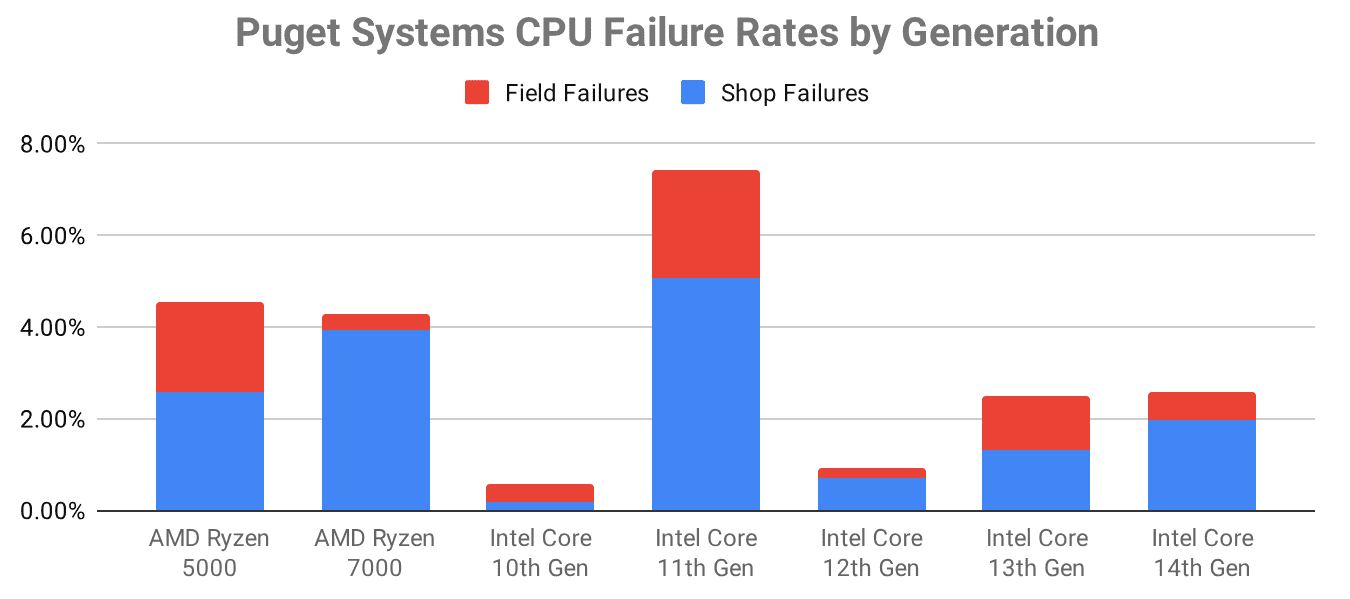
The Ryzen 7000 Series and Ryzen 5000 Series, AMD’s older lineups of desktop CPUs based on the Zen 4 and Zen 3 architectures, have a higher failure rate than 13th and 14th Gen Intel Core processors, according to new data that has been shared by Puget Systems, a company that describes itself as being America’s #1 custom computer builder. AMD chip failures are shown exceeding 4% in a chart from Puget that shows failure rates in the context of multiple generations, which is higher than Raptor Lake, although Intel still appears to lead substantially in failures based on what Puget experienced with its 11th Gen Core processors.
Puget’s Jon Bach writes:
- “…the Intel Core 13th and 14th Gen processors do have an elevated failure rate but not at a show-stopper level.”
- “14th Gen isn’t as rock solid as Intel’s 10th or 12th Gen processors, but at least for us, it isn’t yet at critical levels.”
- “Based on the failure rate data we currently have, it is interesting to see that 14th Gen is still nowhere near the failure rates of the Intel Core 11th Gen processors back in 2021 and also substantially lower than AMD Ryzen 5000 (both in terms of shop and field failures) or Ryzen 7000 (in terms of shop failures, if not field).”
- “We aren’t including AMD here to try to deflect from the issues Intel is currently experiencing but rather to put into context why we have not yet adjusted our Intel vs. AMD strategy in our workstations.”
Puget Systems’ CPU failure rates by generation:
Bach added:
We…are concerned with the rise in failure rate, but it is not at a level of severity that changes our CPU recommendations for our customer workflows. We will start with internal testing for stability and performance. If it passes that testing, we will begin using it on our shipping configurations as soon as possible.
Discussion (5 replies)
Join Discussion →All I see are numbers of CPU failure, and no details of what issues the CPUs experienced. I seriously doubt the veracity of their report. They stated that they overclock...so does this mean maximum overclock? Stable overclocks? Modest overclocks? What? What kind of issues did they experience with the CPU failing? They are trying to keep up their intel sales (I know what they said, but hmmmm).
Very true, also no indiciation of numbers sold - so could be "more returns" just due to the statistics of having sold more of those types of systems.I retract this statement - the article shows failure by percentage, which is indeed a rate and irrespective of total volume sold.
It also differentiates between "shop" and "field" failures, so while it isn't as nuanced as @Slag-King mentions (and those are very valid points, btw) - it does at least give an indication of what failures are happening after the systems ship, versus what Puget is catching during the building phase using whatever QC checks they have in house.
That may be the case... but Intel has set it up as a ticking time bomb with all the news. Your CPU WILL FAIL if you don't get the checks in place in time. If you don't it's damaged goods and will require an RMA to ever be truly stable again. If you DO it SHOULD be fine... most likely. For the life of the system whatever that is.
Problem is the fact that the ticking time bomb in materials/configuration exists and has existed for as long as it has without someone addressing it. If you got on the 13th gen K series (or non now) bandwagon and did the higher speed memory clock to take advantage of Intel's great memory controller... guess what... you started cooking your CPU. FASTER than otherwise.
Even if you did the manufacturer spec for the motherboard bios settings you're still COOKING your CPU and it WILL fail sooner than expected.
Yea consumer is small potatoes. But consumer hardware is what most of us with home systems run even if we build out big bad servers for our work. And that consumer experience INFORMS our professional experience. Hands down.
Would my consumer experience inform my CPU choice in the enterprise. YES. Would it sway me off of Intel... maybe. Depends. Still not 100% off but damn if I wouldn't give some EPYC CPU's a try where it works for my use case.
So yea raw failure rates today... AMD might be a bit more. But the failures are due to things failing in an predictable manner.
Not Intel... it was running fine for 6 months then started crapping the bed left and right because XMP finally cooked my CPU.
I'm considering AMD 9000 series for my nnext machine but only of they managed to remove some of the bugs/quirkiness from the 7000 series.
I did dodge a bullet by not going for a 14900k to retain my platform due to the limited gains.
But it seems my USB ports are starting to fail and some other crap going on with my current machine which will make an upgrade kind of necessary in the near future.
Yeea I'm thinking 9000 series for.my next refresh when the new motherboards come out for it. I should say chipsets.