
Conclusion
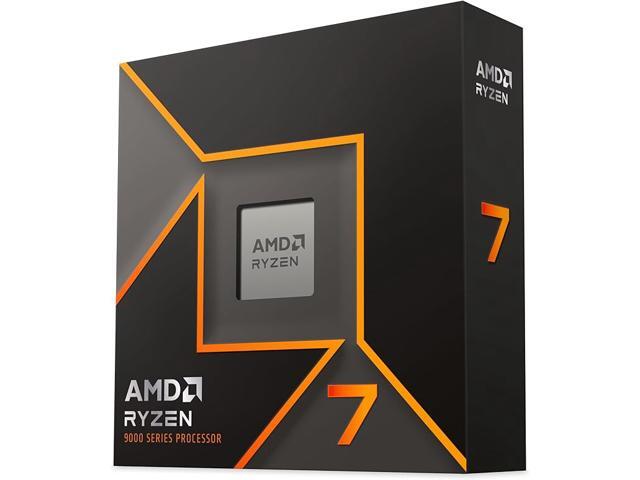
Announced at Computex 2024 in early June, the AMD Ryzen 9000 series Zen 5 desktop CPUs are here. The first off-the-block, and will be available in retail is the AMD Ryzen 7 9700X and AMD Ryzen 7 9600X on the shelf on August 8th, 2024.
The AMD Ryzen 7 9700X has an official set MSRP of $359 from AMD, coming in 11% cheaper at launch than its predecessor, the AMD Ryzen 7 7700X which launched in September of 2022 at $399. Two years later, the Ryzen 7 9700X replaces it, at a lower price at launch, and based on a new architecture, and a better process node from TSMC. The Ryzen 7 9700X ushers in a new wave of efficiency, yet performance that exceeds the previous generation in some key areas.
At its heart, the Ryzen 7 9700X is an 8-core/16-thread midrange CPU, similar to the Ryzen 7 7700X with a boost clock that is 100MHz higher at 5.5GHz, and the same 40MB of total cache, and 32MB of L3 cache. The differences come down to the process node at now 4nm for the CCD, compared to 5nm on the 7700X, and a lower overall TDP of 65W compared to 105W on the 7700X. With architecture changes, the AMD Ryzen 7 9700X is able to surpass the Ryzen 7 7700X in performance for multi-thread and single-thread workloads thanks to its IPC uplift.
In our review of the Ryzen 7 9700X today, we put it through a hard course of testing in system benchmarks, synthetic testing of multi-thread and single-thread workloads, content creation, and of course gaming. Our goal was to see what the differences were compared to the Ryzen 7 7700X it is replacing, as well as include the competition’s CPUs for reference. We have more gaming-only focused reviews planned for the future, so stay tuned.
Power to Performance Efficiency
One key takeaway we want to shine focus on is the incredible power efficiency of the Ryzen 7 9700X. The fact that it performs faster than the Ryzen 7 7700X, yet runs at an all-core lower clock frequency, and a lower package power, while providing an uplift in performance. This, and the incredible single-core/thread IPC performance uplift it provides are probably the most exciting facts about the AMD Ryzen 7 9700X.
At a package power of 88W, compared to the Ryzen 7 7700X at 142W, the Ryzen 7 9700X outperforms the Ryzen 7 7700X in our testing. Our testing also showed that on an all-core/full-load the Ryzen 9700X operates all cores at 4.4GHz, which is lower than the Ryzen 7 7700X at 5.2GHz, yet the Ryzen 7 9700X is still faster in actual performance. This combination yields a very low operating temperature for the Ryzen 7 9700X, which ultimately means you do not need exotic or expensive cooling to achieve good performance, saving you money. It also makes us excited for PBO, and enabling that for even better performance which we will test at a later date.
Single Thread Performance and IPC
The single-thread/core IPC performance uplift the Ryzen 7 9700X offers is impressive. In fact, this is its claim to fame, in our testing. Most of the performance improvements were coming from this single-thread performance uplift, and this is the sort of thing that helps gaming performance as well.
Naturally, each game is going to vary, also depending on your game settings, but you could see up to 6% gains right now at 1080p, showing its potential. The single-thread performance of the Ryzen 7 9700X in gaming rises up to the level of the 14600K and 14700K’s single-thread performance, which was very good in gaming as well.
It also helps applications and performance for common business-type tasks, for example running Microsoft Office and Office applications. The PCMark 10 system test had it performing at the top of the charts, and that benchmark is focused on light office-type workloads. We also saw specific 1T performance in 3DMark and Geekbench. There were huge gains in AES encryption performance. Even content creation, like Cinebench R23, showed a great 1T performance.
It is important to keep in mind that single-thread/core IPC performance is exactly the sort of thing that will help future gaming performance on faster GPUs. Games and video cards are evolving, and we think the true power of this performance uplift will only improve over time with new and faster GPU releases. The Ryzen 7 9700X will certainly have longer legs, than the previous generation, and it makes us excited for the “X3D” part to come.
Multi-thread performance is also up a bit, we saw common improvements even in content creation apps like V-Ray, and Cinebench R23, but it was more of a mixed bag for multi-threading. Interestingly, memory bandwidth is up 5% on the Ryzen 7 9700X using the same RAM and memory frequency and timings. Clearly, work has been done.
Pricing
The biggest enemy of the Ryzen 7 9700X is actually AMD’s own CPU lineup, specifically their current, now previous generation, Ryzen 7000 family. While the Ryzen 7 9700X is launching at a lower MSRP than the Ryzen 7 7700X launched, which is great to see, current street pricing on the Ryzen 7 7700X has fallen a lot over time, it’s been 2 years. You can find the Ryzen 7 7700X around $300 now online (even slightly lower in some places), which puts the Ryzen 7 9700X in a precarious situation by comparison.
If you are on a current Ryzen 7000 series CPU, there is no reason to upgrade unless you want to go for a CPU with a higher core count. If you were on the Ryzen 5 7600X, the Ryzen 7 9700X would be an upgrade with a core count increase that would make a difference for you. Otherwise, the Ryzen 7 9700X would be a good option for those who have waited to jump on the AM5 platform and still have AM4 systems or the Intel equivalent. It makes more sense, for people on older platforms wanting a good midrange Zen 5 CPU that can take on many tasks, and game very well.
If you now want to make the jump over to AM5 now that AMD has committed to AM5 longevity of 2027+, then the Ryzen 7 9700X makes some sense. It will have better single-thread IPC performance, which over time, will help in gaming performance on faster and faster GPUs to come. If you are driving applications that also benefit from single-core enhancement or AVX, then the Ryzen 7 9700X will also help, or if you need more cores, it’s a great 8-core option. Just be aware, that you won’t be seeing huge multi-thread performance improvements compared to the Ryzen 7 7700X overall.
Final Points
The AMD Ryzen 7 9700X is a continued evolution of the AM5 platform from AMD and extends leadership in 8-core midrange CPU performance for business, content creation, and gaming. It is great that AMD has announced a furthering of the longevity of the platform to 2027 and possibly beyond. There have been a lot of consumers worried about the switch to AM5, but those worries should be gone now.
The AMD Ryzen 7 9700X is not a major change from the previous generation, but rather a steady and continued forward march to iterate upon it, with performance gains in key specific areas. As time progresses, and prices fall just like the 7700X did, as well as the 7700X inventory begins to dry up as well, then the Ryzen 7 9700X will increase in its appeal over time and it may age very well for performance in many situations.



Discussion (19 replies)
Join Discussion →I'm sorry. LESS Power draw, Slower Clock. But so much IPC gain that it out performs it's previous generation.
I can not WAIT to see the 9950 and 9900 reviews!!! (Especially when you get the new gen of motherboard chipsets!)
So all we get basically this go-around is better power-efficiency.. I mean, that's all well and good but this was AMD's chance to put their foot on Intel's throat and they missed the mark...
Thank you Brent for a thorough review as always!
How do you figure they missed the mark? the 9700x is out performing in many cases systems with more threads from Intel.
Maybe if the 9900x is loosing to the 14700k you will have a point.
But an 8 core processor trading blows with 20 and more thread CPU's from the competitor is impressive. And for FAR less power?! AND lower GHZ rating. That's an IPC and Power improvement on an impressive scale.
Missed the mark... do you work for intel marketing? Or did you just misread the article?
Nah, think @Space_Ranger may have not realized that these are basically i5 competitors, but also are falling between 14th gen and whatever comes next from Intel. Weird place to be.
Intel was barely holding on to any 'marks' up to this point. 7800X3D erased really any reason to go Intel purely for gaming aside from cost or wanting something that is only available on the Intel platform.
Higher IPC, efficiency, and lower temperatures. There's still overclocking to consider, could be plenty of headroom above 88W stock, and the thermal improvement bodes well for overclocking as well as for the eventual X3D releases.
Yeah idk, it feels like techtubers are missing the mark on this one and people are just being dense.
I didn't misread the article. I did take other reviews into my OPINION on the matter. If having an opinion you don't like placing me in "Intel Marketing" territory, then so be it..
No it just seems way off the mark of the review. And others in have seen this far. To be fair inhacent hunted for ones either.
Personally excited for the 9900x and the 9950x
Thanks, @Brent_Justice for the thorough review. Glad to see the single-threaded performance gains and improved power efficiency. I'll probably be holding out for a bit longer but still keeping track of AM5 progress and happy to see CPUs like this making their strides.
@Brent_Justice
Yeah I would like to echo Peters comment, that was a great review.
The title picture is a bit cheeky tho.... =)
I did not see it mentioned but I have not read everything, how is RAM and/or system stability? I seen techtubers having lot's of issues with RAM speeds and crashing of benchmarks.
I need to see this improved b4 I will consider these CPU's (the 3D variants anyways)
@Brent_Justice can probably expand more on this...
1. We haven't had stability issues with our systems.
2. We're using AMD's suggested configuration, which is essentially the X670E board and EXPO ram kit that they shipped for the Zen 4 launch reviews. We haven't dabbled with various configurations.
3. We're using a very new bios for the board that AMD sent us (that is not released yet to my knowledge).
4. The motherboard/bios combination is what is setting FCLK in EXPO mode. Our board is setting it to 2100MHz - different boards will set it to different values, however, AMD says that if you're not stable at 2100MHz (as it's going to depend on CPU quality and board), to drop the FCLK manually to 2000MHz (in non EXPO mode it runs even lower than this). I suspect this could be part of what the TechTubers are running into is having a board/CPU combo that doesn't like the board's selected FCLK.
I will echo what David said. So far, I have only seen 1 TechTuber report stability issues, but I haven't watched a ton of videos yet. I do not know if stability problems are a widespread issue. For my testing, I had absolutely no stability problems with the 9700X and 9600X. I actually tried 2 different BIOS's on the ROG CROSSHAIR X670E HERO I'm using, first, the official public BIOS from ASUS prior to the launch, which was version 2124 dated 7/19, this BIOS is based on AGESA Combo AM5 PI 1.2.0.0a. I had no problems at all with the 9700X on this BIOS. Second, I updated to BIOS 2201 provided by AMD, it is still based on Combo AM5 PI 1.2.0.0a but adds a PatchA for improvements with 12c and 16c Zen 5 CPUs, that's the only difference in that BIOS, but I also had no problems with that. Right now, ASUS has an even newer one on their website, 2204, but I have not used it yet, it only became available on the 5th, and it says the exact same Combo AM5 PI 1.2.0.0a PatchA version as the one AMD sent.
David hit the nail on the head with FCLK. It is possible some might experience issues on certain CPUs/RAM/Mobo combos with a higher 2100MHz (or higher) FCLK (Infinity Fabric). The "sweet spot/safe spot" for stability is 2000MHz. In the one video I saw, of the tech tuber having stability issues, they did manually set it to 2000MHz. So beyond that, I don't know what else would case stability issues. But, surely you may see some differences in both performance benchmarks, and stability, based on the motherboard/RAM a reviewer is using for reviews, so as I stated in our YouTube video, make sure to always check the Test Setup page for any review you read online, to see what they are running.
For me, and the hardware I'm using, this launch was super smooth. The only thing that I questioned was the performance I experienced, I felt it to be below expectations, therefore I exchanged a lot of messages back and forth with AMD to share my concerns, and experiences and compare benchmarking performance. AMD actually re-ran several benchmarks in their labs, of what I was using, so we could compare notes and validate performance. There was a good interaction there with AMD, and AMD was very tentative about my experiences in regards to the performance that I experienced.
Great review. I sat out the last round, still on AM4 5700x. I hope the AM5 mobos that are in the wild will at least boot and allow a firmware update, if I end up buying a Microcenter bundle or whatever.
I'm going to wait on the new chipset because I'll ride that combo for a least a couple years.
AM4, one for the history books for sure. Nothing really wrong with AM5 and some nice features for sure but AM4 has stood the test of time for just getting the job done.
Just checked, coming up on its 8-year anniversary in September.