
Lenovo, CyberpowerPC, and MSI are three of the companies that may not honor Intel’s extended CPU warranty, with Acer, Dell, Alienware, and NZXT being among those that will not, outright, promise a warranty extension for the instability issues plaguing 13th and 14th Gen Intel Core processors, according to the results of a query to several popular PC makers that have been shared online. The report, which includes the responses (or lack of responses) from 14 companies, notes that while some have agreed to extend their warranty (or even beat Intel’s), others were more vague.
What PC makers think about Intel’s warranty extension:
- “Acer — would not promise warranty extension.”
- “Asus — two-year warranty extension.”
- “Dell and Alienware — would not promise warranty extension but ‘all costs are covered.'”
- “HP — two-year warranty extension.
- “Lenovo — no reply.”
- “MSI — no reply.”
- “Corsair — four-year total CPU warranty.”
- “Digital Storm — five-year CPU warranty.”
- “Falcon Northwest — five-year total CPU warranty.”
- “Maingear — five-year total CPU warranty.”
- “Origin PC — four-year total CPU warranty.”
- “NZXT — would not promise warranty extension.”
- “Puget Systems — three-year total CPU warranty.”
- “CyberPowerPC — no human reply.”
- “iBuyPower — five-year total CPU warranty.”
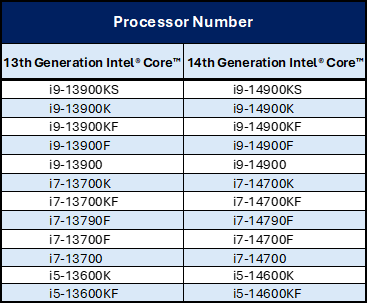
CPUs that are covered by Intel’s two-year extended warranty:
From a report:
…what if you didn’t buy a chip — but, rather, an entire PC? Will PC makers have your back? Will they pass along the extra two years of warranty that Intel just theoretically granted them or perhaps try to save money at your expense? We asked over a dozen desktop computer companies that last question.
There is no fix for Intel’s crashing 13th and 14th Gen Raptor Lake desktop processors. If your chip isn’t yet damaged, please apply motherboard BIOS updates early and often to prevent issues. If it’s already damaged, your only option is to exchange it.
Discussion (6 replies)
Join Discussion →This isn't surprising. Warranties from OEM's are for the total system for a period of one year typically. Outside of that there is no warranty what so ever unless you bought an extended warranty or your particular hardware has a longer one as is the case with servers and workstations.
Since this is how most CPU's are procured by the public, Intel won't actually have to replace that many of them in the grand scheme of things.
Other than laptops, I typically buy by the part.
I'm guessing its like if I got a new refrigerator. If the 6502 (just go with it) running the display does some self immolation, I dont have a warranty on the part do I? Hmmmmmmm
Socketed CPU's vs soldered I see being an issue too.
Do OEM's get a warranty on parts they purchase? Or some sort of defect/damaged protection?
For our community, persons knowledgeable of hardware/software and who keep in touch with industry news and events, yes, we all know the root cause is with Intel along with other specifics.
For John Q Public, with his new iBuyPower (just to pull a name at random), they dont know anything beyond who they bought from and the brand name on the box that stopped working and was giving them so much trouble. HP, Dell and the like are big enough to be able to get attention and perhaps considerations from Intel, I just dont see the smaller, more thin of a margin, iBuyPower type places having the resources without Intel support. Maybe that is why Intel laid off so many employees?
Anyhow its late and I drone on....
Thoughts? Opinions?
Typically - yes. An integrator or manufacturer will get some warranty on parts they purchase
Usually, though, that warranty is not transferable
So Motorola sells Frigidaire that 6502, and you buy that refrigerator. When that 6502 breaks - Frigidaire can make a warranty claim as the original purchaser, but not you as the end user. That’s why the warranty claim flows up through Fridigdaire.
Some warranties are transferable - like for your car, if you sell it before that 50K/5 years is up, the remainder transfers to the new owner. But the warranty has a specific clause to allow for that.
Not exactly if it turns out to be a design flaw with the product then it doesn't matter if it is still under regular warranty or not.
Oh yes it does. Manufacturers have no obligation to do anything beyond the product's original warranty.
No, they are not obliged, but it opens them up for a class action.