
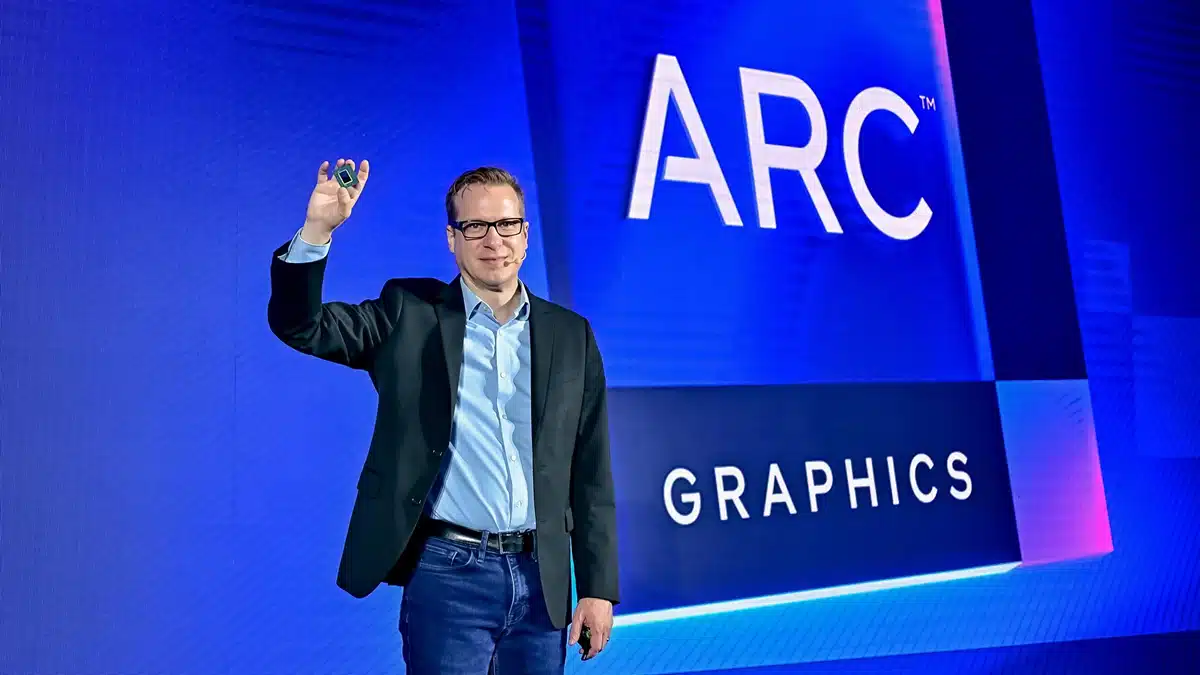
Intel’s future lineup of Arc graphics cards, including “Battlemage” (second gen), “Celestial” (third gen), and “Druid “(fourth gen), may comprise fewer models than what can be found in the current “Alchemist” series. That’s according to Intel CEO Pat Gelsinger, who mentioned during a recent earnings call about how Intel is “simplifying its roadmap” with “fewer SKUs” as part of its strategy for client products, noting that there’s “less need for discrete graphics in the market going forward.” Here’s the exchange between Gelsinger and Joseph Moore, who, according to his LinkedIn profile, is a semiconductor industry analyst at Morgan Stanley:
Moore:
… In your opening remarks, you talked about narrowing the product focus and prioritizing x86. Can you talk about, practically speaking, what happens there? Does that mean, are there other areas that you’re investing less in to focus more on x86? Is that a mindset shift, organizational shift? Just what do you mean by that?
Patrick Gelsinger:
Yes. And there’s a lot of details behind it, Joe, but I’ll just maybe give a couple of quick examples. We, for instance, create complexity in the server product line E-Cores, P-Cores across different socket types that complexity was maybe appropriate when the business was substantially larger and growing. At its current size, it puts too much complexity on our development as well as our customers and OEM, how many SKUs they’re developing. So we’ve taken steps to simplify the product line, have fewer SKUs to cover the marketplace, and we’re focused on the efficiencies associated with that. Similarly, in the client product area, simplifying the roadmap, fewer SKUs to cover it. How are we handling graphics and how that is increasingly becoming a large integrated graphics capabilities. So less need for discrete graphics in the market going forward. So simplifying the roadmap in those areas. And then the steps we took around our CCG and Edge business to be able to bring that together for better reach to the market, leveraging our core investments. So a variety of those, but many others behind that as we get ourselves, I’ll say, in fighting shape that allows us to leverage our investments, hit our $17.5 billion OpEx that Dave spoke about and still have a very solid growth in a more profitable way for the future.
Discussion (19 replies)
Join Discussion →as it should be as long as they keep at it. But maybe this mean they wont. Really 3 models is all that is needed. I dont know how many they had though.
I lost track but the lower they got the more I thought why as the gap shortened between iGPU and dGPU. I know people want budget cards but you can do a lot with a strong CPU with integrated graphics. Any time I buy a new gaming laptop one of the things I usually test is the iGPU just to see how it performs and the one my current, with a 13900HK, can play basic games fairly decently at 1080p.
Kinda sounds like Intel is throwing in the towel already. A 3rd player would be nice for keeping nVidia and AMD in check, but sadly Intel still hasn't really become a 3rd player in the GPU market yet. More like an interesting curiosity.
I agree with this too. Just need low-end, middle-ground, and high-end SKUs.
Intel just doesn't have the money to do it, and they are firing people left and right, teams are disappearing. It's sad to see, to be honest, they had the potential to be a real discrete GPU player and would have been a good one, they were on the right track.
As long as this does not result in wasted die's it's fine, the abundance of models is usually due to silicon defects and lack of production capacities
Unfortunately a lot of Intel's decisions haven't paid off and throwing money at that market segment just really isn't in the cards for them right now.
I was concerned this would happen.
Intel only jumped in because of the insane profit margins during the crypto boom, and now that those are gone, they are out.
Which is sad. We really need 3-5 active competitors in the industry for it to function right.
We almost had three for the first time in over 20 years, then AMD announced they were no longer going to focus on the high end, Nvidia announced they are no longer a graphics company, and Intel does this...
The industry is really fucked and completely broken when something for which there is so much demand just isn't worth it to these companies.
Who's going to save us?
I guess soon it won't matter, everything will be core integrated.?
I don't think even Linus at his height pulled in enough of that sweet sweet Google money to buy out Intel.
But if Intels current trajectory continues.... :p
Need to send their MBAs to anti-ADD school, like most short-sighted companies
I don't think it was necessarily the WRONG thing to at least try, given the margins GPU's were fetching there for a while.
And many were preaching how crypto was the future. They probably expected the boom to stick around longer.
The justification was probably based on the fact that if things didn't work out they could always just scale it down to IGP levels and use it to better compete against AMD's increasingly performant APU's and it wouldn't be a complete waste.
Though I suspect that was held in the reserve in case they really went up shirts Creek, but here we are with Intel in a precarious situation. If they weren't in as much trouble as they are right now, I bet they would continue to market Arc discrete graphics products, but you know, they can't sell discrete graphics cards if they aren't there to sell them because they ran out of money.
So they need to right the ship first.
Maybe after that, they will come back to discrete GPU'e. Who knows.
If I fault the Intel Old Guard for anything, it is probably a bit of hubris, partly from a "We are a Intel, we can do anything" perspective and partly from a perspective where they never expected to find themselves in this situation.
Extreme times call for extreme measures. Intel has had some troubles since early 10nm woes (which we didn't know of yet)forced them off of the Tick-Tock model in 2016, but I don't think they ever expected to find themselves in the situation they are now, despite these difficulties.
They have always had an air of "we are the market" and inevitability about them, and that's how giants fall.
IBM - Hold my beer!
BlackBerry - Hold my beer!
Any number of 'too big to fail!' ?
Indeed.