

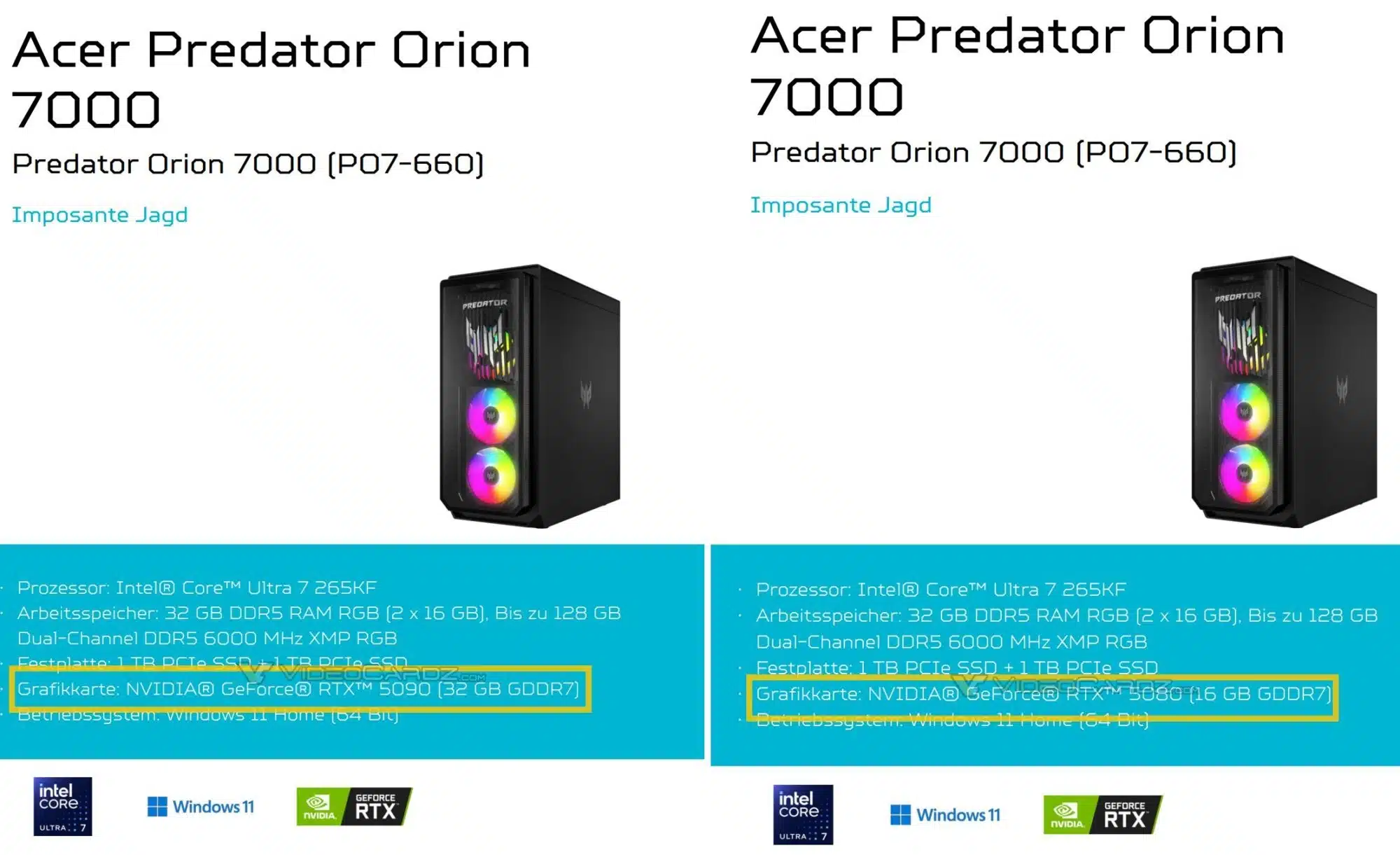
ACER has seemingly confirmed NVIDIA GeForce RTX 5090 32 GB and RTX 5080 16 GB memory sizes via a leaked datasheet. With only two weeks to go until CES 2025, when NVIDIA CEO Jensen Huang is expected to officially unveil the new RTX 50 series, it appears one needn’t look for rumors from hardware insiders since it seems easier to obtain promotional materials and content from manufacturers instead. The latest comes via datasheets for ACER’s Predator Orion 7000 series pre-built gaming PCs which appear to be getting updated with the unreleased GPUs.
According to the datasheet, ACER is planning two models, one with an NVIDIA GeForce RTX 5090 32 GB graphics card (a VRAM configuration recently listed Zotac as well) and then an alternate with an NVIDIA GeForce RTX 5080 featuring 16 GB of GDDR7 memory. Both models also include an Intel Core Ultra 7 265KF processor, something many gamers are likely to wonder about, paired with 32 GB DDR5-6000 of system memory. The leaked datasheet comes via VideoCardz who somehow managed to obtain it.
NVIDIA GeForce RTX 5080
The NVIDIA GeForce RTX 5080 graphics card is rumored to use a GB203 die with 10,752 CUDA cores. It has also been rumored that it may launch with two variants, one with 16 GB, and another with 24 GB of GDDR7 memory, both on a 256-bit bus. Another new rumor states that its memory modules will be running 30 Gbps providing 960 GB/s of bandwidth. Its TDP might be 400 Watts.
NVIDIA GeForce RTX 5090
The NVIDIA GeForce RTX 5090 graphics card is rumored to use a GB202 die with 21,760 CUDA cores. While 32 GB of VRAM seems all but official it is still not known if this will be on a 384-bit (similar to past x90 models) or on a 512-bit bus (something rarely seen on consumer graphics cards) that could have a bandwidth of over 1.7 TB/s. The power draw for the unannounced card is believed to be around 600 Watts.
Discussion (2 replies)
Join Discussion →Wow.... those cuda core counts are HUGE... was the 4080 and 4090 that disparate from each other... to google!
While 16384 is MUCH higher than 9728.. it's no 21760, compared to 10752. If scaling is linear for these types of cores the performance difference... should be rather drastic and leaves PLENTY of space for a TI and TI SUPER ULTRA model too of the 5080.
Of course this just about guarantees that Nvidia will be charging AT LEAST 1k for the 5080 and probably bottom dollar 2200 for the 5090, at least in my mind... sadly.
I can’t recall a time when general performance has ever been linear with core count.
Some specific benchmarks, sure, but there always seems to be diminishing returns in real world performance just from throwing more cores at it — even taking out items like power and thermal restrictions that often kick in and can result in lower performance from extreme core counts