
Doom: The Dark Ages
Doom: The Dark Ages was released to PC in May of 2025 and uses the id Tech 8 game engine. This game features advanced graphics technologies, including path tracing, realistic lighting, reflections, and soft shadows. It has fully ray-marched volumetric effects with dynamic lighting and improved particle effects. It has detailed destructible environments, realistic water, and upscaling technologies such as DLSS 4. This is another one of those games that has ‘ray tracing’ enabled at all times, by default. You can optionally enable Path Tracing on top of it. We are going to utilize the game’s built-in benchmark level: Reckoning, but we will utilize Frameview to capture 1% Lows.
Native Resolution
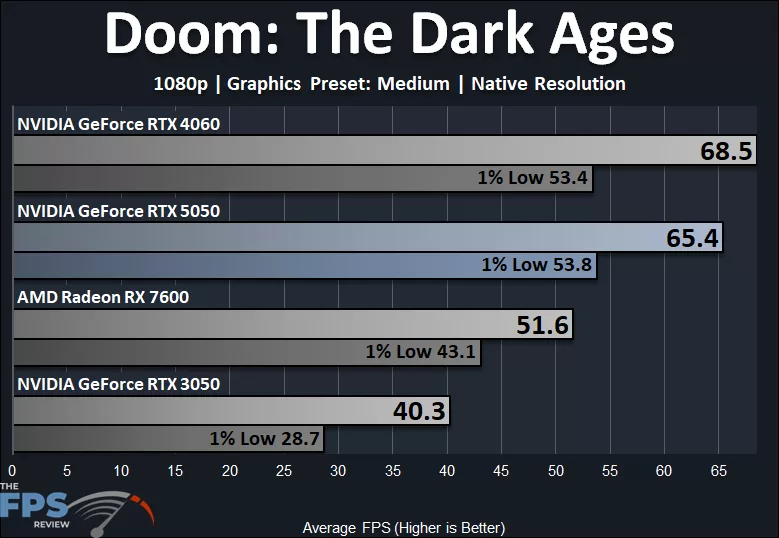
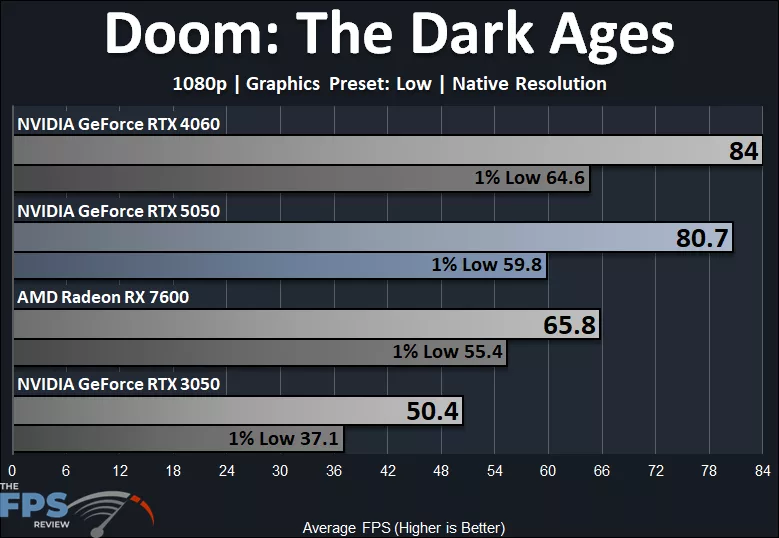
The first graph below is at the “Ultra Nightmare” quality preset, the second graph is at the “Medium” quality preset, and the third graph is at the “Low” quality preset at 1080p.
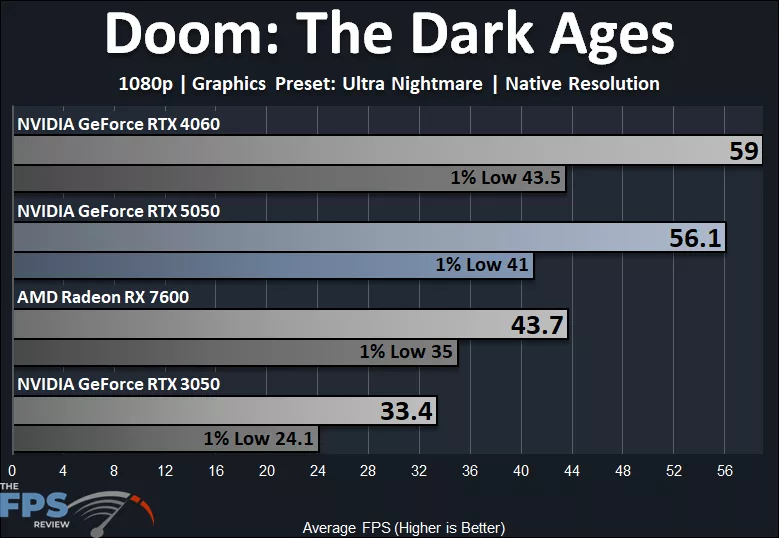
We wanted to start Doom: The Dark Ages off at the very highest quality setting of “Ultra Nightmare” just to see if the GeForce RTX 5050 could handle it at 1080p. We can see that it averages 56FPS, but the 1% Lows are at 41FPS, and for this game, we would not call that playable; therefore, this test is for academic purposes. The GeForce RTX 5050 is 5% slower than the GeForce RTX 4060, but 68% faster than the GeForce RTX 3050 and 28% faster than the Radeon RX 7600.
When we lowered the game down to the “Medium” setting, we can see that the average is only now above 60FPS, but the 1% Lows are still in the lower 50’s, so for this fast-paced game may not be the smoothest playable experience. The GeForce RTX 5050 is 5% slower than the GeForce RTX 4060, but they both have the same 1% Lows. The GeForce RTX 5050 is 62% faster than the GeForce RTX 3050 and 27% faster than the Radeon RX 7600.
Only at “Low” is the GeForce RTX 5050 truly playable at Native Resolution 1080p with 80FPS average and 1% Lows near 60FPS. The GeForce RTX 5050 is slightly slower than the GeForce RTX 4060, and 60% faster than the GeForce RTX 3050 and 23% faster than the Radeon RX 7600.
DLSS Upscaling
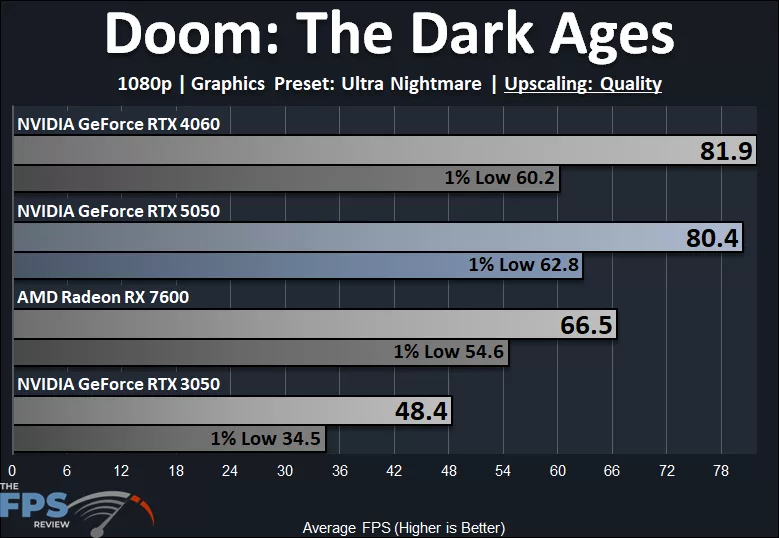
Now, what we did find is that when you enable DLSS Upscaling Quality mode, the GeForce RTX 5050 was playable at “Ultra Nightmare” settings at 1080p. You can see above that it averages 80FPS with the 1% Lows above 60FPS. This is just slightly slower than the GeForce RTX 4060, but 66% faster than the GeForce RTX 3050 and 21% faster than the Radeon RX 7600.
Path Tracing w/ DLSS Upscaling
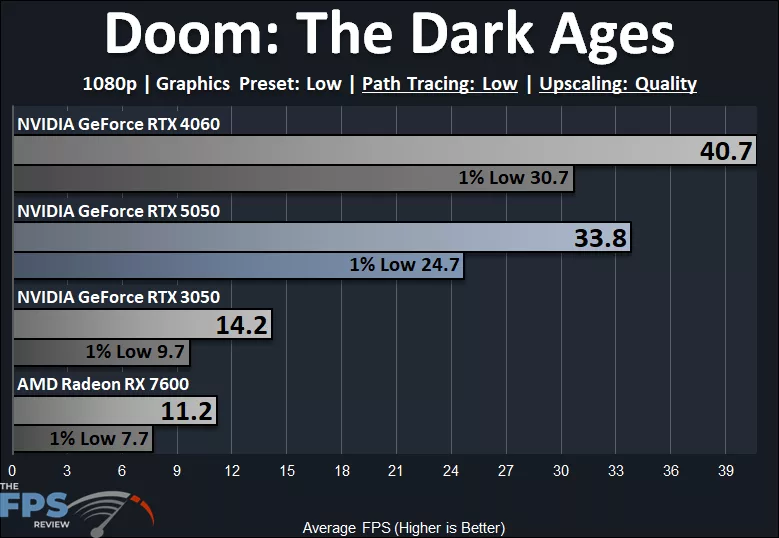
Just for academic purposes, we enabled “Low” Path Tracing at 1080p with the graphics preset also at “Low.” You can see that it is not playable, of course. Though we do see the GeForce RTX 5050 is below the GeForce RTX 4060 by 17%, but above the GeForce RTX 3050 by 138%.
Discussion (4 replies)
Join Discussion →Buy a used 4060.
Seems like a particularly hard sell when the 50-series' biggest party trick is at its least useful when the base framerate is a little tenuous.
The 130w/8GB combo is also kind of harsh. That's high enough draw that going for the modern card on an efficiency basis (while it will help a bit) won't be as dramatic an effect as you might like; and if you hit a VRAM wall anywhere it will be in the same place you would on a 3050; and one of the 12GB 3060s will still be chugging along for 40 watts more.
OEMs love these low end SKUs.
- Yeah, this is basically a repurposed laptop chip that would otherwise be used to bump a $499 office laptop into the $799 "entry gaming laptop" market.
These cards absolutely have their place however, good way to stand up a hella basic gaming PC that will be thesus' shipped into something respectable over time.
If you know what you're doing though, used 3080's and 6800XT's are starting to hit the $299 and lower price point (while 3070 and 6700XT are at $250 and below) and you'd get a helluva lot more bang from your buck there.