
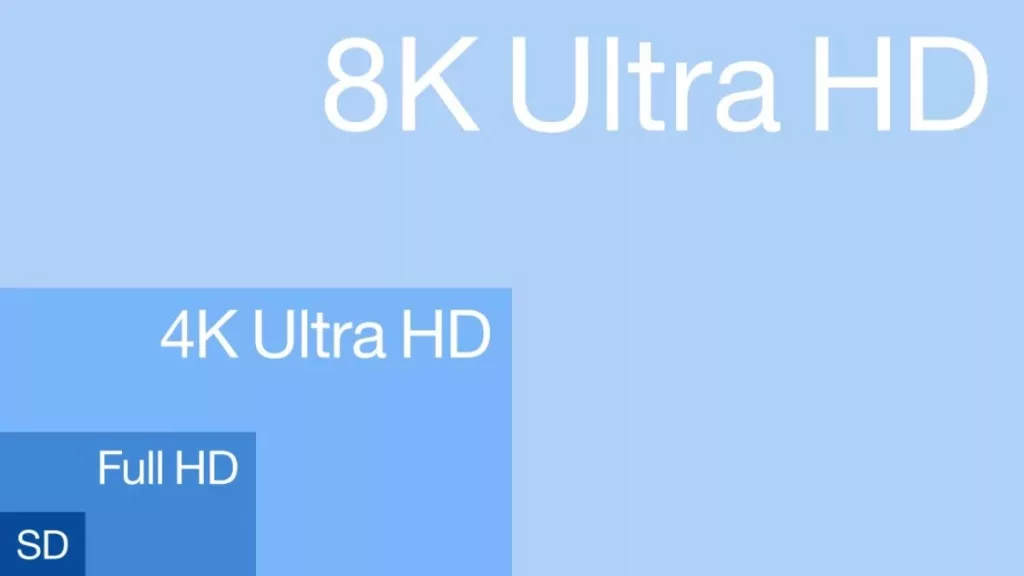
8K has had about as much popularity as a lead balloon since its arrival around ten years ago, but for those still interested in it, the basic rule is to go big or go home. Titled “Resolution limit of the eye — how many pixels can we see?”, a study (via Nature Communications) conducted by researchers from the University of Cambridge and Reality Labs has produced some interesting results. From an online optimal viewing distance calculator for various sizes and resolutions to an analysis of different rendering methods and detailed references to past studies of the human eye, there’s some interesting data to consider when thinking about what constitutes an optimal viewing experience with different types of displays.
“As large engineering efforts go towards improving the resolution of mobile, AR and VR displays, it’s important to know the maximum resolution at which further improvements bring no noticeable benefit, But there have been no studies that actually measure what it is that the human eye can see, and what the limitations of its perception are.”
-Dr Maliha Ashraf, Cambridge Department of Computer Science and Technology
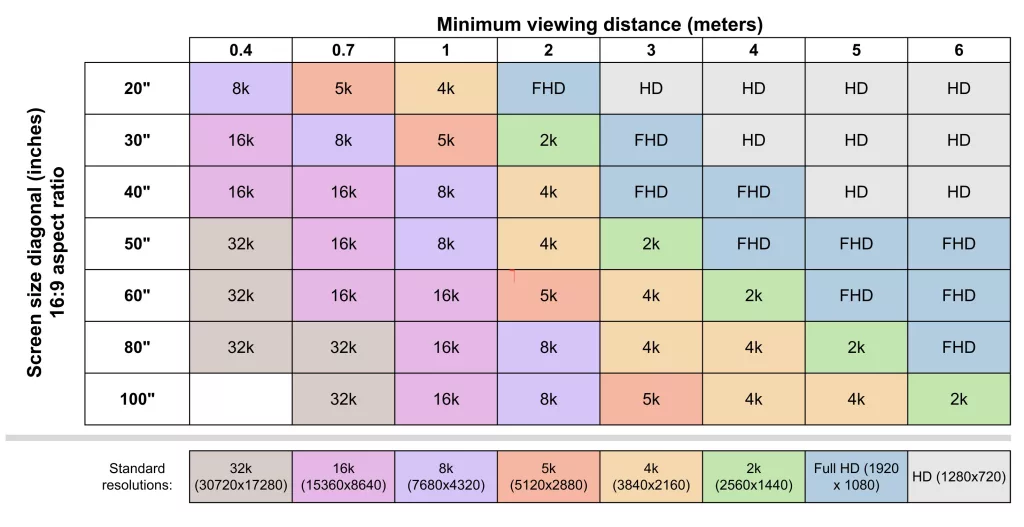
While the experiment had a low number of participants, 18 young adults with an average age of 26, there were 162 measurements recorded using a display setup featuring a sliding mount to adjust the distance from the subject. Generally speaking, it was discovered that most could not discern the increased pixel count of a 44-inch 8K or 4K if they were more than 2.5 meters (just over 8 feet) from the screen, and according to the above chart, a viewer would need at least an 80-inch screen to see the difference at 2 meters. There are numerous articles online suggesting similar optimal viewing distances, as are discussions regarding optimal PPI, but this one just adds to an ongoing compilation of data supporting that we are nearing limits of what can be perceived by the human eye with higher resolution displays in regard to their size and distance setups.
“Our results set the north star for display development, with implications for future imaging, rendering and video coding technologies,”
-Dr Alex Chapiro, Neta Reality Labs
Discussion (19 replies)
Join Discussion →Didn't they do the same thing with 4K as well?
This reminds of the stupid misconception that was widespread in the 90s / 2000s. That if you buy a larger TV you must sit proportionally further away from it. Which ofc. would completely defeat the purpose of the larger screen. There were even charts for this nonsense, that said how many feet further you have to move for every inch of screen size or something like that.
Depends on the size of the display.
I have both 1440 and 4K 32" monitors. I've played games on both. I can't tell a difference other than lower FPS on the 4K
Yeah, back when standard definition 480x720 was a thing. The larger the screen the larger those pixels became the worse it looked up close.
It's not nonesense, it's about field of view.
[URL unfurl="true"]https://en.wikipedia.org/wiki/Field_of_view[/URL]
Yes they used FOV to justify it and it was / is nonsense. Think about it. What is the benefit of a bigger screen if you view it from a distance so it appears the same size as a smaller one?
Except individual pixels weren't really discernible on a CRT or a Projector screen. And the distances were ridiculous like 10 feet for a 27" and such.
You sit closer you would need to pan your head to watch the whole screen. and no, it wasn't 10ft for 27"
[URL unfurl="true"]https://goodcalculators.com/tv-viewing-distance-calculator/[/URL]
I've got 27" 4K's right now... I dunno if I could tell between 1440 and 4k, I've never tried that... but I can definitely tell between 1080 and 4k.
27" used to be a giant massive cabinet of a TV though. I can remember my first TV was a 27" Trinitron and it weighed like 300 lbs and seemed absolutely ~massive~ in my living room.
I kinda miss that TV.
I recall the same argument for 1080p vs 720p and 4k vs 1080p.
The best way to point and laugh at the idiots is to not participate.
The limit of human vision at whole-screen distances is somewhere between 1440p and 4k; we can err toward 4k just due to the absolutely batty sub-pixel arrangements used by OLED makers, but really, you're not getting much more out of it.
And not just because your eyes can't see it, again at comfortable whole-screen viewing distances, but also if you could see the content on a per-pixel level, you wouldn't be able to pay attention to it at all. This is why good 1080p content is almost indistinguishable from low-bitrate 4k content, for motion content at least.
It's a little different on computer monitors, both for desktop use and for gaming. Here you are close enough to focus on a small area of the screen and details matter. But we'd still put 8k down as the upper limit of single-user single-screen scenarios*, as the extra resolution does nothing for the user aside from requiring more horsepower to run.
(*once you start having multiple screens, with or without multiple viewers, more resolution can be helpful, but really only at larger sizes and closer than full-display viewing distances, where essentially viewers are cropping into the viewable area)
I read somwhere that 16k is the max for the human eye's.
But 8k seems more realistic.
Its NOT resolution, is mastering and whatever else makes a quality image, period, end of story.
Every single time, resolution an effing gimmick.
Crap is crap at 16k, 8k, 4k, 1080, and 720p.
And most material and whatever they do for video is borderline crap, dont get me wrong, i am happily entertained with all the garbage I consume, but on the rare occasion I have seen better curated contents image quality wise, it is like ahhhhh, oohhh, you know celestial sounds and all that, ive seen this at 720p, and 1080p, i dont even remember what movie/ program it was, i just remenber thinking, what hell, a DVD can look this good all this time? And then same with blu rays, its all mostly crap, not showcasing capabilitilies, at any resolution.
Its cause, whatever they do editing, mastering , whatever, probably costs lots of money. Probably will always cost money even of they implement AI or some crap, AI will probably do a crap job and everybody will be like stick that 8k label and send it.