
Doom: The Dark Ages
Doom: The Dark Ages was released to PC in May of 2025 and uses the id Tech 8 game engine. This game features advanced graphics technologies, including path tracing, realistic lighting, reflections, and soft shadows. It has fully ray-marched volumetric effects with dynamic lighting and improved particle effects. It has detailed destructible environments, realistic water, and upscaling technologies such as DLSS 4. This is another one of those games that has ‘ray tracing’ enabled at all times, by default. You can optionally enable Path Tracing on top of it. We are going to utilize the game’s built-in benchmark level: Reckoning, but we will utilize Frameview to capture 1% Lows.
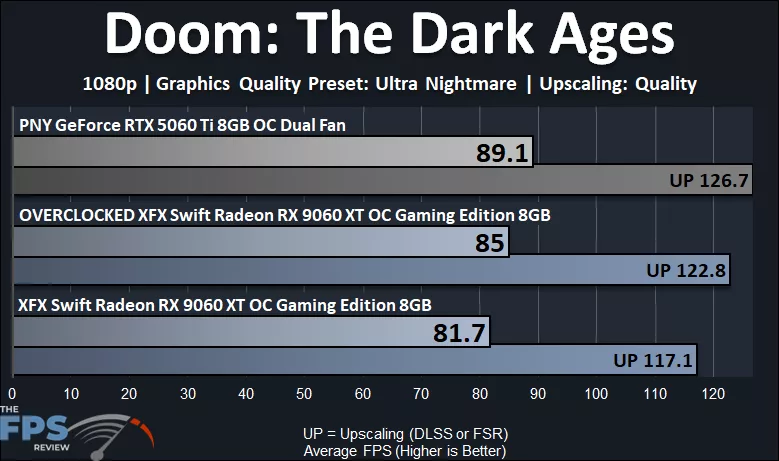
In Doom: The Dark Ages, we are running at 1080p but using the “Ultra Nightmare” quality setting, which is the game’s highest image quality setting. This game also has Ray Tracing turned on at all times and is thus demanding. The XFX Swift Radeon RX 9060 XT OC Gaming Edition 8GB does allow a playable experience in Doom: The Dark Ages at Ultra Nightmare and at native resolution with 81FPS average framerate. Enabling FSR Upscaling boosts that to over 100FPS average. The XFX Swift Radeon RX 9060 XT OC Gaming Edition 8GB is 8% slower than the GeForce RTX 5060 Ti 8GB video card. Overclocking the XFX Swift Radeon RX 9060 XT OC Gaming Edition 8GB improves performance by 4%.
Discussion (4 replies)
Join Discussion →In 2026, 8GB video cards will become more and more common as a need.
blox fruits
I wonder if we are entering a time of monitors going for better pictures but lower resolution and refresh rates for mass consumers.
I've been keeping an eye on 1440p stuff and from 2025 through 2026 there are quite a few examples of them getting more image quality related features. Basically catching up to what's been what's been happening with the 4K OLED stuff along with some other new features to boot. Sad part is that while 8 GB will suffice for many games at this resolution but there are certainly some AAA titles which will happily use 12 or 16 GB if the card has it to offer. However, there are some very cool 3rd and 4th gen 21:9 models out and on the way.
1080p panels has seen some improvements as well but I have noticed more effort has been put into to getting panels with insanely fast refresh rates which means as long as the system is overall fast, 8GB is perfect for those panels. It seems like the refresh rate angle is the larger focus for display manufacturers with the non-stop swath of 27" 1080p monitors.
The entire sentence could be deleted, and not be missed.