

Microsoft’s Advanced Shader Delivery has shown promising results in a round of testing, showing majorly reduced load times and improved 1% lows. From long load times to constant stuttering, gamers often encounter shader compilation issues in modern titles. Microsoft has been working to mitigate these issues by introducing Advanced Shader Delivery technology. Originally announced last August for ROG Xbox Ally handhelds, ASD uses a State Object Database (SODB) to create a precompiled shader database (PSDB) in the cloud to cut down compilation times.
“We have worked with our key hardware partners to separate out the shader compiler from the graphics driver and unite the game data in the SODB with the compiler in the cloud to create a Precompiled Shader Database (PSDB). This PSDB can be distributed by the Xbox store alongside the game to supplement the shader cache.”
– Microsoft
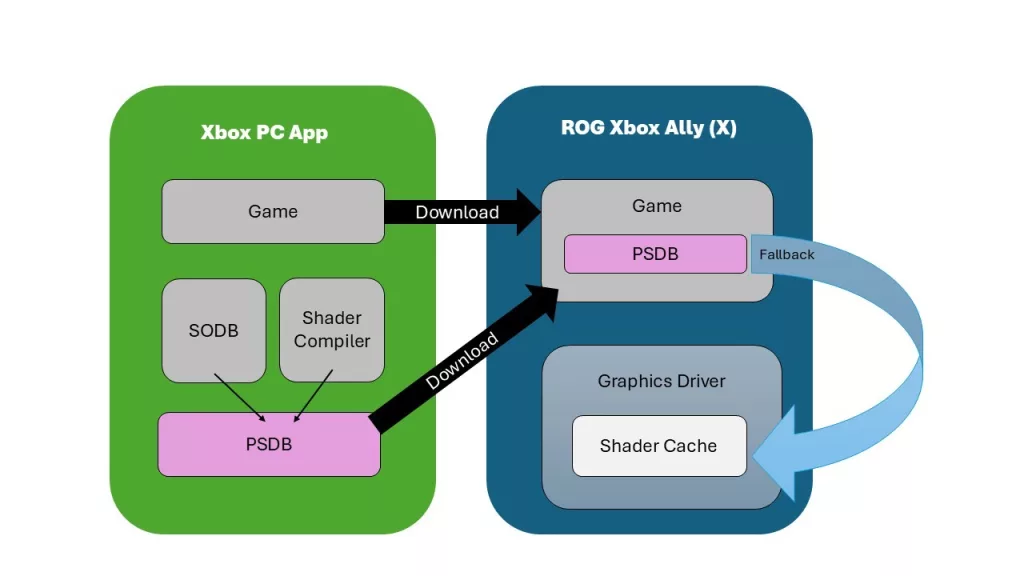
Now, roughly a year later, testing by Tom’s Hardware has shown that Microsoft has made significant gains with its Advanced Shader Delivery on PC hardware. While Microsoft is working with an assortment of partners, including NVIDIA and Intel, this round of testing was performed using AMD hardware. The test system consisted of a Ryzen 7 9800X3D with 64GB of DDR5-6200 memory and a PowerColor Red Devil Radeon RX 9070 XT.
As explained by Microsoft, Pipeline State Objects (PSOs) are where shader compilation issues arise, and often due to a massive amount of data being generated. A huge amount of PSOs can lead to the aforementioned increased load times and still might not encompass all the shader compilation needed for a game, leading to stutters when more are needed in-game. It’s possible for a game to fully compile all of its shaders ahead of time, but that could take hours depending on the needs of the title, so such an option is unlikely to be palatable to one wanting to sit down and play in the moment. This is where ASD comes into play with its cloud-based library of precompiled shaders, and the proof is in the pudding, where Tom’s testing has shown impressive results.
- Forza Horizon 6: Load times dropped from 48 seconds to 2 seconds. 1% lows increased from 54 FPS to 72 FPS.
- Hogwarts Legacy: Load times dropped from 71 seconds to 31 seconds. 1% stayed the same.
- The Outer Worlds 2: Load times dropped from 172 seconds to 9 seconds. 1% stayed about the same.
- Ninja Gaiden 4: Load times were unchanged since it does not perform a shader precompilation at launch, but 1% lows increased from 67 FPS to 74 FPS with a slight increase in average FPS.
- Avowed: Load times dropped from 174 seconds to 38 seconds. 1% stayed about the same.
- Silent Hill f: Load times were unchanged since it does not perform a shader precompilation at launch, but ASD was unable to solve any stuttering issues or improve 1% lows.
Multiple factors contribute to whether or not ASD can provide improvements, and these can range from a developer not uploading files to the SODB, supporting the feature, or limitations of the API. For games that do not perform shader precompilation at launch, there’s no change in load times, but there could be improvements during gameplay with 1% lows. However, for games that have a lengthy precompilation period at launch, load times can be drastically reduced by ASD. Clearly, Microsoft’s efforts with ASD show potential to improve gaming on PCs and are striving with its partners to advance the technology. Presently, there are only around 30 titles that support ASD, but Microsoft is working to add more via its partnerships with game developers and graphics card manufacturers.
“Today, Microsoft is uniting these ecosystem pieces between game developers, IHVs, and game stores to solve shader compilation on PC going forward.”
– Microsoft
Discussion (2 replies)
Join Discussion →I'll give them that it's a solid boost to load times. Notably faster than Forza 5 or 4.
And David has more regarding this from AMD's side of things here:
[URL unfurl="true"]https://www.thefpsreview.com/2026/05/18/amd-adrenalin-26-5-2-brings-microsoft-advanced-shader-delivery-to-rdna-3-and-rdna-4-speeding-up-game-loads/[/URL]