
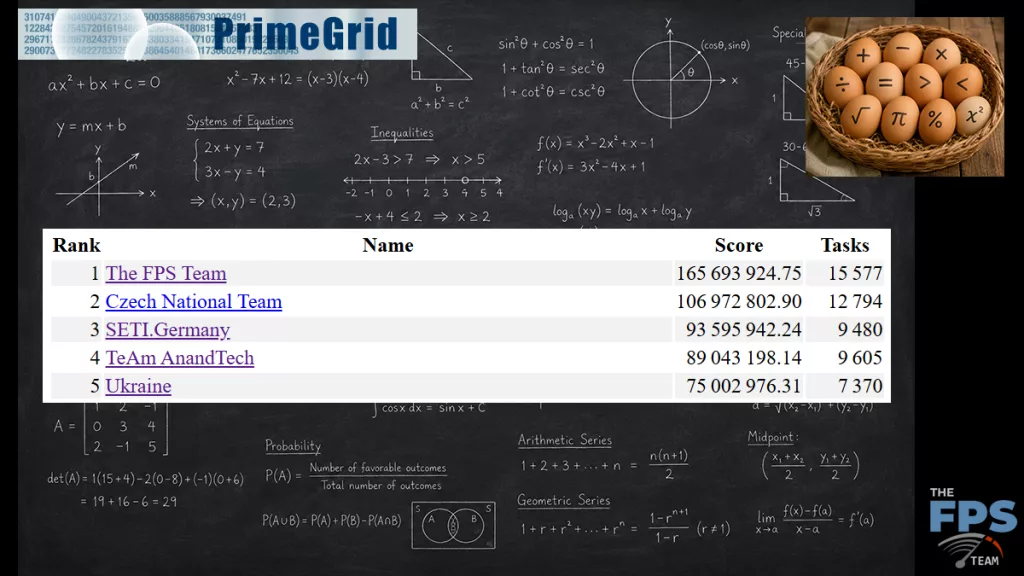
We did it. The FPS Team finished first in PrimeGrid’s National Egg Day Challenge, and it wasn’t close. Every member who attached a machine and let it run through the event is the reason we’re sitting at the top of the standings, and you have my thanks. This is exactly the kind of result we hoped for when we set up shop here at TheFPSReview.
If you’re reading this and have no idea what any of that means, stick around. Here’s what we just won and why it’s worth your time.
Final standings
| Rank | Team | Score | Tasks |
|---|---|---|---|
| 1 | The FPS Team | 165,693,924.75 | 15,577 |
| 2 | Czech National Team | 106,972,802.90 | 12,794 |
| 3 | SETI.Germany | 93,595,942.24 | 9,480 |
| 4 | TeAm AnandTech | 89,043,198.14 | 9,605 |
| 5 | Ukraine | 75,002,976.31 | 7,370 |
A new team taking the top spot over names that have been doing this for years is no small thing. That’s all of you.
What PrimeGrid is
PrimeGrid is a volunteer computing project that hunts for prime numbers. Not small ones. We’re talking about numbers with millions of digits, the kind that take a serious amount of math to confirm are actually prime. The project breaks that work into small chunks, hands them out to thousands of computers around the world, and stitches the results back together. Your PC does a slice of the search while you’re away from it.
It all runs on BOINC, the Berkeley Open Infrastructure for Network Computing. BOINC is free, open source software that quietly puts your idle CPU and GPU to work on real research. You install the client, attach to a project like PrimeGrid, and that’s about it. When you’re gaming, it gets out of the way. When you’re not, it crunches.
The 321 subproject
The National Egg Day Challenge ran on PrimeGrid’s 321 Prime Search. The name comes from the shape of the numbers it looks for: primes of the form 3 × 2^n – 1 and 3 × 2^n + 1. You take three, multiply it by two raised to some large power, then add or subtract one, and test whether the result is prime. Most of the time it isn’t. Every so often it is, and when it is, it’s enormous. The biggest 321 primes found so far run into the millions of digits.
You might be the one who finds it
Here’s the part that hooks people. The work units get handed out to individual machines, so when 321 turns up a new prime, it was found on someone’s specific computer. That someone could be you. PrimeGrid credits the finder by name, the discovery goes into the official prime number records, and depending on the size it can land on the list of the largest known primes on the planet over on t5k.org (top 5000 primes). It’s one of the few hobbies where the gaming rig under your desk can put your name on a real mathematical record.
You don’t have to run it year round
A lot of people assume joining a project like this means leaving your machine pegged at 100 percent forever. You don’t. The fun part, and the smart part for your power bill, is to go hard during competitions and ease off the rest of the time. A challenge like this one is a fixed window, usually just a few days. You spin up, you push, the team racks up points, and then you drop back to normal. Your electric meter gets a break, and you still get the rush of watching the leaderboard. Honestly, the competitions are the best way to do this anyway.
Fun math versus medical research
I’ll be straight about something. PrimeGrid is, at heart, a math project. Finding giant primes is genuinely useful for stress testing hardware and algorithms, and it’s a beautiful corner of number theory, but a lot of it gets done simply because it’s fun and because chasing records is a blast. There’s nothing wrong with that.
If you’d rather your electricity go toward something with a more direct human payoff, BOINC has you covered there too. SiDock@home runs molecular docking for drug discovery. World Community Grid hosts health research like cancer marker mapping and pandemic response. Rosetta@home, out of the Baker Lab, works on protein structure and design that feeds disease research. Same client, same idle hardware, different mission. Plenty of crunchers split their time between the fun stuff and the serious stuff, and that’s a perfectly good way to run a rig.
Next up: the World Snake Day Challenge
PrimeGrid sets the schedule and names every challenge, so we take them as they come. The next one in the series is the World Snake Day Challenge, running July 16 through 21. It moves off 321 and onto the Factorial Prime Search, which looks for primes of the form n! plus or minus one (n factorial, then add or subtract one). The acronym lines up nicely too: the FPS Team on FPS.
Fair warning, this one is not set and forget. Factorial Prime Search runs multiple threads per task and leans on a decent chunk of L3 cache, so raw core count isn’t the whole story. The move is to run only as many tasks as your cache can actually feed. On AMD that means keeping each task inside the L3 of a single CCD or CCX instead of letting it spill across the die, and on Intel you’re balancing against the shared L3. Run too many at once and the tasks starve each other on cache and your throughput drops. Dial it in and this becomes the kind of challenge that rewards people who enjoy tuning, which is to say it’s built for this crowd.
So mark the 16th. If you want in and haven’t joined yet, install BOINC, attach to PrimeGrid, and find The FPS Team in the team list. https://www.primegrid.com/team_display.php?teamid=8796
First place looks good on us. Let’s go get the next one.
Discussion (1 reply)
Join Discussion →Awesome job guys!
I thought I was gonna hold the top spot and then, out of freaking no where, @Icecold came crashing in like the kool-aid man. Haha