

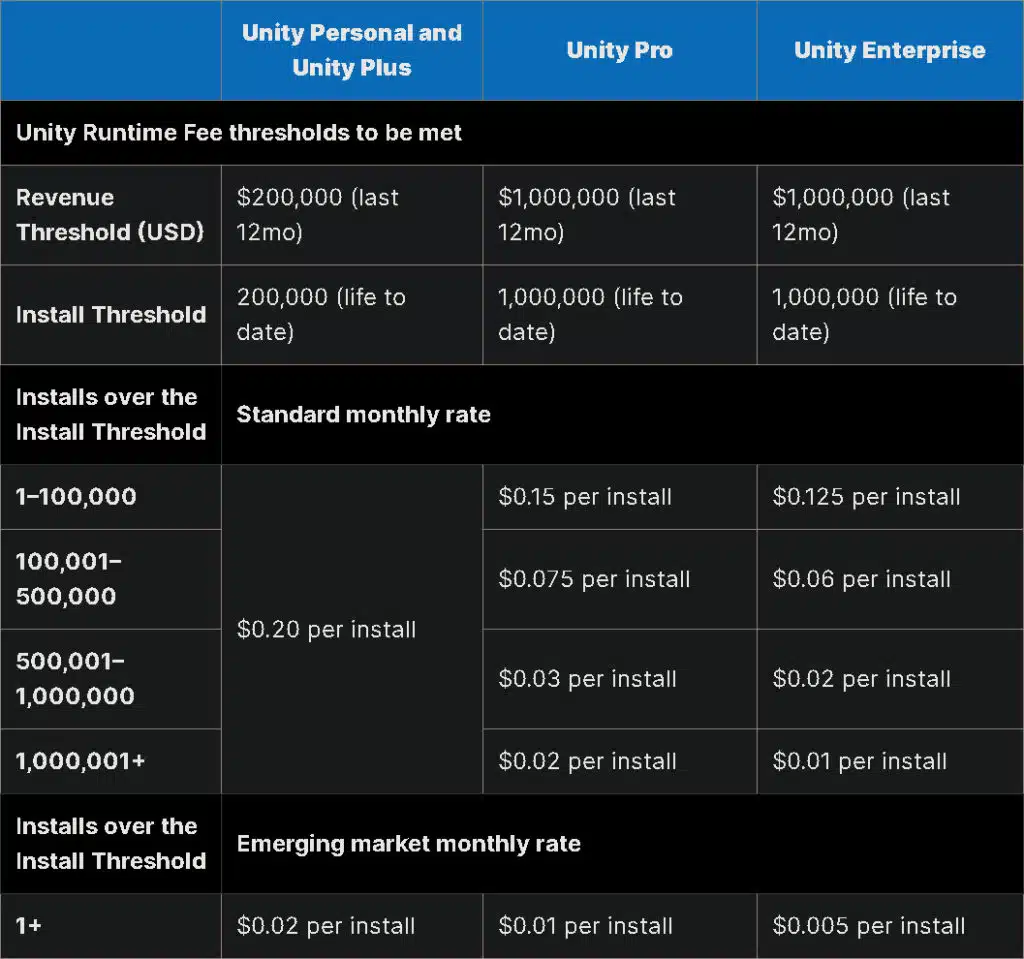
Unity has announced that it will be charging qualifying studios, developers, and other creators a “small, flat fee” for each and every game install. The Unity Runtime Fee, as it’s called, is applicable to Unity Personal and Unity Plus subscribers who have made $200,000 USD or more in the last 12 months and have at least 200,000 lifetime game installs, while Unity Pro and Unity Enterprise subscribers are affected as well, with those who have made $1,000,000 USD or more in the last 12 months and have at least 1,000,000 lifetime game installs needing to pay some sort of fee. Unity Technologies is launching this new policy on January 1, 2024, and according to a breakdown that the company shared, fees can go up to $0.20 per install depending on the plan.
We are introducing a Unity Runtime Fee that is based upon each time a qualifying game is downloaded by an end user. We chose this because each time a game is downloaded, the Unity Runtime is also installed. Also we believe that an initial install-based fee allows creators to keep the ongoing financial gains from player engagement, unlike a revenue share.
Qualifying customers may be eligible for credits toward the Unity Runtime Fee based on the adoption of Unity services beyond the Editor, such as Unity Gaming Services or Unity LevelPlay mediation for mobile ad-supported games. This program enables deeper partnership with Unity to succeed across the entire game lifecycle. Please reach out to your account manager to learn more.
Discussion (5 replies)
Join Discussion →Does nobody have a brain at unity?
They might as well put up a banner: Hey don't use our game engine.
They clearly didn't release enough details for anyone that wanted to question the minutia...
When a company is being vague you always have to assume they are being vague for a reason.
I don't think my questions are about minute details. They are everyday practices that a spyware which only counts downloads is likely unable to differentiate between.
As it turns out they are not even going to count installs, just somehow magically infer the install base, on a trust me bro basis. Absolutely insane.
I could see a per license thing, and I’m pretty sure Unreal and other engines charge along those lines - but per install is a different metric than that.