
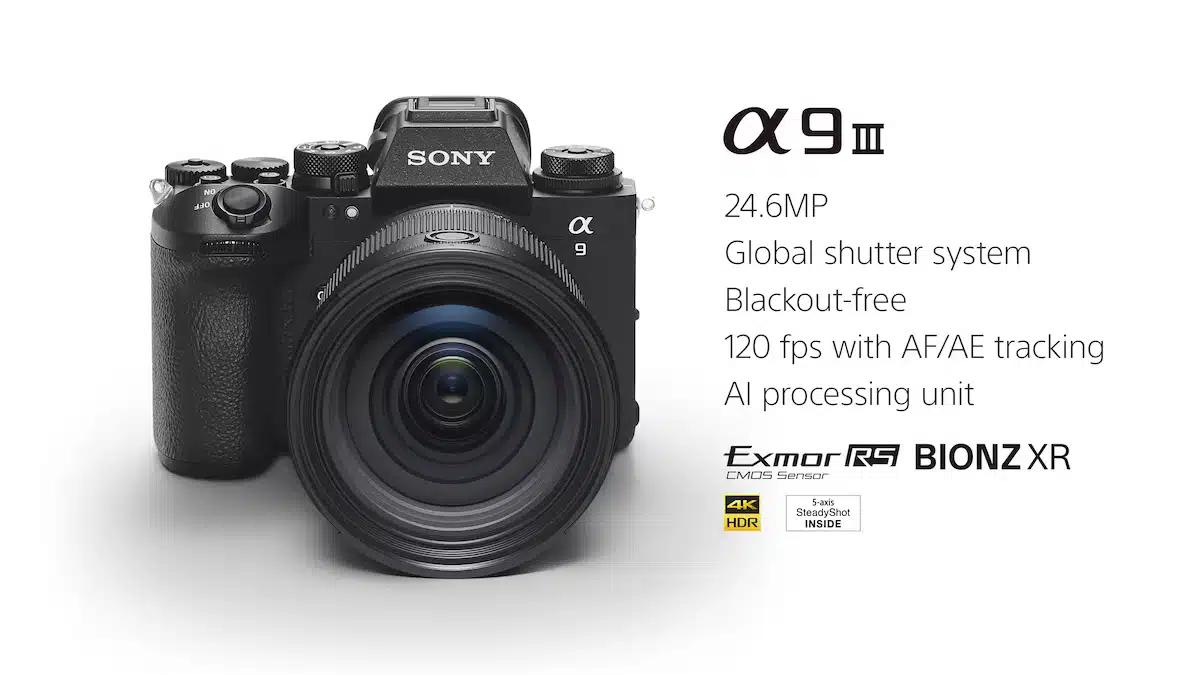
Sony has announced that the new Alpha 9 III camera is now available for pre-order at a variety of Sony’s authorized dealers, for a suggested retail price of $5,999.99 USD and $8,299.99 CAN.
That isn’t exactly cheap for a camera, but the price point may be well justified, with it being the world’s very first full-frame camera with a global shutter system.
According to Sony, what this basically means is that users can use the Alpha 9 III to capture photos at burst speeds of up to 120 frames per second without rolling shutter distortion or camera blackout, enabling blackout-free shots every time.
Here’s what Sony has to say about some of the Alpha 9 III’s key features, which include a full-frame stacked 24.6 MP CMOS image sensor, as well as in-body image stabilization for clearer handheld shots at lower shutter speeds, although the maximum shutter speed appears to go up to 1/80000 second:
The Alpha 9 III is equipped with the newly developed, world’s first global shutter full frame stacked CMOS image sensor with approximately 24.6 effective megapixels and built-in memory. Combined with the latest image processing engine BIONZ XR, the Alpha 9 III achieves blackout-free Continuous Shooting Speed with AF/AE tracking of up to approximately 120 fps. The Alpha 9 III is supplied with high-density focal plane phase detection AF. A designated AI processing unit uses Real-time Recognition AF to recognize a wide variety of subjects with high precision. By combining high-speed performance of up to 120 fps with highly accurate subject recognition performance, it is possible to easily photograph scenes and moments that cannot be seen with the naked eye. The AI processing unit in the Alpha 9 III supports movies as well as still photography with accurate subject form and movement recognition. The Real-time Recognition AF and Real-time Tracking provide a significant improvement in human eye recognition performance, allowing the camera to automatically recognize, track, and focus on the eyes of a specified subject. The Alpha 9 III is equipped with 8.0 stops of optical 5-axis in-body image stabilization, allowing for high-quality image rendering.
Shutter speed is freed from the limitations of conventional mechanical shutter image sensors and achieves a maximum shutter speed of 1/80,000 second (1/16,000 second during continuous shooting), making it possible to capture at high speed without any distortion. When a compatible Sony flash is attached, such as the HVL-F60RM2 and HVL-F46RM (sold separately), it is possible to synchronize the flash and take pictures at all shutter speeds up to 1/80,000 secondv. Previously, if the user released the shutter at a speed faster than the flash’s synchronization speed, the amount of light would drop sharply, but with the full-speed flash synchronization function, it’s now possible to photograph scenes that could not be easily captured with conventional technology. Also, when shooting stills or movies under LED lighting, the Hi Frequency Flicker function can significantly reduce high-frequency flicker problems by allowing the shutter speed to be finely adjusted to match the flicker frequency while viewing the monitor.
Alpha 9 III users can also expect to shoot video in 4K/120p without any cropping, a first for an Alpha camera:
The global shutter image sensor provides distortion-free image expression for videos as well as still images. For example, the user can shoot images of nearby scenery from a fast-moving vehicle such as a car or fast-moving subjects with ease. This camera is the first in the Alpha series to be able to record 4K 120p high-frame-rate video without cropping, allowing the user to shoot at the angle of view intended. It is also possible to shoot high-resolution 4K 60p videos with 6K oversampling.
“The Alpha 9 III full-frame camera is a landmark achievement for the industry,” says Yang Cheng, Vice President, Imaging Solutions, Sony Electronics. “Designed with the needs and demands of professional photographers in mind, every single update to this camera – from the sensor to even the size to the button layouts and menu functions – has been made to address specific input and feedback from our community. We have listened and are thrilled to bring the new capabilities of the Alpha 9 III to market—capabilities which allow photographers to capture things they’ve never been able to capture before.” Cheng continued, “For professionals everywhere, they can achieve even more dynamic expressions when the Alpha 9 III is combined with our rich lineup of lenses, in particular with the new 300mm F2.8 G Master OSS – the world’s lightestii large-aperture telephoto lens.”
Discussion (19 replies)
Join Discussion →So... can it actually capture 80,000 FPS video at a high resolution? Or is that just the effective shutter speed of a digital shutter.. so very effective at capturing high speed movement with stills?
I find it interesting how the market has changed.
When I was really into photography (~2008-2012) Nikon was absolutely killing it, with the best high speed and low light performance on the market, and terrific professional lenses.
Canon was a close second, and Sony - despite providing Nikon's sensors - was pretty much an also ran.
Now Nikon seems like they have fallen behind and Sony seems to be filing it out with Canon.
Wait, aren't all DSLRs global shutter by definition? So this maybe the first mirrorless camera with a global shutter, but definitely not the first full frame camera.
I replaced my old nikon with a sony and I can safely say it was the worst decision of my life. I hate it. I wish I could go back without incurring huge losses.
Nope - DSLR shutters physically 'roll'. A global shutter requires global (instantaneous across the image sensor) blanking, otherwise motion artifacts from the sequential readout are possible.
That's the max 'shutter speed', i.e., can capture ONE frame at 1/80000th of a second. From the video I watched the camera tops out at 120FPS - at full 24MP, and in lossless raw, so full possible quality.
Should've remembered the old Onion video about Sony - they're usually anathema to things like ergonomic human interfaces and making things work intuitively.
They have gotten much, much better in the camera sector though, through decades of being berated by press and users alike.
Nikon and Canon were the mainstays, Sony was a bit of a sore upstart (their camera business grew from Sony' acquisition of Minolta, the first Sony DSLRs and their DSLTs (fixed, translucent mirror) all used Minolta's digital mount.
Sony went into mirrorless big first, and aside from being mirrorless with a short, adaptable mount, they were pretty terrible as camera systems. But Sony basically owns every fab that produces image sensors that isn't Canon or Samsung, they have access to smartphone technology (and succeed swimmingly in providing smartphone camera modules), and have other fabs and businesses besides, so as they quickly iterated, they quickly improved, coming from way in the back to what's arguably a leading position today.
Note that neither Nikon nor Canon have gotten worse; they've just all improved at different cadences and according their own priorities and budgets. Right now I'd say all three have managed to differentiate themselves while still competing heavily across their lineups, and between stills and video (for which Nikon was a running joke for a long time, but no more).
Also note that your Nikon lenses can be adapted well to Nikon mirrorless cameras, as well as to Sony and Canon cameras with varying degrees of interoperability (the Nikon adapters are first-party and official, of course). If you're so inclined.
This is actually a bit of a sore spot for me.
Most of my best lenses are old style screw motor AF and AF-D lenses, for which - at least the last time I checked - no one has released an adapter yet.
As far as adapter goes, only the new style AF-I and AF-S lenses need apply :/
The AF is a no-go; I'd thought someone was building an adapter with a motor in it for the screwdrive lenses (Sony did this), but I've only found refutations and of course your thread asking about it on the a few years back...
For some reason I always assumed DSLRs weren't affected by sequential readout artifacts. Sony had global shutter sensors in the professional segment whichI've been using for work for over a decade. Although those are only 5MPX.
It's not just the ergonomics, although that is significantly worse also, but I could live with that. It's that 99% of pictures I take turn out as absolute shite no matter what setting I use. I never had this problem with Nikon cameras, from D60 to D850. I know the 850 is full frame and not a fair comparison, but if the 850 is 10 on a scale of 10, then the entry level Nikon DSLRs that I owned are at least a 7, but the SONY alpha 6400 I have now is a 3 at best.
...you're not using the kit lens are you? Sony put out some really horrific kit lenses for whatever reason...
I've been using a SEL55210 which is better than the kit lens, but I still wasn't satisfied with the quality. So I recently got a Tamron lens, which I have not yet used enough to give a verdict on.
I've already tried selling the whole thing before I got the Tamron, but nobody was interested for the lowest price I was willing to go down to.
That's still a 4x entry-level zoom; short tele, of course, so these are usually better than the standard range kit zooms, but sometimes only just.
Which Tamron did you get? They vary just as much in terms of quality from middling to class-leading (like their 35mm f/1.4 lens).
I've had no quality issues with similar entry level zoom lenses for Nikon, of course the fixed lenses have better low light quality but they were too inflexible for me. Not to mention that this entry level Sony lens cost twice as much as I ever paid for a lens during my Nikon era. So for that kind of money I expected at least the same performance. And I have fair comparison as I used to have a Nikon 55-200mm f/4.5-5.6G with optical stabilization as well. I also had a TAMRON Di II AF18-200mm f/3.5-6.3 XR for Nikon, which was still better IMO, despite being a sub $200 lens. It had some chromatic aberration, but I'd take that any day over the hazy grainy images that come out from the SONY. Or maybe it is not the lens, just the 8 years older Nikon camera I had was so much better.
This is unlikely. Without meaning to imply disrespect, if the Sony camera is producing worse quality, the problem is likely how it's set up.
These are still 'kit' grade lenses, and lower. The Tamron is a ~21x super zoom and unlikely to meet sensor resolution at any setting; it's a lens for flexibility with a priority of being able to frame the shot over shot quality. Note that Canon produces a 24mm-240mm consumer zoom for their new full-frame RF system, so it's not like the desire for these lenses has gone away, just that they're not ever going to be the pinnacle of image quality.
Some have actually been stellar; many photographers keep the kit lenses because they're small, they're light, they're cheap (with respect to say concerns about robbery or theft when travelling), and within their niche they can still produce excellent images. Sony's entry-level kit zoom for their APS-C cameras was an exceptionally poor standout versus what everyone else (literally) was producing.
Sure, but that's the tradeoff, whether you're spending ~US$300, ~US$3000, or ~US$30,000+ per lens.
Having the ability to change the lens is the whole point of having an interchangeable lens camera though, since it isn't possible to get 'everything' in one lens - and attempts to do so push size, weight, and cost up very quick (see Canon's f/2 and latest f/2.8 zooms for example).
Comparing at the same iso speed the images captured by the Sony look worse, the grain is more pronounced and there seems to be compression artifacts as well. (highest quality jpeg) maybe, I could try using RAW. I rarely did that with the Nikon, and when I did not because of compression.
That is exactly the point, I always used cheap lenses because I could never afford (or was willing to pay for) hi-end ones. But with the SONY everything is 2x 3x as expensive. What I could get for $200 in nikon DX costs $500-1000$ for sony APS-C
So far my experience is that the exceptionally poor bit applies to more than the kit lens.
And I'm happy with that tradeoff, I just didn't know the tradeoff with Sony will be twice as big for twice the money spent.
For some reason SONY lenses are insanely expensive. For example the cheapest 35mm f1.8 one is more than double of what I paid for a similar Nikon adjusted for inflation. And it still looks like one of those kit lenses. So I'd need to pay 3x for a Samayang 35mm that actually looks like a proper one. And the proper Sony ones? Closer to $2000 than to $1000.
If you're not comparing raw to raw, you're not really comparing the cameras but also all built-in corrections, noise cancelling, and JPEG rendering as well. Though I wouldn't be surprised with Nikon putting out better JPEGs.
You got an E-mount, and literally everyone that makes lenses for other mounts makes E-mount lenses; you can even get AF lenses from the likes of Viltrox and Samyang.
Well, it's going to apply to nearly every entry-level zoom, which is most APS-C zooms.
They're proud of their brand for sure, but honestly they're not too much out of line.
That's the APS-C 'trap', where the real upgrades are to use full-frame lenses. Look at FX versions of Nikon's lenses as opposed to the DX ones, (like the 35mm f/1.8 ones) and you'll see similar price hikes. Also, generally speaking, the newer the lens, the more expensive it will be priced. Most of Sony's lenses are newer, whereas I'm still using Canon lenses that were originally released 30 years ago - and use massaged optical formulas that are older than that.
But yeah, you really have to look outside of Sony's branded lenses. Sigma, Tamron, Tokina, Samyang, Viltrox to name a few. You can even adapt Canon EF lenses fairly reliably (and retain all functionality like autofocus and stabilization) as well as some Nikon lenses and others. Don't forgo looking used and / or refurbished if you're sticking to a budget, I do this all the time with Canon lenses.