
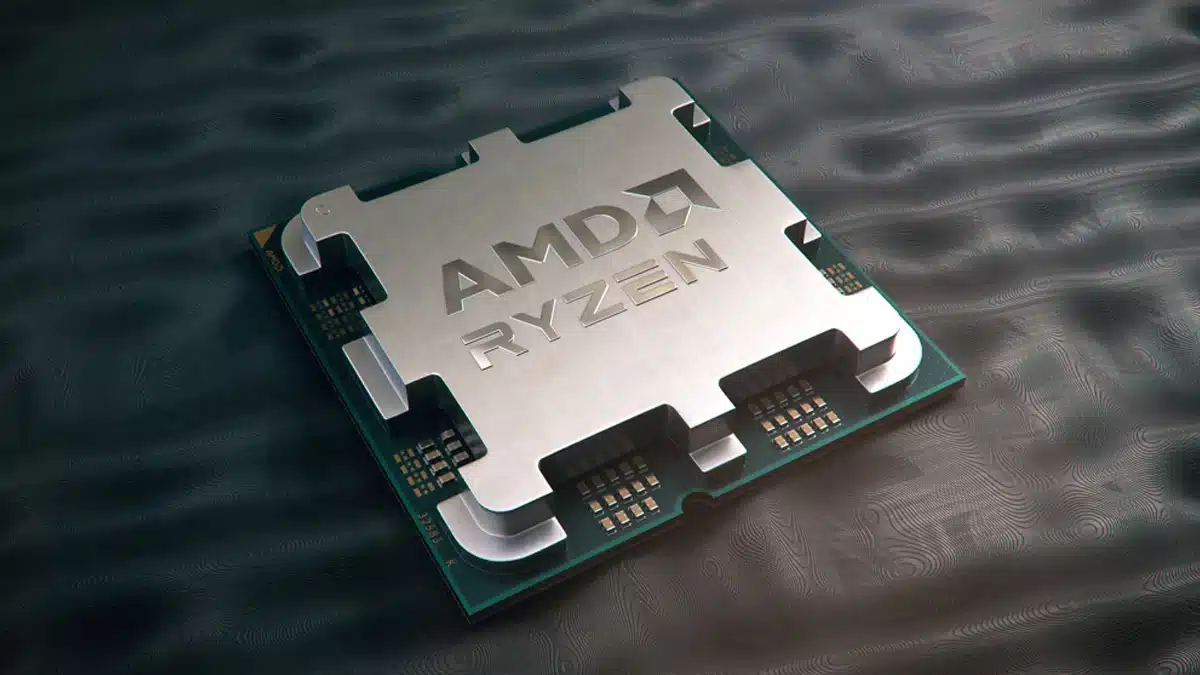
The Ryzen 7 9700X and Ryzen 5 9600X, two new Zen 5 desktop processors that AMD launched for the AM5 platform on August 15 for $359 and $279, respectively, will be getting new specifications soon, according to an insider who claims AGESA 1.2.0.1a, a new and incoming BIOS update, is set to increase the TDPs of these CPUs from 65 watts to 105 watts. The AMD Ryzen 9 9950X and Ryzen 9 9900X, which we reviewed today, feature TDPs of 170 watts and 120 watts, respectively.
TDP updates for Ryzen 9000 Series:
- Ryzen 7 9700X
- Original: 65 watts
- New: 105 watts
- Ryzen 5 9600X
- Original: 65 watts
- New: 105 watts
The original word from chi11eddog:
AMD will increase Ryzen 5 9600X and Ryzen 7 9700X TDP from 65W to 105W, with AGESA 1.2.0.1a Patch A.
— chi11eddog (@g01d3nm4ng0) August 14, 2024
🧐🧐🧐
A look at the current specs:
| Model | Cores / Threads | Boost / Base Frequency | Total Cache | PCIe | TDP |
| AMD Ryzen 9 9950X | 16 / 32 | Up to 5.7 GHz / 4.3 GHz | 80MB | Gen 5 | 170W |
| AMD Ryzen 9 9900X | 12 / 24 | Up to 5.6 GHz / 4.4 GHz | 76MB | Gen 5 | 120W |
| AMD Ryzen 7 9700X | 8 / 16 | Up to 5.5 GHz / 3.8 GHz | 40MB | Gen 5 | 65W |
| AMD Ryzen 5 9600X | 6 / 12 | Up to 5.4 GHz / 3.9 GHz | 38MB | Gen 5 | 65W |
AMD on its upcoming chipsets:
The Socket AM5 motherboard family features two new chipsets. Designed to seamlessly integrate with AMD Ryzen 9000 Series desktop processors, the new AMD X870E and X870 chipsets boast support for the latest technologies such as PCIe 5.0, DDR5, USB4, and WIFI7. Socket AM5 platforms are built to last, with support through 2027 and beyond.
These new chipsets feature USB4 as a standard feature and are also designed to support even faster DDR5 memory overclocking with AMD EXPO Technology. Both the X870 and X870E feature 44 total PCIe lanes and direct-to-processor PCIe 5.0 NVMe connectivity for the ultimate transfer speeds. The X870E is differentiated with 24 PCIe 5.0 lanes, with 16 lanes dedicated to graphics. When PCe 5.0 direct-to-processor storage and graphics care are enabled at the same time, the X870E offers twice the bandwidth of competing platforms.
Discussion (4 replies)
Join Discussion →I wonder if this warrants all new testing.
Would have been nice if they had just launched them with this setting.
Still, you could probably preview what performance will be like by just enabling PBO.
In some rare cases, you might see a big performance increase, but the 20% that was bandied about by many (I think Der8auer was responsible for this) is probably false. We are likely talking between 0 and 2% improvement in most cases.
I don't know where that 20% figure comes from but that's beyond wishful thinking. The problem with focusing on performance-per-watt and energy efficiency is that for the most part, desktop users don't care about that. They want performance. The fact that a CPU comes in at almost the same performance of its predecessor with a reduced TDP makes the processor less than compelling.
I don't want a CPU that performs the same at lower power. I want a CPU that performs better at the same or lower power level. If I want to gimp my CPU by undervolting it for power savings that should be on me.
I really don't care about how much power a CPU uses outside of a mobile/laptop setup. My shizz is plugged in, give me all the beans!
I really want both. I want power efficient and maximum performance per watt when I’m just running distributed computing. But when I’m gaming, I want full performance regardless of power. AMD has been close, but I have to reboot to switch between eco mode and full over drive. If I could just flip a switch, it would be perfect