
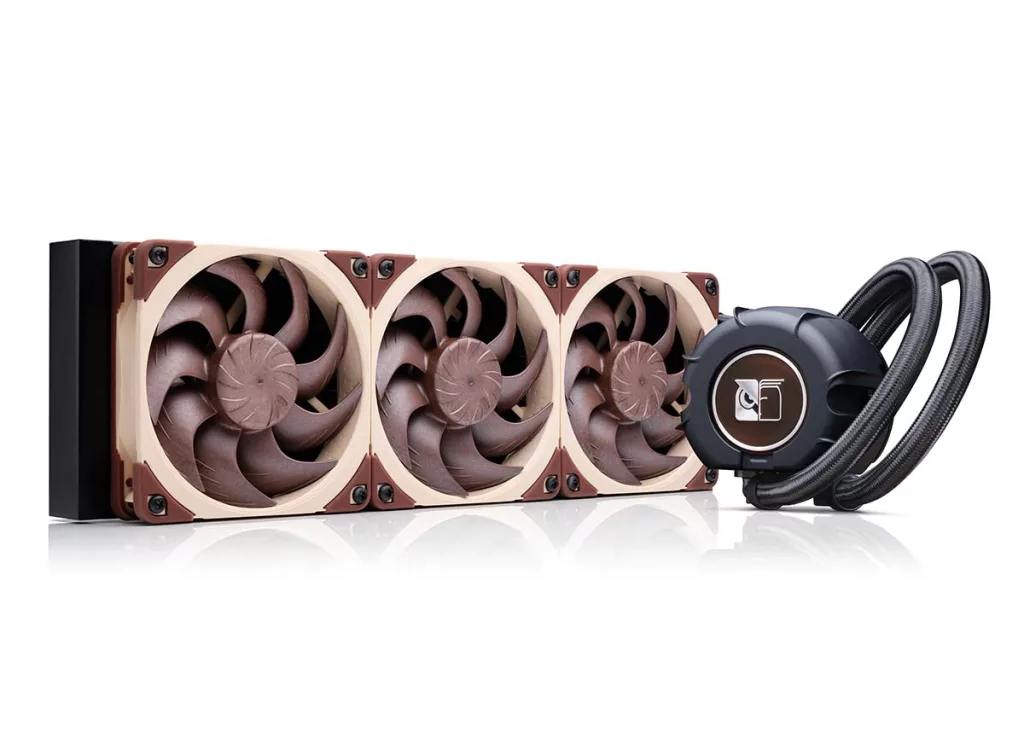
Noctua spent 25 years perfecting air cooling before touching liquid, and this week the reviews are in on whether the wait was worth it (spoiler: the quietest AIOs reviewers have ever tested). It says something about the week that this only narrowly beats Cooler Master’s trident-shaped 3DHP heatpipe, which Tom’s Hardware calls the most significant advancement in air cooling in years, for the top slot. Beyond the cooling story: the Ryzen AI Halo embargo lifted, TechSpot dropped a 53-board X870 mega-roundup, and our own Brent Justice went deep on the RX 9070 GRE’s 1% Lows.
Noctua NL-LC1 AIO (360mm and 420mm)
Written reviews:
- WCCFTech (360mm and 420mm): https://wccftech.com/review/noctua-nl-lc1-420mm-360mm-aio-coolers-review-the-first-aios-from-the-cooling-masters/
- Previous reviews via earlier Weekenders: https://www.thefpsreview.com/2026/06/20/the-fps-review-weekender-june-20-2026/#h2-1
Consensus summary: Noctua’s first liquid cooling product in 25-plus years is built on Asetek’s Emma V2 platform, differentiated by a three-layer pump vibration absorber, NF-A12x25 G2 fans on the 360mm and NF-A14x25 G2 fans on the 420mm, and a 30mm thick radiator that gives Noctua more surface area than most competing AIO designs. Pricing is $249 for the 360mm and $279 for the 420mm, with an optional NL-ACF1 VRM accessory fan at $19.90. WCCFTech’s July 10 evaluation across both the 360mm and 420mm lands where the earlier reviews did: these are the lowest-noise AIOs the reviewer has tested, the 420mm adds meaningful headroom over the already-impressive 360mm, and the Asetek pump compromise does not diminish the end result.
FPS Review take: We covered the NL-LC1-36 in our June 20 Weekender and the conclusion hasn’t changed. The 420mm data from WCCFTech adds a data point for readers with cases that support larger radiators, and the consistent acoustic results across multiple independent reviewers give us real confidence in the claims. If you have been waiting to convert to liquid cooling for noise reasons, this is the product you were waiting for, you can even find it on Amazon here.
Cooler Master V8 Ace 3DHP Black (and V4 Alpha 3DHP)
Written reviews:
- Tom’s Hardware (V4 and V8): https://www.tomshardware.com/pc-components/air-cooling/cooler-master-v4-and-v8-3dhp-review
- TechPowerUp (V8 Ace Black): https://www.techpowerup.com/review/cooler-master-v8-ace-3dhp-black-cpu-air-cooler/
Consensus summary: Cooler Master’s 3DHP technology replaces the conventional U-shaped heatpipe with a trident-shaped design that adds a third branch running into the center of the fin stack, raising effective fin utilization from roughly 70 percent to near-full saturation. Tom’s Hardware calls it the most significant advancement in air cooling in years, and the thermal results back that up: the V8 Ace in TH testing matches the best dual-tower air coolers on the market in a single-tower footprint, while the smaller V4 Alpha outperforms coolers with three times as many conventional heatpipes. Both outlets note a shared limitation: the reduced fin surface area relative to large towers means ambient case temperature matters more than usual, which can hurt results in gaming scenarios where a hot GPU is raising internal temps.
FPS Review take: We first saw the refreshed V8 series at CES last year (Ed: Yes, 18 months ago), so it’s good to see it finally getting launched. The 3DHP architecture is an engineering development, not a cosmetic refresh, and the V8 Ace at $119.99 is interesting for builders who need dual-tower-class cooling without dual-tower clearance demands. The six-year warranty and tool-free fan swap mechanism are nice touches in a category that usually skips that kind of quality-of-life work.
AMD Ryzen AI Halo
Written reviews:
- Tom’s Hardware: https://www.tomshardware.com/pc-components/gpus/embargo-mon-july-6-8am-pt-1100-edt-amd-ryzen-ai-halo-review
- Hot Hardware: https://hothardware.com/reviews/amd-ryzen-ai-halo-hands-on-review
- StorageReview: https://www.storagereview.com/review/amd-ryzen-ai-halo-review-a-dual-os-200b-parameter-desktop-takes-on-the-dgx-spark
- ServeTheHome: https://www.servethehome.com/amd-ryzen-ai-halo-developer-system-review-amd-goes-for-local-ai/
- The Register: https://www.theregister.com/ai-and-ml/2026/07/06/amds-ryzen-ai-halo-makes-local-ai-look-easy-but-at-4k-easy-doesnt-come-cheap/5266711
Consensus summary: AMD’s $3,999 Ryzen AI Halo is a mini workstation built around the Ryzen AI Max+ 395, combining a 16-core Zen 5 CPU, Radeon 8060S iGPU with 40 RDNA 3.5 compute units, and an XDNA 2 NPU within a 128GB LPDDR5x unified memory pool at 256GB/s. The curated software stack and first-party playbooks are the real story: reviewers consistently found the onboarding experience better than assembling a DIY Strix Halo box from scattered GitHub pages, and Windows 11 support out of the box is a differentiator over the Linux-only DGX Spark. The AI inference picture is more complicated; StorageReview found the Halo ahead of the DGX Spark in CPU-bound workloads but trailing it by 2x to 4x in higher-concurrency vLLM serving scenarios, with the gap stretching to nearly 9x in the most prefill-heavy GPT-class tasks, and the missing 200GbE NIC rules out any multi-node clustering configurations.
FPS Review take: We covered the Ryzen AI Halo announcement at Computex back in May, and the reviews confirm what the hardware always promised: the Strix Halo silicon is more than capable for local inference, but ROCm’s ecosystem gaps versus CUDA still cost AMD real-world performance and compatibility in ways that show up in benchmarks. At $3,999 it sits only $700 below the DGX Spark, which is not quite the bargain AMD would like you to believe.
AMD Radeon RX 9070 GRE — Video Card Deep Dive Review
Written reviews:
Consensus summary: Brent’s review is a post-launch deep-dive on the $549 RX 9070 GRE, the 12GB VRAM RDNA 4 part that AMD released globally after its China-exclusive debut, examining both average framerates and 1% Lows at 1440p alongside FSR 4 and ray tracing results. The launch-wave consensus from Tom’s Hardware and others positioned the 9070 GRE as solid hardware compromised by its pricing, landing between the RTX 5070 12GB and RTX 5060 Ti 16GB at a price that leaves it fighting on multiple fronts simultaneously; the 12GB frame buffer is a particular point of scrutiny given where memory prices are sitting in mid-2026. Brent’s 1% Low testing and ray tracing pass adds a practical dimension the June reviews had limited time to cover.
FPS Review take: This is our own review and worth your time if you have been watching the 9070 GRE from a distance, particularly for the 1% Low data at 1440p and the FSR 4 upscaling numbers against current competition.
Philips Evnia 27M2N5500XD — 500Hz/1000Hz Gaming Monitor
Written reviews:
Consensus summary: The 27M2N5500XD is a 27-inch Fast IPS monitor running 2560×1440 at 500Hz natively, with a 540Hz overclock mode and a 1280×720 Dual Mode that reaches 1000Hz. TechSpot’s verdict is blunt: the underlying IPS panel has an 11ms native response time, which cannot be overdrive-tuned down to the 1ms specification the monitor claims, and the result is motion clarity that does not justify the extreme refresh rate marketing. The contrast ratio of 2235:1 is genuinely excellent for an IPS panel and worth noting, but on the question the monitor was built to answer, it falls short; TechSpot notes that getting 1000Hz out of an LCD requires a next-generation IPS panel technology that does not yet exist in shipping products.
FPS Review take: This is the first 500Hz-plus 1440p monitor through a full review, and the result is a useful data point for the entire category: the panel technology is not there yet, full stop (Ed: I guess that review was measured in Hurts?).
AMD X870 Motherboard Roundup — 53 Boards Tested
Written reviews:
Video reviews:
- Hardware Unboxed: https://www.youtube.com/watch?v=g7EBck-0F50
Consensus summary: TechSpot’s AM5 X870 platform roundup tests 53 boards from every major manufacturer, covering VRM performance, feature sets, memory compatibility, and platform stability in a single consolidated reference. For a platform that has had 18-plus months of retail availability with a wide range of pricing from under $200 to over $700, this is the most comprehensive single-source reference the segment has received, and the timing is well-placed for builders still evaluating their options before the Ryzen AI Max PRO 400 Series desktop refresh arrives in Q3.
FPS Review take: Bookmark this one (Ed: Actually, they should bookmark our X870 motherboard review page). The AM5 platform is mature and the board market is crowded; a 53-board test at this depth is the kind of reference resource that takes significant time to produce, and TechSpot does not release these often. If you are currently spec’ing an AM5 build or have a reader asking which X870 board to buy, this is the right link to send them if they don’t like our reviews.
ASUS ROG Strix Z890-E Gaming Wi-Fi
Written reviews:
Consensus summary: TechPowerUp’s review covers ASUS’s flagship ROG Strix offering for Intel’s Z890/LGA1851 Arrow Lake platform, the full-featured tier of the ROG Strix line. The Z890-E sits above the previously reviewed Z890-A and offers the expected flagship treatment for Intel builders: upgraded connectivity, extensive power delivery, and the full ROG peripheral ecosystem integration.
FPS Review take: Intel’s Z890 platform has been overshadowed by the AMD AM5 hardware cycle this week, but the ROG Strix Z890-E is worth noting for Arrow Lake builders who want TechPowerUp’s characteristically thorough treatment of a flagship Intel board.
G.Skill Trident Z5 6000 AMD EXPO ULL DDR5
Written reviews:
Consensus summary: The “ULL” designation here stands for Ultra Low Latency, and G.Skill is targeting the subset of AM5 builders who want AMD EXPO 6000MHz kit with unusually tight primary timings rather than the typical CL30-plus profiles found on most 6000 DDR5. Guru3D’s review is the first to put the kit through comprehensive benchmarks, and the test results will be relevant to the audience currently evaluating whether extreme latency tuning on the AM5 platform translates into gaming gains consistent with the price premium.
FPS Review take: G.Skill continues to push the headroom of AMD EXPO-validated DDR5, and Brent’s recent Trident Z5 CK RGB DDR5 8400 review from May gives us a useful comparison point at the high-frequency end of the spectrum. The ULL kit targets a different optimization axis: low latency at 6000MHz rather than maximum clock speed, which is worth understanding for readers building gaming-focused AM5 rigs.
Assassin’s Creed Black Flag Resynced — 50 GPU Benchmark
Written reviews:
Video reviews:
- Hardware Unboxed: https://www.youtube.com/watch?v=cm9Q6mSIUoo
Consensus summary: TechSpot’s 50-GPU performance test covers Black Flag Resynced across multiple settings tiers and resolutions, providing a broad reference sweep for current and previous generation hardware. The remaster launched July 8 and earned Steam Deck Verified status before release, which we covered in the news feed on July 6. A 50-GPU benchmark sweep this close to launch is useful for readers who picked up the game and want to calibrate settings for their hardware.
FPS Review take: We covered the Black Flag Resynced launch news and Steam Deck Verified confirmation last Monday, so this benchmark piece closes the loop nicely for our readers.
Discussion (2 replies)
Join Discussion →I like the idea of AIO's, but the problem I've had with almost all of mine (probably around 10) is they all end up losing liquid and become useless without a viable way to refill them.
Pretty sure the AIO on my 5800X3D has reached that point but it has a lot of hours on it but I'm just too tired these days, plus cash-strapped to replace it right now. Original plan was to retire the setup but . . .you know the rest.