
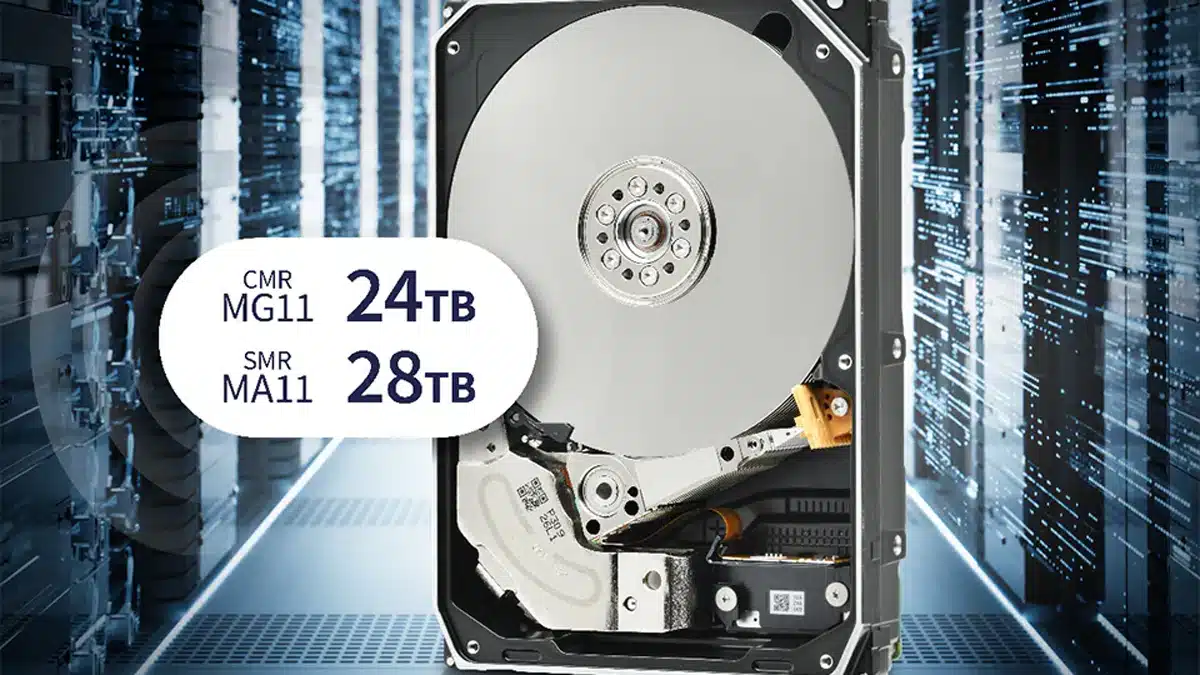
Mx11, a new family of helium-sealed high-capacity HDDs that includes the MG11 Series with capacities of up to 24 TB using conventional magnetic recording (CMR) and the MA11 Series with up to 28 TB capacities with shingled magnetic recording (SMR), is currently in development for use at hyperscalers and data centers, Toshiba has announced. Sample shipments of the MG11 Series will start this month, with those for the MA11 Series coming later, in the fourth calendar quarter of this year.
Key features for the MG11 Series include:
- “Up to 24 TB capacity.”
- “Conventional Magnetic Recording (CMR) for broad compatibility.”
- “Toshiba 2nd generation Flux Control Microwave-assisted Magnetic Recording (FC-MAMR) Technology.”
- “Industry-leading 10-disk helium-sealed design for superior storage density.”
- “Industry Standard 3.5-inch 26.1 mm height Form Factor.”
- “7200 rpm Performance.”
- “Lower operational power profile, providing excellent power efficiency (W/TB) for better TCO.”
- “550 Total TB Transferred per Year Workload Rating.”
- “Sanitize Instant Erase (SIE) option model and Self Encrypting Drive (SED) option model.”
Toshiba on its new hard drives:
The new Mx11 family is designed to deliver new levels of density and power efficiency to customers tasked with controlling (or managing) operational costs while meeting the relentless demands of data growth. Built on a common architecture, both products feature a 10-disk, helium-sealed, standard 3.5-inch 7,200rpm design that leverages Toshiba’s innovative flux control microwave assisted magnetic recording (FC-MAMR) technology. Engineered for higher performance and 24/7 reliability, the Mx11 family is designed with a 1GiB buffer, a workload rating of 550TB per year, an MTTF/MTBF of 2.5 million hours, and an AFR of 0.35%.
The MG11 CMR HDD Series enables cloud, data center, and enterprise storage customers to rapidly scale storage density within existing infrastructure. Built with a 1GiB buffer, the new 24TB HDD is faster than its predecessor, with an approximately 9% faster maximum sustained transfer speed of 295MiB/s. With a choice of 6Gbps SATA or 12Gbps SAS interfaces, the MG11 Series fits seamlessly into any data center to support data storage, online backup and archive, and video surveillance applications. In addition to 24TB, the MG11 Series is available in 22TB, 20TB, 18TB, 16TB and 14TB capacities with sanitize instant erase (SIE) and self-encrypting drive (SED) options for enhanced security.
The MA11 Series achieves 2.8TB per disk using SMR technology. The MA11 Series host-managed SMR increases drive capacity by overlapping the physical tracks on the disk during write operations. Data centers with software that can optimize the MA11 Series host-managed SMR design will benefit from improved cost efficiencies through higher storage densities. The new MA11 Series is available in 28TB and 27TB capacities with a 6Gbps SATA interface and with SED options for enhanced security.
Discussion (3 replies)
Join Discussion →Maybe I'm losing my mind, but I either didn't know, or I had forgotten that Toshiba still made 3.5" hard drives.
I have come to think of them as a laptop drive only manufacturer.
I presume they are enterprise models? Because most hard drives - especially high capacity ones - are enterprise drives intended for servers these days.
I wonder how they compare to current versions of Seagates EXOS line and WD's Gold line.
My twelve 16TB Exos 18's are still going strong, at close to 23,500 hours, are still under warranty for another 2.5 years, and will likely last for a long time before they have to be replaced.
That, and I am only at 48% capacity, so I won't have to replace them for more capacity any time soon either.
I'm kind of hoping that the next time I have to replace them, that SSD's (preferably SATA) will be affordably enough to do it, but that is probably a ways off. Given that I am only at 48%, I could get away with much smaller drives than my 16's, but while ZFS allows expanding by replacing a drive at a time and growing a pool, going the other way (shrinking) is not possible. I'd have to rebuild the entire pool.
Doing this might actually not be a bad idea, though, as this pool has been active and grown dynamically since mid-2012, and there are some architectural choices I probably would do differently if I did it again today...
(Notably I'd probably do native ZFS encryption, to make encrypted off-site backups easier. Back in 2012 I never envisioned backing the whole shebang up to an offsite server, and didn't think I needed encryption. I felt it would only slow me down. There are some ways to do this after the fact, but none of them are really good)
I guess there is a lesson here for being forward looking when you create something that might live a long time.
Either way, this is really not an option yet. Even if I could move to 8TB SSD's (which would require pruning a lot of data, or leaving an uncomfortably small amount of free space) it would still be prohibitively expensive... The cheapest 8TB drive I can find is like $645, and I'd need 12 of them. That's $7740 :eek:
That said, I do have 12 empty slots in the server, so I could also do 24x 4TB SSD's, but even that would be pricy. The cheaper 4TB SSD's are some really sketchy brands. If I sort by price, by the time I get into something I somewhat trust, we are at the ~$240 level. That's $5760 :eek:
That said, seeing that I have 12 free slots, I could create a secondary smaller pool only for stuff that matters if it is faster using 12 cheaper SSD's, and keep the hard drives around for stuff where speed really doesn't matter (massive drive image dumps, media library, etc.)
It's too bad ZFS doesn't natively support storage tiering. (other than special VDEV's, but those really don't count, as it is not true storage tiering)
Worth thinking about for the future for sure.
The last few 3.5" HDDs I bought where in the Toshiba X300 series (consumer desktop, similar to WD Black series), and a few years ago I was thinking about grabbing some Toshiba N300 drives (they compete with WD Red series) for a future NAS. For a while some years ago Toshiba and HGST were making the most reliable drives (according to the Backblaze stats). Not sure if that is still true. Seagate has always had its periods of ups and downs, and in terms of reliability I think they might be on an upswing again. If I had to buy an HDD again, not sure who I would go with.
I've had Toshiba X-series desktop drives, and they were fantastic (their laptop drives are another matter...slow as molasses). My PC has the 12 GB White label WD drive for archival storage. It is good to see Toshiba still making drives.
However, I think they stopped making consumer drives some time back.After a quick google search, they haven't stopped making consumer drives. I must have mistaken it for another company.