
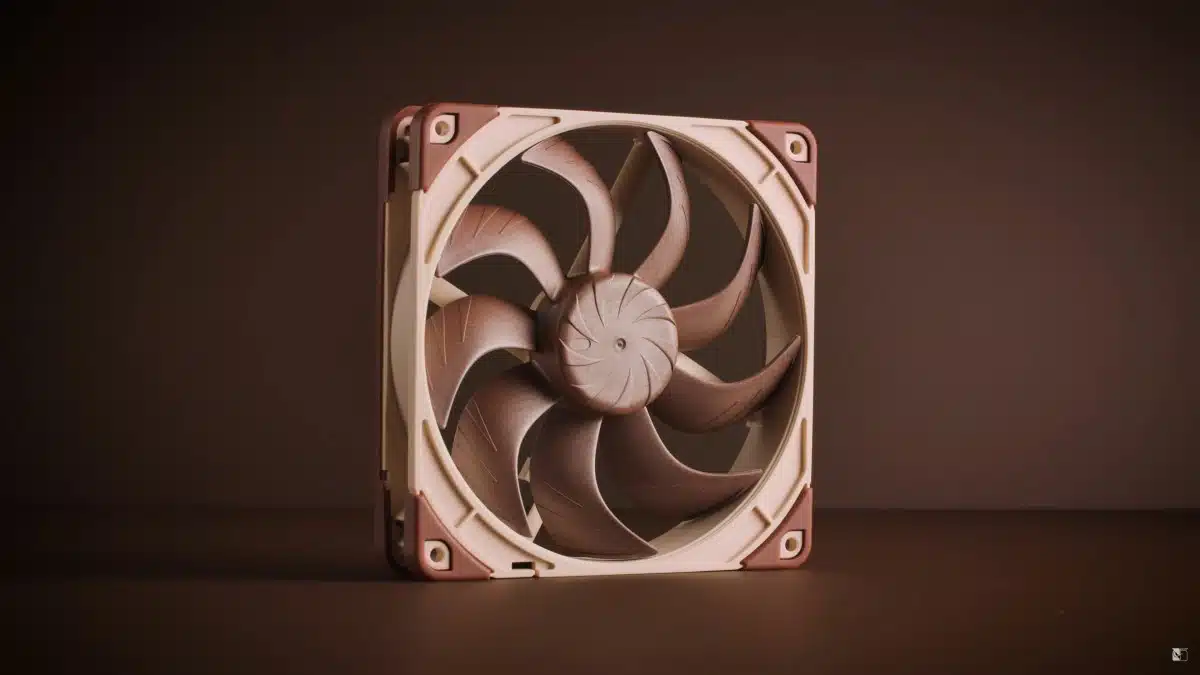
PC builders have another option for efficient and quiet cooling as Noctua launches its next-gen 140mm NF-A14x25 series of fans. The NF-A14x25 G2 series refines upon the previous generation by improving its progressive-bend impeller with winglets which are made from Sterrox LCP. A tip clearance of 0.7mm along with “flow acceleration channels” on its centrifugal hub provides optimal airflow and quiet operation. The NF-A14x25 series of fans comes with a 6-warranty.
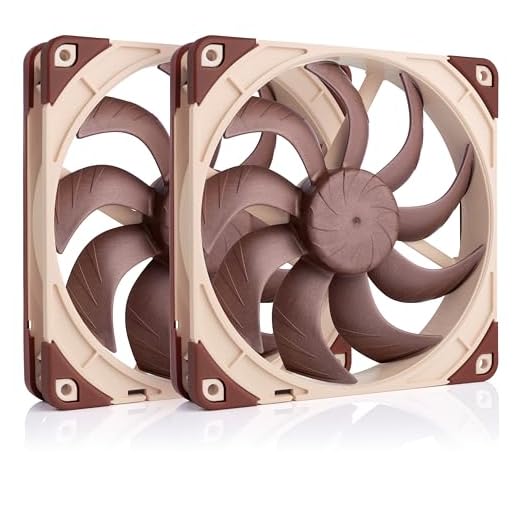
As Noctua launches its next-gen 140mm NF-A14x25 series of fans they will be available in a “standard PWM version with 1500rpm maximum speed, an ultra-quiet LS-PWM version with up to 800rpm as well as in an Sx2-PP set that contains two fans that are offset in speed by +/- ~25rpm.”
-Noctua
“After almost a decade of development work, we’re proud of the substantial performance uplift that we have managed to achieve with this fan“, says Roland Mossig (Noctua CEO). “The NF-A14x25 G2 is easily our most advanced fan today, and we’re confident that the massive advances in performance-to-noise efficiency will be of great value to our customers.”
“Like the NF-A14 and NF-A12x25, the new NF-A14x25 G2 is a true all-rounder that yields superb results in all types of usage, regardless of whether it’s in low-impedance, airflow-oriented applications such as case cooling, or high-impedance, static pressure demanding scenarios such as on heatsinks and water cooling radiators.”
-Noctua
Features (via product announcement page):
- A NA-AVG2-LR anti-vibration gasket is pre-installed to ensure a tighter seal on radiators.
- Optional: The AAO (Advanced Acoustic Optimisation) frame can be used with an optional NA-IS1-14 inlet spacer for superior suction acoustics and flow rates in challenging intake configurations.
- The new ultra-low-loss etaPERF motor with Smooth Commutation Drive 2 technology features unprecedented energy efficiency and with the new SupraTorque feature, is capable of leveraging extra torque headroom to maintain the desired speed when working against added back pressure such as found heatsinks and radiators.
- Uses Noctua’s reference class SS02 bearing
- More about the Sx2-PP Set featuring offset speed: “This speed offset can be beneficial in push-pull operation as well as in situations where two or more fans are operating side by side, such as in case cooling applications or on 280mm water cooling radiators, in order to avoid periodic humming or other undesired acoustic interaction phenomena.”


Further reading
- NF-A14x25(r) G2 performance: improvements for heatsinks, radiators and cases
- NF-A14x25(r) G2 aerodynamic design innovations: the keys to its superior performance
- Fan speed offset: Beat frequency theory and how to further optimise acoustics
- etaPERF™ fan motor: new standards in energy efficiency
- SupraTorque™: leveraging torque headroom to boost fan pressure performance
Discussion (10 replies)
Join Discussion →But we have little options when it comes to the color of Noctua fans. Yeah sure, they got a few fan models that have more normal colors, but in the end, Noctua is always gonna Noctua. Which is fine, cuz I care a lot more about performance than looks, but still Noctua, sheesh.
Agreed and I'm always happy when they have alternatives. The NF-A12x25 PWM Chromax Black I have for intake in the 4090 rig is awesome.
Will be interesting to see how they perform in testing.
Also, do Noctua PWM fans still behave poorly (inaccurate speeds) when you daisy chain several of them off of one PWM source signal?
I used to absolutely love Noctua fans, but that problem killed them for me back in 2019.
Also,
?
Hadn't heard of, or done, that.
I had that problem when I set up my massive overkill water loop for my Threadripper in 2019. (This build thread over on the H. Specifically, starting with this post within it)
In my current loop I have three radiators, two 480's and one 420.
I run them all in push-pull to get the most of them, so that means 8+8+6 = 22 fans connected to radiators. I don't have enough fan control channels to control each fan separately, so it made sense to use 8-way powered splitters for this.
So one PWM channel controls the 8 fans on one 480 radiator, another controls the 8 fans on the other 480 radiator and one controls the 6 fans on the 420 radiator.
Yes, that is a lot of fans :p
Traditionally this worked just fine. With my old Noctual fans from way back, I never had a problem. But in or about late 2019 Noctua changed how their PWM circuits were designed, which resulted in some problems. I guess Noctua just didn't anticipate power users with lots of fans on the same circuit (or they just didn't care)
Normally PWM fans tend to work something like this.
They all have a minimum running speed. It varies from fan to fan, but lets say it is 20% They also all have a minimum startup speed, which is usually higher than the minimum running speed. Lets call it 35% here, but it varies based on the fan.
So, usually when you power a fan on, it will briefly run at the greater of its minimum startup speed or the current requested PWM duty cycle for a few seconds. Then if the current duty cycle is lower than the minimum startup speed, they will drop down to that speed.
Different fan brands alter how they handle PWM duty cycle speeds below the minimum PWM speeds. Some just shut off below that minimum speed, and start back up when you exceed it again (doing the minimum startup speed thing again). Others just maintain the minimum running speed at any requested PWM duty cycle below the minimum running speed. Some of these will shut off the fan only if the requested duty cycle is 0, others won't and continue to run at zero.
So, assuming you have a fan that shuts down at zero, and otherwise maintains the minimum fan speed (lets say 20%) when below the minimum speed is requested, you'd see something like this (ignoring the brief minimum startup speed):
0% PWM -> 0% Fan Speed
0.5% PWM -> 20% Fan Speed
10% PWM -> 20% Fan Speed
20% PWM -> 20% Fan Speed
30% PWM -> 30% Fan Speed
40% PWM -> 40% Fan Speed
50% PWM -> 50% Fan Speed
60% PWM -> 60% Fan Speed
70% PWM -> 70% Fan Speed
80% PWM -> 80% Fan Speed
90% PWM -> 90% Fan Speed
95% PWM -> 95% Fan Speed
100% PWM -> 100% Fan Speed
Now when Noctua changede their design in 2019, the more fans you added to a single PWM channel, the more of a delayed response there was from the fan. With 8 fans on one channel it looked like this:
0% PWM -> 0% Fan Speed
10% PWM -> 0% Fan Speed
20% PWM -> 0% Fan Speed
30% PWM -> 0% Fan Speed
40% PWM -> 0% Fan Speed
50% PWM -> 0% Fan Speed
60% PWM -> 0% Fan Speed
70% PWM -> 0% Fan Speed
80% PWM -> 0% Fan Speed
85% PWM -> 20% Fan Speed
90% PWM -> 50% Fan Speed
95% PWM -> 75% Fan Speed
100% PWM -> 100% Fan Speed
(These are guesstimate numbers, I didn't actually measure anything, and I couldn't get the trend line to work right with the exponential and 20% cutoff, but you get the point)
I tried compressing the PWM cycle used by the fan controller to just the range between 85% and 100%, but this was not very useful, as the exponential nature of it all kept causing fans surging up in speed, and then dropping again afterwards as the temperature dropped. So there was serious oscillation. While the Aquaeros are awesome, at least at the time they did not have the ability to remap the fan speeds to counter-act the exponential nature of the thing, unless I wanted to use static fan curves, which I did not.
To solve this, first I bought a bunch of Arctic fans (based on the recommendations from AquaComputer.de (the manufacturers of the excellent Aquaero series of fan controllers) and they worked perfectly (though the output and static pressure was less than my Noctua iPPC2000 fans
I reached out to Noctua, and they agreed to replace all of my 22 fans with pre-design change models, and that's what I have been using ever since then.
But I don't know if Noctua decided to go back and fix this issue, or if they are still selling the revision of the PWM circuitry that causes the problem described above. This is why I probably would not buy Noctua fans for any large water loop going forward unless an until I have confirmation that they work as expected again. Not too many people build overkill water loops with this many fans in them though, so my opportunities for getting actual data on this are few and far between.
If anyone wants to test (hint, hint ;) ) I wouldn't mind :p
I’m building a new system when the 9950x3d releases, and I will be watercooling it, but to a lesser degree. I’m likely to pickup some of these new fans, though I likely won’t be splitting them 8 ways, I probably will split them 2 ways.
From memory 2-3 fans per channel were not a significant issue even with affected fans. It added up with more fans. Though I can't remember how many.
That was pretty awesome of them to do. Been a fan of their uh fans since forever, but I had no idea how they rolled on the customer service side.
Their customer service is amazing. I've had one of the original DH 15s forever - bought it on as part of a Black Friday build I did in 2014, as I don't like to water cool my NAS (I'm rarely in the same room as the system). I've gotten 2 different mounting brackets for it from customer service, and I'm pretty sure I can get another if i need it.